
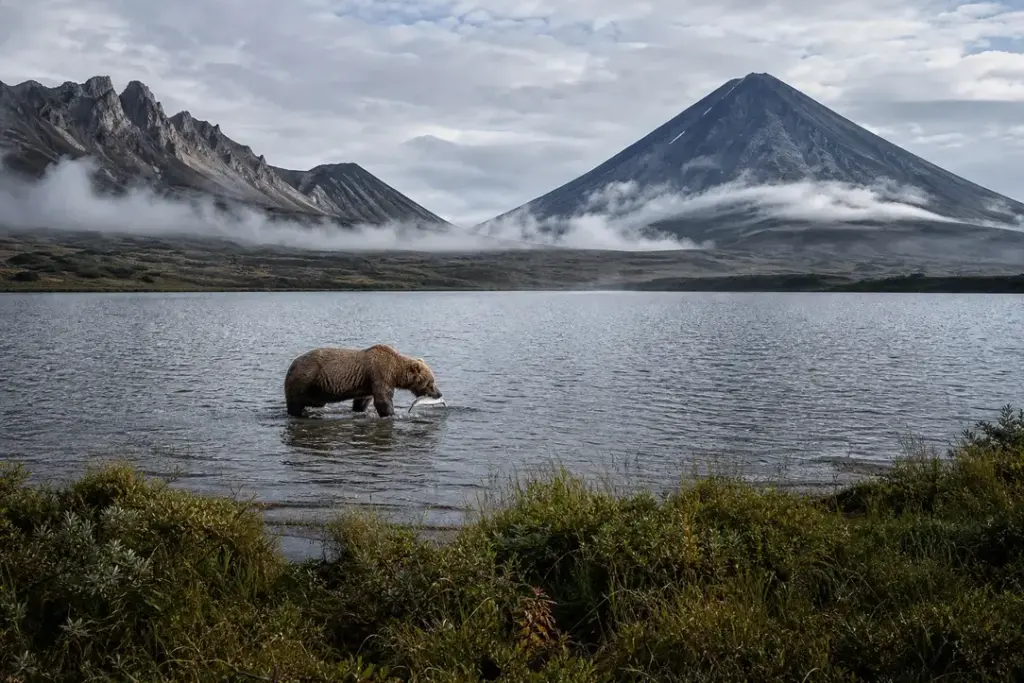
Kurile Lake is a crater lake filling a 7-kilometre-wide caldera formed by a catastrophic eruption around 6640 BC in the southern reaches of the Kamchatka Peninsula. Within the South Kamchatka Wildlife Refuge and a UNESCO World Heritage Site, it covers 76 square kilometres and reaches depths of 316 metres.
The lake’s draw for visitors is straightforward: it hosts the largest sockeye salmon spawning grounds in Eurasia outside Alaska, drawing millions of fish and gathering brown bears in densities found nowhere else in Russia. From June through March, salmon arrive to spawn, drawing bears from across Kamchatka to feed in near-total concentration on the shoreline and in observation areas set up for visitors.
Quick Facts
| Russian name | Кури́льское о́зеро |
|---|---|
| Address | Southern Kamchatka Peninsula Google MapsApple MapsYandex Maps2GIS |
| District | Kamchatka Krai |
| Best time to visit | The best time to visit is late August through September, when salmon spawning is at its peak, bear densities are highest, and weather is most stable. July can be productive for bear viewing but carries higher risk of fog and flight delays. October is possible but bears begin dispersing, and weather becomes unpredictable.Winter (November–April) is technically possible but severely limited by weather, extreme cold, and reduced daylight. Spring (May–June) offers long daylight hours but spotty salmon runs and fewer bears.Plan for flexibility: weather can change rapidly, and flights may be delayed or cancelled. Expect cool temperatures (5–10°C) even in summer; pack layers and waterproof gear. |
What Is (and Isn't) Part of a Visit to Kurile Lake, Kamchatka Peninsula?
| Part | Status | Notes |
|---|---|---|
| Bear observation platforms and lodge | Included in the standard ticket | Standard tours include accommodation, meals, and guided access to platforms positioned near salmon streams and bear feeding areas. |
| Salmon spawning streams and river walks | Included in the standard ticket | Walking access to observe spawning streams and the Ozernaya River outflow, usually accompanied by lodge staff and guides. |
| Boat tours around the lake | Separate ticket or institution | Motorboat excursions to view volcanic islands and Dikiy Greben volcano often available as add-on activities, separate cost. |
| Hot springs and geothermal features | Separate ticket or institution | Access to certain hot springs requires separate guided excursions; safety briefing essential due to boiling water and unstable ground. |
| Scientific observation station | Not open to visitors | The Ozernaya Ranger Station operates for research only; visitor access is restricted to lodge-based observation. |
| Helicopter tours to Volcanoes of Kamchatka | Outside / not part of it | Some tours combine Kurile Lake with visits to the Valley of Geysers or other volcanic sites; these are separate offerings requiring additional days and cost. |
Why Visit Kurile Lake, Kamchatka Peninsula?
Kurile Lake offers one of the world’s most reliable opportunities to observe wild brown bears fishing at close range. During peak salmon season (late August to October), up to 20 bears can gather simultaneously at spawning streams, so accustomed to abundant food that they largely ignore human observers on designated viewing platforms.
The landscape itself is dramatic: the crater walls frame active volcanoes, particularly the distinctive cone of Ilyinsky volcano (1,555 metres) on the northeastern shore, with its lava flowing directly into the lake. Volcanic islands dot the surface, and hot springs warm the shore in places. The combination of wildlife spectacle and volcanic backdrop makes this a destination unlike anywhere else in Russia.
Highlights of Kurile Lake, Kamchatka Peninsula
Salmon spawning and bear fishing grounds
From June through March, sockeye salmon by the millions enter the lake to spawn. Peak season runs July through October, with numbers estimated between 2 and 6 million fish annually. During this time, brown bears gather on the shorelines and in shallow streams to intercept the fish. Visitors typically stay at a lodge on the western shore and walk to observation platforms within 250 metres of active feeding areas, where bears fish just metres away, largely ignoring the presence of people as they focus on catching salmon.
Tip: Book visits in August or September for the most reliable bear sightings and to avoid the extremes of early or late season weather.
Ilyinsky Volcano
Rising 1,555 metres on the northeastern shore, Ilyinsky is a dormant stratovolcano of striking symmetrical cone shape. Its most recent eruption occurred in 1911. On clear days, the volcano's reflection on the lake's still surface creates dramatic photo opportunities. Lava flows from its slopes feed directly into the lake, forming bays and shaping the shore.
Tip: Photograph Ilyinsky early morning or late afternoon when side-lighting accentuates the cone's form and colour.
Dikiy Greben volcano
On the southwestern shore, Dikiy Greben (Wild Ridge) is a lava dome complex reaching 1,040 metres elevation. Unlike the stratovolcano of Ilyinsky, this ridge-like formation of extrusive domes creates a different volcanic profile across the lake. Several lakes have formed in lava-dammed sections of its slopes.
Tip: Walk or boat tours around the lake show the contrast between the two volcanic features from different vantage points.
Volcanic islands and hot springs
The lake's surface is decorated by volcanic islands including Chayachy Island, Nizkiy Island, Serdtse Alaida Island, and the Samang archipelago, with lava domes reaching up to 300 metres high. Hot springs on the shore reach temperatures as high as 45°C. These geothermal features create visual and thermal contrasts across the otherwise cold lake environment.
Tip: Ask lodge staff about safe hot spring access; some can be visited as day trips but require caution due to boiling water and unstable ground.
Ozernaya River outflow
From the lake flows the Ozernaya River into the Sea of Okhotsk to the west. This 48-kilometre river is the lake's sole outflow. During salmon runs, the river becomes intensely active as fish navigate upstream against the current.
Tip: Walking trails along the river reveal additional bear fishing opportunities and bird activity; access is usually restricted but can be included in organized lodge itineraries.
Caldera formation and Holocene history
The caldera formed approximately 6640 BC through one of the largest explosive eruptions on Earth, producing 140–170 cubic kilometres of tephra. The geological drama is visible in pumice deposits and the steepness of the crater walls. Volcanoes Dikiy Greben and Ilinsky subsequently grew around the caldera as post-eruption features.
Tip: The landscape speaks to geological time scales; guides at the lodge can explain the volcanic architecture and recent activity.
Atmosphere
Kurile Lake feels remote and wild in a way few places in Russia do. The landscape is predominantly tundra vegetation—dwarf birch, moss, and low shrubs—punctuated by rocky shores and volcanic formations. The air is cold and often windy. In summer, light persists nearly around the clock at these latitudes, creating an eerie, endless daylight.
The dominant sensory experience is the constant presence of bears and salmon. During peak season, the sound of splashing fish and bears moving through water is nearly constant from sunrise through the evening. The lodge becomes a temporary community of wildlife enthusiasts from around the world, usually small groups (8–20 people) who share observations and morning coffee before heading to observation platforms. There is a palpable tension—not fear, but awareness—that you are in a landscape where humans are guests and bears are sovereign.
History of Kurile Lake, Kamchatka Peninsula
Kurile Lake caldera formed during a massive phreatoplinian eruption around 6640 BC, ranking among the most powerful Holocene explosive events globally. The eruption produced 140–170 cubic kilometres of tephra, making it the largest Holocene eruption in the Kurile-Kamchatka volcanic arc. Deposits from the eruption reached across the Sea of Okhotsk 1,700 kilometres to mainland Asia, in places 5 centimetres thick.
The eruption created a 7-kilometre-wide caldera that subsequently filled with water. After the caldera-forming eruption, the volcanoes Dikiy Greben and Ilinsky grew as post-caldera structures; Ilinsky’s most recent eruption was in 1911. The region remained inaccessible to science until the Soviet era, when observation stations were established on the western shore to study salmon populations and bear behaviour.
Kurile Lake is a national wildlife preserve, national monument, and UNESCO World Heritage Site as part of the Volcanoes of Kamchatka designation. It lies within the Southern Kamchatka Wildlife Refuge. Tourism began in the 1990s as remote lodges opened on the western shore, coinciding with expanded scientific interest in bear ecology and salmon dynamics in response to climate change and ocean conditions.
Legends and Myths about Kurile Lake, Kamchatka Peninsula
The bear gatherings
Legend – historically unreliable. Local stories speak of bears gathering at the lake in numbers so dense that they form temporary hierarchies and fishing territories, with dominant males claiming the best salmon streams. The legend holds that bears remember productive years and return from across Kamchatka even when salmon are scarce elsewhere. Observers note that bears display learned fishing techniques passed across generations, appearing to teach cubs specific catching methods.
Tickets and Booking for Kurile Lake, Kamchatka Peninsula
Kurile Lake is accessible only by organized tour from Petropavlovsk-Kamchatsky, typically 3 to 5 days in duration. Tours must be booked through regional tourism operators or international adventure travel companies with experience in Kamchatka. Most tours include helicopter or floatplane transport (the only access to the remote lake), accommodation at a lodge on the western shore, all meals, and guided access to observation areas.
Booking in advance (weeks to months ahead) is essential, especially for summer and early autumn when weather is most stable and bear activity peaks. Availability is strictly limited by lodge capacity and flight schedules. Travel during the salmon spawning season (June–November) requires coordination with weather windows, as flights may be cancelled or delayed during storms.
Tour operators based in Petropavlovsk-Kamchatsky handle all logistics. International visitors typically arrange trips through established adventure travel agencies specializing in Kamchatka. Costs include transport, accommodation, meals, and guiding. Rates for Russian residents differ from international rates.
Suggested itineraries Kurile Lake, Kamchatka Peninsula
3 days
Day 1: Helicopter flight from Petropavlovsk-Kamchatsky, arrival at lodge by mid-morning, afternoon orientation walk to observe lake and surrounding terrain. Day 2: Full day of bear and salmon observation at platforms, with walks to multiple spawning streams. Day 3: Morning observation, then helicopter return to Petropavlovsk-Kamchatsky.
5 days
Day 1: Arrival and orientation. Days 2–4: Multiple daily excursions to observation platforms, walks to spawning streams, motorboat tour around the lake to view volcanic islands, visit to hot springs (weather permitting), observation of bear behaviour at different times and locations. Day 5: Return flight. This allows for flexibility with weather and observing bears across varied terrain.
7+ days
Extended stays enable multi-day treks into surrounding tundra (if guides available), detailed observation of bear hierarchies and fishing behaviour evolution across days, visits to both Ilyinsky and Dikiy Greben volcanoes from different angles, and potential inclusion of flights to nearby geothermal features or other Kamchatka highlights.
How to Get to Kurile Lake, Kamchatka Peninsula
Kurile Lake is accessible only by air from Petropavlovsk-Kamchatsky, located on the Kamchatka Peninsula coast.
- International access: Fly to Petropavlovsk-Kamchatsky International Airport (from Moscow, approximately 8–9 hours with connections). From the airport, tourism operators arrange onward flights.
- Helicopter or floatplane: The 2–3 hour flight from Petropavlovsk-Kamchatsky to Kurile Lake is the only access. All tours include this transport. Weather can delay flights; operators maintain flexibility in schedules.
- No road access: There are no roads to Kurile Lake. The remote southern location and difficult terrain mean helicopter or floatplane is mandatory.
- Lodge location: The lodge sits on the western shore, with platforms positioned nearby for bear observation.
Accessibility
Kurile Lake presents significant accessibility challenges due to its remote location and logistics. Helicopter or floatplane transfer is the sole access; this is not suitable for passengers with certain mobility restrictions. The lodge and observation platforms are basic: uneven ground, no specialized accessibility features.Walking to observation areas involves uneven tundra terrain and can be muddy or rocky. Observation platforms are accessed on foot, sometimes 250 metres or more from the lodge, and platform stairs or railings vary in stability.Very limited medical facilities are available at the lodge. Visitors with serious health conditions should consult with the tour operator before booking. The physical demands are moderate but continuous across multiple days.
Food Nearby
There is no dining outside the lodge. All meals are included in tour packages and typically consist of hearty Russian cuisine, fresh fish (often salmon from the lake), bread, and tea or coffee. Specific dietary requirements should be communicated to the tour operator well in advance, though options are limited given the remote location.
What to Bring
Pack layers: the weather is cool and windy year-round. Bring a warm jacket, wind-resistant outer shell, waterproof trousers, sturdy hiking boots (waterproof and insulated), thick socks, gloves, and a hat. Sun protection (sunscreen and sunglasses) is important due to bright light and reflection off water. Insect repellent (especially in summer) and binoculars for bear and bird watching are essential.Bring any prescribed medications and a basic first-aid kit. A camera with good zoom capability is recommended. The lodge provides basic amenities; bring toiletries and any personal items not provided. Bag security is straightforward; the lodge is staffed and secure.
Best Views and Photo Spots of Kurile Lake, Kamchatka Peninsula
Main observation platform over spawning stream
Direct view of bears fishing in shallow water, sometimes just metres away, with the crater wall and surrounding tundra as backdrop. The water reflects volcanoes on clear days.
Best time: Early morning (around 05:00–07:00 in summer) when bears are most active and side-lighting is warm; also late afternoon after 18:00.
Ilyinsky Volcano from the northern shore
The symmetrical cone rises from the lake shore, with lava flows creating dramatic shadows and contours. Reflection visible on still mornings.
Best time: Early morning or late afternoon light from the northwest side of the lake, when the cone's form is most pronounced.
Dikiy Greben volcano from the southwestern shore
Ridge-like lava dome complex showing layered, rugged texture. Contrasts with the smoother cone of Ilyinsky.
Best time: Afternoon, when western light accentuates the complex's surface texture and shadows.
Ozernaya River delta
Where the river exits the lake toward the Sea of Okhotsk, salmon and bears congregate in dense numbers during peak spawning. Wide-angle view captures landscape scale and wildlife concentration.
Best time: Peak salmon run season (late August–September), any daylight hour.
Lake surface at dawn
Mirror-like stillness reflects volcanoes and surrounding crater walls. Mist often rises from the water, creating ethereal conditions.
Best time: First light (around 04:00–05:30 in summer) before wind picks up; requires boat access to central lake area.
Photography Rules
Photography is encouraged and unrestricted at observation platforms. Tripods are allowed. Telephoto lenses (200–400mm) are ideal for capturing bears at distance without disturbance. Drones are not permitted. Flash is not necessary outdoors and should be avoided during twilight to prevent disturbing bears. Indoor lodge photography follows standard politeness.
Family Suitability
Kurile Lake tours are not suitable for very young children (under age 8–10) due to the physical demands of helicopter travel, unpredictable weather, and limited medical facilities. Older children with hiking experience and interest in wildlife can participate, though the long days of observation require patience and tolerance for cold, wind, and inactivity.The terrain is uneven and muddy; strollers are impractical. Observation platforms have basic safety railings but are not childproofed. Bears are wild animals that can move unpredictably; children must follow strict instruction from guides. The lodge accommodations are basic but comfortable; family rooms are typically small.
Russia Vibes Tips
- Arrive early in the season (late August) to avoid the rapid decrease in bear density after September. Once salmon numbers decline, bears disperse across Kamchatka.
- Bring a zoom lens of at least 200–300mm to capture bears at platform distance without approaching. The best wildlife photography happens from stationary observation points where bears ignore your presence.
- Bears feed most actively in the early morning and again in late afternoon/evening. Schedule your platform time accordingly rather than midday, when activity slows.
- The lodge fills quickly, especially for late August and September dates. Book 3–6 months in advance to secure preferred travel dates, especially if you have specific timing needs.
- Weather delays and cancellations are common; build in extra days at the end of your Kamchatka trip rather than immediately connecting to your international flight. A day of delay is routine.
- Ask lodge staff about the individual bears: many are named and have distinct personalities and preferences. This local knowledge adds context to behaviour you observe and photographs you take.
Explore Nearby Kurile Lake, Kamchatka Peninsula
Related guides
 Kamchatka Peninsula: Volcanoes, Wildlife and Travel Guide
Main image: AI-generated illustration. It may not show the place exactly as it looks.
Browse more: More in Kamchatka Krai · All Kamchatka Peninsula · All Landmarks · All Sightseeing · All Sightseeing in Kamchatka Peninsula
FAQ: Kurile Lake, Kamchatka Peninsula
How close can you get to bears at Kurile Lake?
Observation platforms position you 50–250 metres from bears fishing in streams and on shorelines. During peak season, bears are so focused on salmon they often ignore human observers. You are instructed to remain on platforms and not approach bears directly; bears sometimes come closer to the platform of their own accord.
Is it safe to visit Kurile Lake?
Yes, with appropriate precautions. Guides enforce strict safety rules: remain on designated platforms, never approach bears, and follow instructions during encounters. Deaths or serious injuries are exceptionally rare. However, it is a remote wilderness; medical evacuation depends on weather. Visitors must be in good health and accept inherent risks of remote travel and wildlife presence.
When is the best time to see bears and salmon?
Late August through September is peak season: salmon spawning is at its height, bear densities are highest, and weather is most stable. July offers good bear viewing but more weather delays. October is possible but bears begin leaving, and weather deteriorates rapidly.
How much does a trip to Kurile Lake cost?
3–5 day tours typically cost in the ₽₽₽₽ range per person (high-end international adventure travel pricing). This includes all transport, accommodation, meals, and guiding. Budget travellers should know this is not a budget destination; the remote logistics and small lodge capacity keep prices high.
Do I need special permits or visas to visit Kurile Lake?
International visitors require a Russian visa; Kurile Lake itself requires no separate permit. Tour operators handle all necessary arrangements with regional authorities. Your operator will advise on visa requirements based on your nationality.
Can you visit Kurile Lake without a guide?
No. Access is only through organized tours. All transportation, lodging, and observation area access is managed by tour operators. Independent travel to the lake is not possible due to remote location, lack of public transport, and wildlife safety protocols.
What if your flight is cancelled due to weather?
Weather delays are common, especially during shoulder seasons. Tour operators build flexibility into itineraries. If your flight is cancelled, you typically remain in Petropavlovsk-Kamchatsky and rebook for the next day or wait for a weather window. Costs and schedule changes should be discussed with your operator before booking.
Is Kurile Lake part of a national park I can visit freely?
No. The lake lies within the South Kamchatka Wildlife Refuge, a protected area with restricted access. Visitation is controlled through licensed tour operators. You cannot simply arrive and explore independently.
Russia Vibes is a one-person project. A coffee keeps it going

Take this guide with you
Get a free PDF of this guide to print or read offline: key facts, tips and a map link on a few clean pages.
Report an issue on this page
Paying for your trip: please read
Payments and bookings between Russia and many other countries are currently restricted. In practice, cards issued in the EU, the UK, the US and several other countries often cannot be used in Russia, Russian cards usually cannot be used abroad, and some booking platforms, airlines and payment providers limit or pause their services for Russia. The situation changes frequently.
We do not give legal or financial advice, and this site does not encourage anyone to break any rule that applies to them. Whatever you plan, you are responsible for following the laws and regulations that apply to you, including those of your country of residence and citizenship.
Many travelers still organise their stay without problems. It is worth asking your bank or payment provider what is currently possible, contacting hotels, tour operators and carriers directly about the payment methods they accept, and checking which services are open to customers from your country. Clarify payment, cancellation and refund terms before you commit to a booking, and keep your plans flexible.
Partner links on this site may not be available in every country, and prices, availability and rules in our guides can differ from what you see when you book.
How we research and update our guides
About this guide: AI assistance and accuracy
This guide is created with the help of AI and is based on official sources where available. Mistakes can still happen. Opening hours, prices, rules and other details are given to the best of our knowledge as of the date shown and can change without notice. It offers general recommendations only, not professional, legal or travel advice. Please confirm important details with the official source before you travel; you are responsible for your own plans and decisions.
* Affiliate link: as an Amazon Associate we earn from qualifying purchases at no extra cost to you.