
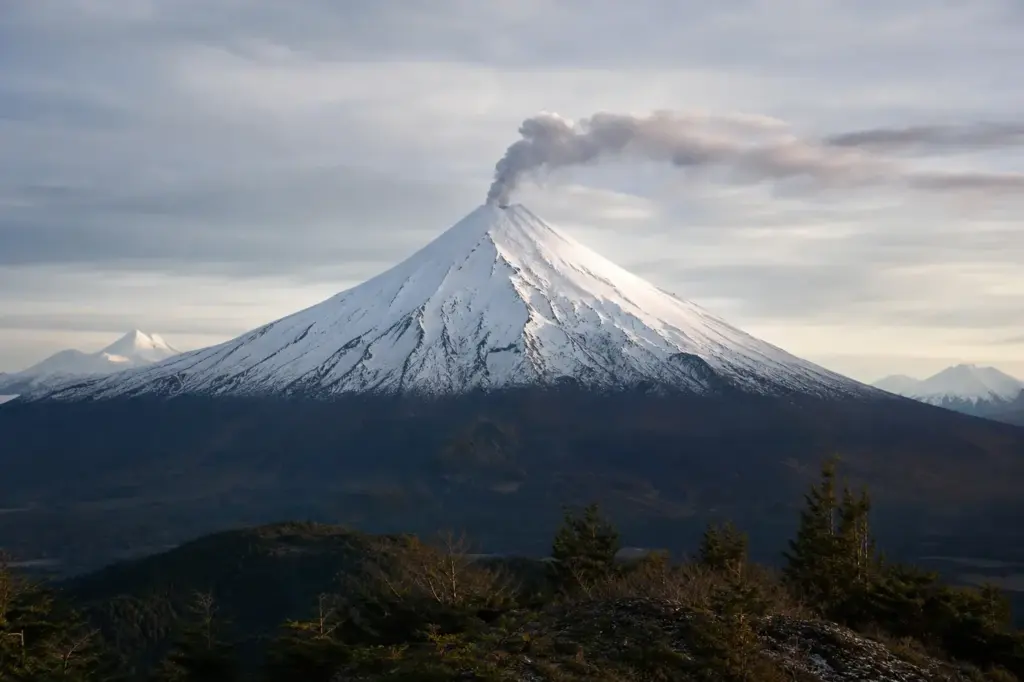
Klyuchevskaya Sopka is the highest active volcano in Eurasia, rising 4,754 metres above sea level on Russia’s Kamchatka Peninsula. The tallest and most active of 29 active volcanoes on Kamchatka, this remote stratovolcano dominates the eastern landscape.
The volcano is continuously active and dangerous, with eruptions occurring roughly every 3 years on average. Its first recorded eruption occurred in 1697, and it has been almost continuously active ever since. Access is extremely limited; it was first climbed in 1788 by Daniel Gauss and two other members of the Billings Expedition. No other ascents were recorded until 1931, when several climbers were killed by flying lava on the descent. As similar dangers still exist today, few ascents are made.
Current access notice: As of October 2026: Klyuchevskaya Sopka is an active, remote volcano on Russia's Kamchatka Peninsula with ongoing eruptions. The volcano is not open to general public tourism and is monitored exclusively by scientists. Access is extremely dangerous and restricted. Check the Kamchatka Volcanic Eruption Response Team (KVERT) website for current volcanic activity status before planning any regional travel.
Quick Facts
| Russian name | Ключевская сопка |
|---|---|
| Built / opened | 7000 |
| Address | Ust-Kamchatsky District, Kamchatka Krai Google MapsApple MapsYandex Maps2GIS |
| District | Kamchatka Krai |
| Best time to visit | The volcano is active year-round, but visibility is affected by seasonal weather. Summer (June–September) offers the best visibility and weather for observing the volcano from a distance, though snow and glaciers remain visible most of the year. Winter viewing is possible but limited by short daylight hours and severe weather conditions. |
What Is (and Isn't) Part of a Visit to Klyuchevskaya Sopka, Kamchatka Peninsula?
| Part | Status | Notes |
|---|---|---|
| The summit and flanks of Klyuchevskaya Sopka | Not open to visitors | The volcano is actively erupting and inaccessible to general visitors. Climbing requires specialized mountaineering skills, volcanic hazard knowledge, and is extremely dangerous. |
| Scientific observation from a distance | Included in the standard ticket | The volcano can be observed from safe distances, particularly from the village of Klyuchi (about 30 km away) or from aerial perspectives. |
| The Klyuchevskaya volcanic group | Outside / not part of it | The volcano is part of a group of six closely spaced volcanoes; other nearby volcanoes such as Bezymianny and Tolbachik are separate entities with their own activity patterns. |
Why Visit Klyuchevskaya Sopka, Kamchatka Peninsula?
Klyuchevskaya Sopka is primarily of interest to volcanologists, geologists and adventurers rather than casual tourists. The volcano offers an unparalleled opportunity to study active subduction-zone volcanism and impacts regional climate patterns and aviation safety. Viewing the volcano from a distance or photographing it from safe locations near the village of Klyuchi, about 30 km away, is possible for those interested in volcanic landscapes. However, the volcano itself is not open to the general public and is actively monitored for eruptions that can disrupt regional air traffic.
Highlights of Klyuchevskaya Sopka, Kamchatka Peninsula
The Summit Crater
The 700-m-wide summit crater has been frequently modified by historical eruptions recorded since the late-17th century. The crater is the source of both explosive and effusive eruptions, including Strombolian activity and lava fountains. The summit is typically snow and ice-covered except during active eruptions when volcanic heat melts surrounding glaciers.
Tip: The summit is not accessible to general visitors due to ongoing volcanic activity and extreme danger from lava fountains and falling rock.
Recent Eruption Activity
Klyuchevskaya's most recent confirmed eruption began on April 8, 2025. Prior eruptions occurred in 2023 (VEI 3), 2019–2021 (VEI 2), 2015–2018 (VEI 3), and 2013 (VEI 3). The volcano regularly produces ash plumes, lava flows, and pyroclastic material.
Tip: Check current volcanic activity reports from the Kamchatka Volcanic Eruption Response Team (KVERT) before planning any visit to the region.
Flank Eruptions and Cinder Cones
More than 100 flank eruptions have occurred at the volcano during the past roughly 3000 years, with most lateral craters and cones occurring along radial fissures between the unconfined NE-to-SE flanks at elevations between 500 m and 3600 m. These side vents create visible cones and scarred landscapes on the volcano's slopes.
Tip: Lower elevation slopes show the geological effects of centuries of flank eruptions, though they remain dangerous and off-limits to visitors.
Stratovolcano Structure
The volcano is a stratovolcano built from alternating layers of basaltic lava flows and pyroclastic deposits over approximately 6,000 years. The mountain forms an almost perfectly shaped cone with slopes inclined at 33 degrees. This classic symmetrical form makes it visually distinctive from a distance.
Tip: The cone's regular shape is best appreciated from aerial views or satellite imagery, as ground-level viewing is limited by distance and weather.
UNESCO World Heritage Status
The volcano is part of the natural Volcanoes of Kamchatka UNESCO World Heritage Site, recognized for its outstanding geological and ecological significance. The site includes 29 active volcanoes and represents one of the world's most important volcanic regions.
Tip: While the site is protected, tourism is extremely limited due to the remote location and active volcanic hazards.
Glaciers and Eruption Effects
During the 2005 eruption, lava flow melted a large part of the Ehrman glacier on the summit of the volcano. The interaction of hot lava with snow and ice produces powerful steam explosions and lahars (mudflows) that flow down river valleys toward populated areas.
Tip: Glacier-related hazards make the lower slopes particularly dangerous during and after eruptions.
History of Klyuchevskaya Sopka, Kamchatka Peninsula
Klyuchevskaya Sopka appeared approximately 7,000 years ago, making it one of the younger major volcanoes in the Kamchatka region. For most of its existence, its activity is known only through geological evidence.
Its first recorded eruption occurred in 1697, and it has been almost continuously active ever since. It was first climbed in 1788 by Daniel Gauss and two other members of the Billings Expedition, marking the first successful ascent by Europeans. This expedition provided early scientific observations of the volcano’s structure and activity.
The early 20th century brought a significant change in eruptive behavior. Previously, all known eruptions occurred from the central crater, but since 1932, flank eruptions on the slopes began to be observed, with the first such event recorded on January 25. The most significant flank outburst was the eruption of 1938, which beginning on November 7 lasted for 13 months, creating a 5 km long fissure with several explosive craters at elevations from 1,000 to 1,900 m.
The 1986–1990 eruption lasted approximately four years, produced ash clouds to 15 km altitude, and was rated VEI 4 — the volcano’s most powerful event in over 150 years. Three VEI 4 eruptions have occurred in the historical record (1829, 1931, 1986–1990) — the most VEI 4+ events at any single volcano in Kamchatka.
The volcano has erupted 113 times in recorded history with an average recurrence interval of roughly 3 years, remaining nearly continuously active since Russian explorers first documented its eruptions in 1697, with no dormant interval exceeding approximately 12 years.
Legends and Myths about Klyuchevskaya Sopka, Kamchatka Peninsula
The Birthplace of the World
Legend – historically unreliable. Klyuchevskaya Sopka is considered sacred by some indigenous peoples, being viewed by them as the location at which the world was created. Other volcanoes in the region are seen with similar spiritual significance, but Klyuchevskaya Sopka is the most sacred of these.
Tickets and Booking for Klyuchevskaya Sopka, Kamchatka Peninsula
Klyuchevskaya Sopka is not open to general tourism. There are no ticket sales, visitor facilities, or public access to the volcano. The site is actively monitored by the Kamchatka Volcanic Eruption Response Team (KVERT), a scientific body that tracks volcanic activity and issues hazard warnings. Scientific expeditions or specialized mountaineering expeditions may be organized through specialized adventure companies familiar with Kamchatka, but these are extremely rare, expensive, and require extensive preparation and insurance. For current information on volcanic status, visit the KVERT official updates or the Smithsonian Institution’s Global Volcanism Program website.
How to Get to Klyuchevskaya Sopka, Kamchatka Peninsula
Klyuchevskaya Sopka is located on Russia’s remote Kamchatka Peninsula, approximately 60 km from the village of Klyuchi and about 100 km from the regional center of Petropavlovsk-Kamchatsky. Access to the volcano is not organized for tourists. To reach the region, visitors fly to Petropavlovsk-Kamchatsky Airport (PKZ), the main airport serving Kamchatka. From there, it is possible to hire a guide or join a specialized expedition company, but visiting the volcano itself remains restricted due to active eruptions and extreme danger. Most visitors view the volcano from a distance near the village of Klyuchi or from helicopter tours (if operating).
Accessibility
Klyuchevskaya Sopka is not accessible to visitors with mobility limitations or to the general public. The volcano is actively monitored by scientists and is unsafe for civilian visits. No accessibility infrastructure exists.
Food Nearby
The village of Klyuchi, approximately 30 km from the volcano, has basic food options including cafés and small shops. Petropavlovsk-Kamchatsky, about 100 km away, offers more dining options including restaurants and shops. Food in rural Kamchatka is limited and prices are high due to remote location.
What to Bring
For viewing the volcano from a distance: warm clothing (temperatures drop significantly even in summer), waterproof jacket, sturdy hiking boots, binoculars for distant observation, sunscreen and hat for sunny days, and insect repellent. Bring sufficient water and snacks as services near the volcano are minimal. If traveling with a guide to remote areas near Klyuchi, bring camping equipment and emergency supplies.
Best Views and Photo Spots of Klyuchevskaya Sopka, Kamchatka Peninsula
Village of Klyuchi viewpoint
The village of Klyuchi, about 30 km north-northwest of the volcano, offers distant views of the symmetrical cone against the sky. In clear weather, the summit and eruption plumes (when active) can be seen.
Best time: Early morning light from the east provides the best illumination of the volcano's cone. Clear weather conditions are essential; summer offers more stable visibility.
Kamchatka River valley
The Kamchatka River valley, which flows near the volcano, provides vantage points for viewing the mountain's northeast and eastern flanks. Valleys and surrounding forest frame the volcano.
Best time: Late afternoon light highlights the volcanic slopes. Summer and early autumn offer the clearest skies.
Helicopter or aircraft views
Aerial views from helicopter tours operating from Petropavlovsk-Kamchatsky reveal the full cone structure, summit crater, and surrounding volcanic landscape and glaciers.
Best time: Clear weather days in summer provide the best aerial photography; early morning flights avoid afternoon cloud buildup.
Photography Rules
Photography of the volcano from a distance is permitted. However, do not attempt to approach the volcano or climb it without expert guidance and proper permits. Drone use is restricted in many areas of Kamchatka due to proximity to volcanic hazard zones and military restrictions. Flash photography is not an issue outdoors.
Family Suitability
Klyuchevskaya Sopka is not suitable for family visits. The volcano is actively erupting and is inaccessible to the general public. Viewing it from a distance (from Klyuchi or other safe vantage points) is possible, but the volcano itself poses no direct hazard to observers at safe distances. Young children would find a long journey to viewing points challenging. This is primarily an interest for adventurers, volcanologists, and extreme-sport enthusiasts with specialized knowledge.
Russia Vibes Tips
- Check KVERT volcanic activity status before traveling to Kamchatka. Major eruptions can disrupt regional air traffic and affect visibility. The agency posts daily updates on current volcanic conditions.
- The village of Klyuchi, 30 km away, is the closest settlement. Visitors seeking to observe the volcano typically base themselves here or hire local guides, though tourist infrastructure is minimal.
- Never attempt to climb the volcano or approach the active zones without expert mountaineering guides, proper equipment, volcanic hazard training, and current KVERT approval. Climbers have been killed by flying lava as recently as 1931, and similar dangers persist.
- Helicopter tours offering views of the volcano operate seasonally from Petropavlovsk-Kamchatsky, weather permitting. These are expensive but provide the safest way to see the summit crater and glaciers up close.
- Bring heavy-duty binoculars if viewing from a distance. Ash and steam plumes are visible from Klyuchi in clear weather, and eruption activity can be observed without approaching the dangerous zone.
- The volcano is part of Russia's Volcanoes of Kamchatka UNESCO World Heritage Site. However, mass tourism is not present; the site is protected for its scientific and ecological value, not visitor convenience.
Explore Nearby Klyuchevskaya Sopka, Kamchatka Peninsula
Browse more: More in Kamchatka Krai · All Kamchatka Peninsula · All Landmarks · All Sightseeing · All Sightseeing in Kamchatka Peninsula
FAQ: Klyuchevskaya Sopka, Kamchatka Peninsula
Can I visit or climb Klyuchevskaya Sopka?
No, the volcano is not open to general tourism. It is actively erupting and extremely dangerous. Climbing is theoretically possible only with expert mountaineering guides, specialized volcanic hazard training, and advance permission, but such expeditions are extremely rare and expensive. The volcano is monitored exclusively by scientists.
Is Klyuchevskaya Sopka currently erupting?
Yes, as of October 2026, the volcano has been erupting since April 2025 and remains active. Klyuchevskaya has erupted roughly every 3 years on average and has been almost continuously active since 1697. Check the Kamchatka Volcanic Eruption Response Team (KVERT) website for the latest eruption status and hazard warnings.
Can I see the volcano from nearby villages?
Yes, from the village of Klyuchi (about 30 km away) and other nearby locations, the volcano's cone and summit are visible in clear weather. Ash and steam plumes from eruptions can be observed from safe distances. Viewing from the village is the safest way for non-specialists to observe the volcano.
How do I get to Kamchatka and the volcano?
Fly to Petropavlovsk-Kamchatsky Airport (PKZ), which has connections from Moscow and other major cities. From there, hire a local guide or join a specialized expedition company to reach Klyuchi or other viewing locations. Ground transportation to the volcano itself is not available for tourists.
What time of year is best to visit?
Summer (June–September) offers the best weather and visibility for observing the volcano from a distance. Winter is possible but more challenging due to short days and severe weather. The volcano is active year-round, so eruptions can occur at any season.
Are there hotels or restaurants near the volcano?
The village of Klyuchi, the closest settlement at 30 km away, has very limited tourist infrastructure. Petropavlovsk-Kamchatsky (about 100 km away) has more hotels and restaurants. Food and accommodation in rural Kamchatka are expensive and basic compared to major cities.
Has the volcano always been active?
No. The volcano formed about 7,000 years ago. Its first recorded eruption was in 1697, and it has been almost continuously active ever since. Before 1697, its activity is known only through geological evidence preserved in rock layers.
What makes this volcano special?
Klyuchevskaya Sopka is the highest active volcano in Eurasia and one of the world's most active volcanoes. It has erupted more than 110 times in recorded history and is part of the UNESCO World Heritage Site 'Volcanoes of Kamchatka'. Its continuous activity and accessible location for scientific study make it important for understanding how subduction-zone volcanoes work.
Russia Vibes is a one-person project. A coffee keeps it going

Take this guide with you
Get a free PDF of this guide to print or read offline: key facts, tips and a map link on a few clean pages.
Report an issue on this page
Paying for your trip: please read
Payments and bookings between Russia and many other countries are currently restricted. In practice, cards issued in the EU, the UK, the US and several other countries often cannot be used in Russia, Russian cards usually cannot be used abroad, and some booking platforms, airlines and payment providers limit or pause their services for Russia. The situation changes frequently.
We do not give legal or financial advice, and this site does not encourage anyone to break any rule that applies to them. Whatever you plan, you are responsible for following the laws and regulations that apply to you, including those of your country of residence and citizenship.
Many travelers still organise their stay without problems. It is worth asking your bank or payment provider what is currently possible, contacting hotels, tour operators and carriers directly about the payment methods they accept, and checking which services are open to customers from your country. Clarify payment, cancellation and refund terms before you commit to a booking, and keep your plans flexible.
Partner links on this site may not be available in every country, and prices, availability and rules in our guides can differ from what you see when you book.
How we research and update our guides
About this guide: AI assistance and accuracy
This guide is created with the help of AI and is based on official sources where available. Mistakes can still happen. Opening hours, prices, rules and other details are given to the best of our knowledge as of the date shown and can change without notice. It offers general recommendations only, not professional, legal or travel advice. Please confirm important details with the official source before you travel; you are responsible for your own plans and decisions.
* Affiliate link: as an Amazon Associate we earn from qualifying purchases at no extra cost to you.