
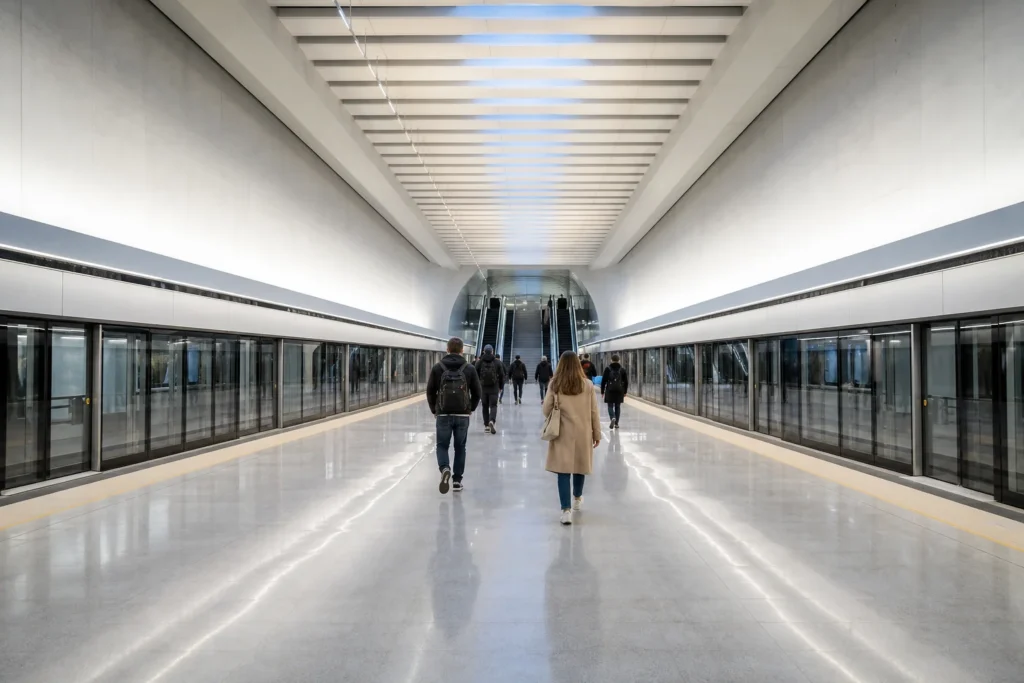
Putilovskaya Metro Station opened on 26 December 2025 as the northeastern end of Line 6, the Krasnoselsko-Kalininskaya line, the newest line of the Saint Petersburg Metro. It lies in Kirovsky District, in the old industrial south-west of the city, and is joined by an underground corridor to Kirovsky Zavod on Line 1.
The station is named after Nikolay Putilov, the nineteenth-century industrialist whose works grew into the Kirov Plant. Line 6 began with just two stations, Putilovskaya and Yugo-Zapadnaya, over a length of about 2.6 kilometres, so a ride here is short. For most visitors it is a new link rather than a destination.
Quick Facts
| Russian name | Путиловская |
|---|---|
| Built / opened | 2025 |
| Address | OpenStreetMap · Google Maps |
| District | Kirovsky District |
| Interchanges | Putilovskaya (Line 6, northeastern terminus of Line 6; check the current station plan for the street exit) Kirovsky Zavod (Line 1, transfer by an underground corridor) Yugo-Zapadnaya (Line 6, the other end of Line 6, the only other station on the line) |
| Opening hours | The station runs with the metro network, daily from early morning until shortly after midnight. Line 6 is new and hours or train intervals can change, so check before an early or late journey (as of October 2026 – check the official site of the Saint Petersburg Metro). |
| Best time to visit | The station is underground, so it works in any season and in any weather. For a calm look at the hall, choose midday or a weekend morning. The weekday morning and evening rush fills the transfer corridor, and the Kirov Plant district is best seen in daylight. |
| Last updated | October 16, 2026 |
Why Visit Putilovskaya Metro Station, Saint Petersburg?
Putilovskaya is the way into the sixth metro line, which opened in December 2025 after being planned for more than thirty years. If you collect lines and stations, this is the newest one in the city, and it is only a short corridor away from one of the most striking Stalin-era halls on Line 1.
It is also the stop for the Kirov Plant district, whose history stretches back to the Putilov Works. You pay only for a metro ride, and 15 to 30 minutes covers the transfer corridor and a look at the platform. Keep in mind that Line 6 has only two stations for now, so it is not yet a route across the city.
Highlights of Putilovskaya Metro Station, Saint Petersburg
The newest line in the metro
Line 6, the Krasnoselsko-Kalininskaya line, opened on 26 December 2025 with two stations: Yugo-Zapadnaya and Putilovskaya. Putilovskaya is the northeastern terminus, and the line is about 2.6 kilometres long.
Further stations are planned, so the line is expected to grow, but at the moment it is a short shuttle between these two stops.
Tip: Check the official metro site for news before you plan a journey that depends on Line 6.
The corridor to Kirovsky Zavod
An underground transfer corridor connects Putilovskaya with Kirovsky Zavod on Line 1, the red line. The interchange opened together with Line 6 and is the reason most people use the station.
Follow the signs for Line 1, and allow a few extra minutes at rush hours, when commuters change in both directions.
Tip: Use the corridor to see Kirovsky Zavod's monumental hall, which opened in 1955.
Named after Nikolay Putilov
The station is named after Nikolay Putilov, the nineteenth-century industrialist who developed the ironworks on this site into one of the largest factories in the Russian Empire. After 1917 the works became the Kirov Plant.
The name is a reminder that this district grew up around the factory, and that Kirovsky Zavod and Putilovskaya are two names for the same history.
Tip: Read the names on the signs in the corridor; the older and newer names of the plant appear side by side.
A deep, modern hall
Putilovskaya has a single island platform, about 58 metres below the surface according to the available data, so the escalator ride is long. It is a modern station of the 2020s, and its decoration and layout were not verified in detail for this article.
Plan a few extra minutes for the ride up and down.
Tip: Check the station on site for decoration details; they are new and may be updated.
The Kirov Plant district above
The streets above the station lie in the district of the Kirov Plant, the former Putilov Works, which traditionally made armaments and heavy machinery. The plant has a history museum.
The workers' strike at the Putilov Works in January 1905 is remembered as the prelude to Bloody Sunday.
Tip: Check the plant museum's official information before you plan a visit; it has its own hours.
The other end of Line 6
The only other station on Line 6 is Yugo-Zapadnaya, the south-western terminus. The two stations are about 2.6 kilometres apart, so the ride is short.
The line was first planned more than thirty years before it opened, and the two stations are only the first stage of a much longer route.
Tip: Ride the line once to say you have used the newest metro line; it takes only a few minutes.
Atmosphere
The hall feels new: clean surfaces, bright lighting and the particular quiet of a line that few passengers know yet. The sound is trains arriving, the long hum of the escalators and the footsteps of people crossing towards Kirovsky Zavod.
It is mostly commuters from the south-western districts, residents of Kirovsky District and curious passengers trying the new line. The station is busiest on weekday mornings and evenings, and calm in the middle of the day. Above ground, the district is a mix of old factory buildings, wide avenues and new housing.
History of Putilovskaya Metro Station, Saint Petersburg
The ironworks that gave the station its name was founded at the beginning of the nineteenth century on the road to the south-west of Saint Petersburg. In 1868 it was bought by the industrialist Nikolay Putilov, who turned it into one of the largest factories in the Russian Empire, producing rails, locomotives and armaments. It became known as the Putilov Works.
In January 1905, a strike at the Putilov Works was the prelude to the march of Bloody Sunday. After the Revolution the works kept its importance, and in 1934 it was renamed the Kirov Plant, after the Leningrad party leader Sergei Kirov. The district around it became Kirovsky District.
The metro came here on 15 November 1955, when Kirovsky Zavod opened as one of the first stations of the Leningrad metro, with reliefs and sculptures that celebrate the plant and its workers. For seventy years that station was the only one serving the district.
Line 6, the Krasnoselsko-Kalininskaya line, was first planned more than thirty years before it opened, as a line running from the south-west of the city through the centre to the north-east. The first stage was finally completed in 2025, with two stations: Yugo-Zapadnaya at the south-western end and Putilovskaya at the north-eastern end, joined over about 2.6 kilometres.
Putilovskaya opened on 26 December 2025, together with Yugo-Zapadnaya. It is the north-eastern terminus of the line, and a transfer corridor links it to Kirovsky Zavod on Line 1, so passengers can change between the red line and the new one. The name recalls Nikolay Putilov, whose works grew into the Kirov Plant.
Further stations are planned to extend Line 6 towards the centre and the north-east, with interchanges to Lines 1, 2 and 5, but at present the line consists of only these two stops.
Today Putilovskaya is a short but significant addition to the network: a new line, a new interchange and a new name on the metro map for the old industrial district.
Tickets and Booking for Putilovskaya Metro Station, Saint Petersburg
Putilovskaya has no entrance fee of its own: you pay for a ride on the Saint Petersburg Metro, at a flat level of ₽ for a single journey regardless of distance. The transfer to Kirovsky Zavod is made inside the system, so you do not pay again.
- Contactless bank card: accepted at turnstiles with a card reader, but whether a card issued outside Russia works varies, and the sanctions rules of your own country may restrict the use of Russian payment services, so check this yourself before you travel.
- Podorozhnik card: a reusable transport card sold at metro ticket offices and usually the simplest choice for a visitor who plans several rides.
- Mobile Podorozhnik app: works by NFC on Android phones and by QR code on iPhones, subject to the same checks.
Rates for Russian citizens and concession categories differ. Rush hours fall on weekday mornings and evenings, when the transfer corridor is at its most crowded. The official site metro.spb.ru lists current fares, payment methods and categories.
Plan and Book
How to Get to Putilovskaya Metro Station, Saint Petersburg
By metro: take Line 6 from Yugo-Zapadnaya, or take Line 1 (the red Kirovsko-Vyborgskaya line) to Kirovsky Zavod, between Narvskaya and Avtovo, and follow the signs through the transfer corridor.
From the centre: ride Line 1 south-west from Pushkinskaya, Tekhnologichesky Institut or Baltiyskaya to Kirovsky Zavod, and change there.
On foot and by road: the station lies in the Kirov Plant district, and buses, trams and taxis run along the main avenues. Check the current station plan for the street exit, because the new line is still being integrated into the surrounding transport.
Accessibility
Putilovskaya is a modern station of the 2020s, but whether it has lifts or other step-free routes was not confirmed for this article, and the transfer to Kirovsky Zavod includes passages and stairs. Check the accessibility information on metro.spb.ru and ask staff before you travel, especially with luggage, a stroller or a wheelchair.
Food Nearby
The streets around Kirovsky Zavod and Avtovo have the usual neighbourhood mix of cafes, bakeries and fast-food places, and the district's shopping centres have food courts. For a wider choice, ride Line 1 towards Narvskaya or the centre. There is no verified cafe inside the station.
What to Bring
A payment card or a Podorozhnik card, comfortable shoes for the transfer corridor and a camera for the monumental hall of Kirovsky Zavod. Security checks apply at the entrance, so keep bags easy to open.
Best Views and Photo Spots of Putilovskaya Metro Station, Saint Petersburg
The Line 6 platform
The new island platform with its clean lines and lighting, seen along its length from the end.
Best time: Midday or a weekend morning, when the platform is clear.
The transfer corridor
The long corridor linking Line 6 with Kirovsky Zavod, with signs for both lines.
Best time: Outside the rush hours, when the corridor is empty.
Kirovsky Zavod hall
The monumental Line 1 hall of 1955 with its reliefs and sculptures, a few minutes from Putilovskaya.
Best time: Between trains, outside the rush hours.
The Kirov Plant district
The old factory buildings and wide avenues of the district above, a reminder of the Putilov Works.
Best time: Daylight, in clear weather.
Photography Rules
Casual photography is generally tolerated, but tripods, professional filming and flash usually need permission from the metro. Keep escalators and platforms clear, and avoid photographing staff or other passengers.
Family Suitability
Workable for families. The station is new and easy to navigate, but the escalators are long and the transfer corridor can be crowded at rush hours. Strollers need to be handled on the escalators unless a lift is available, which was not confirmed. There is little to see above ground for young children.
Russia Vibes Tips
- Follow the red signs for Line 1 in the corridor; they lead to Kirovsky Zavod and the older hall.
- Combine the ride with a look at Kirovsky Zavod's monumental hall, a few minutes along the corridor.
- Check the metro's news before travelling; Line 6 is new and trains and hours may change.
- Remember that Line 6 has only two stations for now, so it is not yet a route across the city.
- Read the old and new names of the plant on the signs; they explain the district's history.
- Allow extra time on the way back, because the escalator ride up from about 58 metres is long.
Explore Nearby Putilovskaya Metro Station, Saint Petersburg
Metro stations near Putilovskaya Metro Station, Saint Petersburg
 Kirovsky Zavod Metro Station, Saint Petersburgabout 50 m away (~1 min walk)
Main image: AI-generated illustration. It may not show the place exactly as it looks.
 Narvskaya Metro Station, Saint Petersburgabout 2.5 km away
Main image: AI-generated illustration. It may not show the place exactly as it looks.
 Avtovo Metro Station, Saint Petersburgabout 1.4 km away (~22 min walk)
Main image: AI-generated illustration. It may not show the place exactly as it looks.
Related guides
 Kirovsky Zavod Metro Station, Saint Petersburg: Industrial Hall
Main image: AI-generated illustration. It may not show the place exactly as it looks.
Browse more: More in Kirovsky District · All Metro Stations · All Metro Stations in Saint Petersburg · All Other Hubs · All Saint Petersburg
FAQ: Putilovskaya Metro Station, Saint Petersburg
When did Putilovskaya open?
On 26 December 2025, together with Yugo-Zapadnaya, as the first stage of Line 6, the Krasnoselsko-Kalininskaya line.
Who is the station named after?
Nikolay Putilov, the nineteenth-century industrialist whose ironworks grew into the Kirov Plant.
Is there a transfer to another line?
Yes. An underground corridor links Putilovskaya with Kirovsky Zavod on Line 1, the red line. You change without paying again.
How many stations does Line 6 have?
Two for now: Yugo-Zapadnaya and Putilovskaya. The line is about 2.6 kilometres long, and further stations are planned.
How deep is the station?
About 58 metres below the surface according to the available data, so the escalator ride is long. Confirm on the official metro site.
Is Putilovskaya the same as Kirovsky Zavod?
No. They are separate stations on different lines, joined by a corridor. Kirovsky Zavod, on Line 1, opened in 1955, and Putilovskaya on Line 6 in 2025.
What is there to see above ground?
The Kirov Plant district, with the plant's buildings and its history museum. Check the museum's official information for hours.
Is it worth a special trip?
Only if you want to try the newest line or combine it with Kirovsky Zavod's hall. Otherwise it is a quick transfer.
Russia Vibes is a one-person project. A coffee keeps it going
Last updated: October 16, 2026. Found an error or something out of date? Report it and we will check and fix it.
How we research and update our guides
About this guide: AI assistance and accuracy
This guide is created with the help of AI and is based on official sources where available. Mistakes can still happen. Opening hours, prices, rules and other details are given to the best of our knowledge as of the date shown and can change without notice. It offers general recommendations only, not professional, legal or travel advice. Please confirm important details with the official source before you travel; you are responsible for your own plans and decisions.
International sanctions affect payments between Russia and many other countries. In practice, cards issued in the EU, the UK, the US and several other countries often do not work in Russia, Russian cards usually do not work abroad, and some booking platforms, airlines and payment providers limit or suspend their services for Russia. The situation changes frequently. We do not give legal or financial advice, and this site does not encourage anyone to break or circumvent sanctions. Whatever you plan, you are responsible for following the laws and regulations that apply to you, including those of your country of residence and citizenship. Many travelers still organise their stay lawfully. It is worth asking your bank or payment provider what is currently permitted, contacting hotels, tour operators and carriers directly about the payment methods they accept, and checking which services are open to customers from your country. Clarify payment, cancellation and refund terms before you commit to a booking, and keep your plans flexible. Partner links on this site may not be available in every country, and prices, availability and rules in our guides can differ from what you see when you book.Paying for your trip: please read

Take this guide with you
Get a free PDF of this guide to print or read offline: key facts, tips and a map link on a few clean pages.