
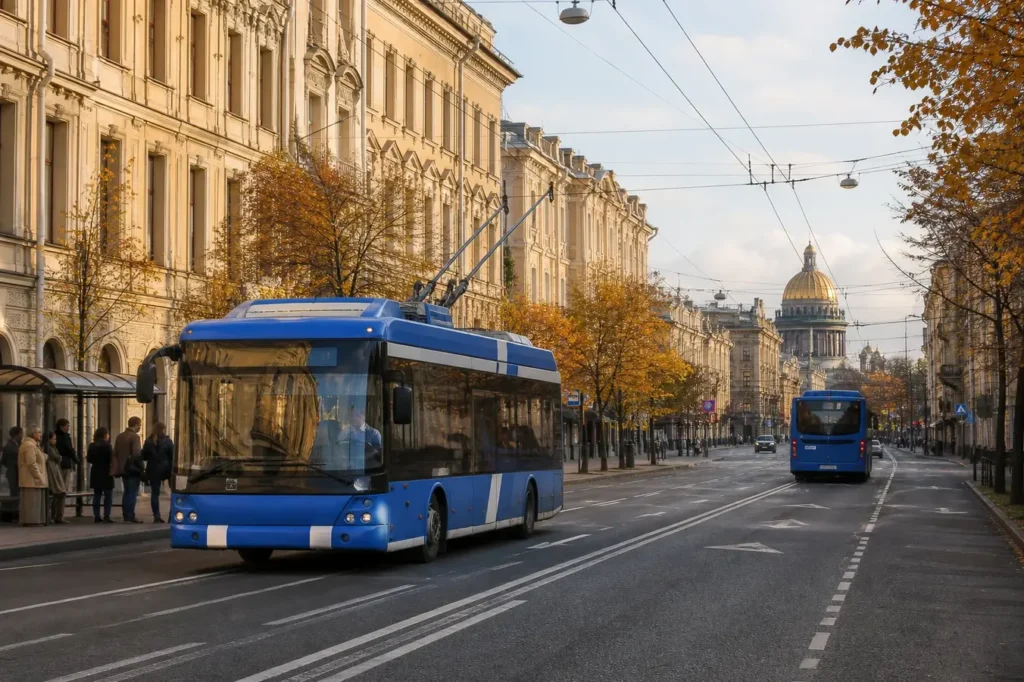
How to Ride Buses, Trams and Trolleybuses, Saint Petersburg, is a useful skill for exploring the city beyond its metro stations. Surface transport connects historic streets, residential districts, railway stations and attractions that are not always within an easy walk of the underground network. Buses are particularly widespread, while trams and trolleybuses offer a different view of the city’s streets, bridges and neighbourhoods.
For a first journey, start in Tsentralny District near Nevsky Prospekt, where several routes connect the historic centre with other parts of Saint Petersburg. The simplest approach is to plan the journey using the city’s official transport portal, identify the correct stop and direction, and validate your ticket immediately after boarding. This guide explains each stage, along with transfer arrangements, service hours and common mistakes.
Quick answer: Plan your route using Saint Petersburg's official transport portal, board at the designated stop and validate your fare immediately. Journey time depends on the route. Cost level: ₽.
At a Glance
| Total time | Approximately 5–10 minutes to plan, plus route-dependent waiting and travel time |
|---|---|
| Typical cost | ₽ |
| Last updated | October 17, 2026 |
What You Need Before You Start
- Your starting point and destination in Saint Petersburg
- Access to the official city transport portal or a saved route
- A valid Podorozhnik transport card, supported payment method or suitable ticket
- A phone or map showing the correct stop and travel direction
- The name of your destination stop
- A little extra time for traffic and possible route changes
- Weather-appropriate clothing for waiting outdoors
Compare Your Options
| Option | Duration | Price | Notes |
|---|---|---|---|
| City Bus — Recommended for General Travel | Route-dependent; allow for traffic and waiting time | ₽ | Buses provide extensive coverage throughout Saint Petersburg, including areas not directly served by metro lines. They are useful for ordinary city journeys, reaching railway stations and connecting residential districts with attractions. The official operator states that city bus routes use low-floor vehicles. Service frequency varies considerably by route and time of day. Some busy corridors have frequent departures, while less-used routes run at longer intervals. First and last departures must be checked for the specific route. |
| Tram — Best for Routes Along Tram Corridors | Route-dependent; check tram stops and interchange time | ₽ | Trams follow fixed tracks and can be useful where a direct line connects your starting point with the destination. They operate across several districts, although the network does not cover every part of the historic centre. Some tram lines use fully low-floor vehicles, while others have mixed or high-floor fleets. Routes, departure intervals and operating hours are listed individually by the transport operators. Best for travellers whose destination lies directly along a tram corridor. |
| Trolleybus — Best for Selected Central Streets | Route-dependent; allow for road traffic | ₽ | Trolleybuses are electrically powered road vehicles, commonly recognisable by their overhead current collectors. They are particularly useful along streets such as Nevsky Prospekt and on routes connecting the centre with neighbouring districts. Unlike trams, they travel on ordinary roads and share many of the same traffic conditions as buses. The official city operator lists low-floor vehicles across all trolleybus routes. Check individual first and last departures because there is no single network-wide schedule. |
| Metro Combined with Surface Transport | Route-dependent; includes transfer and walking time | ₽ | A useful combination for journeys spanning different parts of Saint Petersburg. Take the metro across a longer section, then continue by bus, tram or trolleybus to a destination beyond walking distance. Metro travel avoids road congestion, while surface transport covers the final section. This option is especially practical when travelling from the historic centre towards outer districts. Check the complete route in the official planner and account for separate transport-ticket conditions. |
₽ budget · ₽₽ moderate · ₽₽₽ upscale · ₽₽₽₽ splurge. Price levels are estimates compared with typical prices for visitors.
Step-by-Step Instructions
Step 1: 1. Plan Your Journey Before Leaving
Open the official public transport portal operated by Saint Petersburg's Passenger Transport Organizer. Enter your starting point and destination, then select the option to build a route. You can compare buses, trams, trolleybuses and metro connections, or filter the results by transport type. The planner identifies walking sections, intermediate stops and transfers. It also provides vehicle location information, helping you judge when to leave your hotel or attraction.
Tip: For a journey through the historic centre, compare the surface route with walking. A short distance on the map can involve several turns or a slow crossing.
Step 2: 2. Find the Correct Stop
Go to the stop indicated in your journey plan. Near Gostiny Dvor Metro Station on Nevsky Prospekt, in Tsentralny District, several city bus and trolleybus services operate through the surrounding streets. Look for the public transport stop sign and any timetable or route information displayed nearby. Stops on opposite sides of a street usually serve different directions. At larger intersections, a tram stop may be in a different position from the nearest bus stop.
Tip: Match the stop's location on the route planner rather than assuming all vehicles serving an intersection use the same boarding point.
Step 3: 3. Confirm the Route Number and Direction
As the vehicle approaches, check its route number on the front or side display. The destination shown alongside the number usually identifies the direction of travel or final terminus, not every intermediate stop. Compare it with your planned journey. This is especially useful for routes that run through Nevsky Prospekt and continue towards another district. Two vehicles with the same route number may be travelling in opposite directions.
Tip: Keep the name of the terminus in your journey plan. It is often easier to recognise on a vehicle display than the name of a small intermediate stop.
Step 4: 4. Board Safely at the Designated Stop
Wait until the vehicle has stopped completely and passengers have finished getting off. Most modern city buses and trolleybuses have low-floor entrances, while tram accessibility depends on the vehicles assigned to the route. Use the doors opened for boarding. Certain vehicles have individual door-opening buttons, and routes requiring front-door boarding display the relevant instructions. If the stop is beside tram tracks in the roadway, use the designated pedestrian approach rather than crossing into traffic unexpectedly.
Tip: Passengers with pushchairs or limited mobility should look for the accessible entrance, commonly near the middle of a low-floor vehicle.
Step 5: 5. Validate Your Fare Immediately
Once aboard, locate an electronic validator, usually attached to a handrail near a door. Hold your physical transport card against the reader or present the applicable digital ticket using its supported method. Wait for a clear confirmation on the screen before moving away. If the first attempt fails, read the displayed message and try an appropriate alternative. Do not assume that entering through an open door automatically registers your journey.
Tip: Remain near a handrail while validating. The vehicle may start moving before you have finished.
Step 6: 6. Follow the Stops During the Journey
Move away from the doorway and find a safe place to sit or stand. Saint Petersburg's buses, trams and trolleybuses commonly have electronic information displays, while the municipal electric transport fleet also uses spoken stop announcements. Compare the announced stops with your journey plan. Watch for junctions where several routes separate, particularly when crossing between the central districts and the city's islands. A live map provides an additional way to track your progress.
Tip: Count the remaining stops rather than relying only on travel time. Road congestion can make a short section take much longer than expected.
Step 7: 7. Prepare to Leave the Vehicle
When your destination is approaching, gather your belongings and move towards an appropriate exit without blocking other passengers. Some vehicles have buttons for requesting a stop or opening an individual door. On services with stops marked as request stops, notify the driver in good time using the available button or the method specified on board. Remain behind the doors until the vehicle has stopped and they are ready to open.
Tip: If travelling with a large suitcase, begin preparing slightly earlier so you can leave without rushing through the aisle.
Step 8: 8. Make Your Connection or Finish the Journey
After leaving, check whether your next stop is on the same side of the street or across an intersection. Transfer points can involve separate platforms or stops even when they share a similar name. Follow the walking directions in the journey planner and allow enough time to cross safely. If your route changes because of roadworks or an event, consult the operator's latest route information before continuing. Otherwise, follow the final walking section to your destination.
Tip: At major intersections, check both the street name and the route direction before boarding your connecting vehicle.
Common Mistakes to Avoid
- Boarding the correct route number in the wrong direction. Compare the vehicle's displayed destination with the terminus shown in your journey plan.
- Assuming a bus stop automatically serves nearby tram and trolleybus routes. Different services may have separate boarding points around the same intersection.
- Waiting for a conductor to approach before registering a ticket. The operator requires passengers to validate or pay immediately after boarding.
- Depending on cash being accepted on every vehicle. Some routes are marked as cashless, and the official list of services allowing cash purchases is restricted.
- Assuming all trams have step-free entrances. Check the operator's accessibility information when travelling with a wheelchair or pushchair.
- Following an old route screenshot during roadworks or major public events. Verify the current stop positions and route changes before departure.
- Assuming every surface-transport stop is served throughout the night. Confirm the last journey and possible alternatives before leaving an evening attraction.
Tickets, Payment and Booking
Tickets and payment: Ordinary city buses, trams and trolleybuses accept the Podorozhnik stored-value Unified Ticket, supported contactless bank cards and approved electronic tickets. Paper QR tickets are sold at metro ticket counters and authorised Passenger Transport Organizer outlets. Cash ticket purchases are available only on designated routes. No advance reservation is needed for regular urban services.
Transfers: As of October 2026, the standard Podorozhnik stored-value ticket has a discounted transfer arrangement for qualifying surface-transport journeys within 60 minutes. Metro journeys interrupt that arrangement. Other ticket products have different conditions.
International visitors: Foreign-issued Visa and Mastercard cards do not work in Russia under the networks’ suspended operations. Check your country’s sanctions rules before using Russian payment services. Verify current fare and ticket conditions with the Saint Petersburg Committee for Transport or Passenger Transport Organizer. Avoid unofficial ticket resellers.
Helpful Links
Compare hotel pricesSearch flights
Advertisement: these are partner links. If you book or buy through them, we may earn a commission at no extra cost to you.
Russia Vibes Tips
- For a short journey along Nevsky Prospekt, compare the surface route with the pedestrian route. Busy junctions and traffic lights can make walking competitive with a bus, particularly when your starting point is between stops.
- Treat Palace Square and the surrounding embankments differently from a normal street grid. Vehicles may travel along adjacent roads instead of crossing the square itself, so the nearest useful stop may require a short walk.
- During the White Nights season, crowds and major public celebrations can make central streets slower than expected. Plan journeys around large events rather than assuming a normal evening service pattern.
- If you are exploring Vasilyevsky Island or Petrogradsky District, check which bridge your chosen route uses. A direct-looking journey can become inconvenient if you board a service crossing a different bridge.
- In winter, give yourself extra time to reach a tram stop. Snowbanks, slippery pavements and street-crossing arrangements can make the approach slower even when the vehicle itself is running normally.
- For a scenic street-level journey, trolleybuses offer a useful alternative to the metro along selected central corridors. Sitting beside a window makes it easier to recognise streets, bridges and familiar landmarks as you travel.
Explore Nearby How to Ride Buses, Trams and Trolleybuses, Saint Petersburg
Sights near How to Ride Buses, Trams and Trolleybuses, Saint Petersburg
 Nevsky Prospekt, Saint Petersburg · typical visit: 2–4 hours for the main stretch; a full day with stops
Main image: AI-generated illustration. It may not show the place exactly as it looks.
 Kazan Cathedral, Saint Petersburg · typical visit: 30–60 minutes
Main image: AI-generated illustration. It may not show the place exactly as it looks.
 State Russian Museum, Saint Petersburg · typical visit: 3–4 hours for the main building
Main image: AI-generated illustration. It may not show the place exactly as it looks.
 Church of the Savior on Spilled Blood, Saint Petersburg · typical visit: 1 hour inside, plus time to walk around the outside
Main image: AI-generated illustration. It may not show the place exactly as it looks.
 Fabergé Museum, Saint Petersburg · typical visit: 1–2 hours
Main image: AI-generated illustration. It may not show the place exactly as it looks.
Metro stations near How to Ride Buses, Trams and Trolleybuses, Saint Petersburg
 Gostiny Dvor Metro Station, Saint Petersburg
Main image: AI-generated illustration. It may not show the place exactly as it looks.
Browse more: All How-To · All How-To in Saint Petersburg · All Other · All Saint Petersburg
FAQ
What is the difference between buses, trams and trolleybuses in Saint Petersburg?
Buses run on ordinary roads and provide the broadest coverage of the three surface-transport types. Trams travel on rails, while trolleybuses normally draw electricity from overhead wires and move on rubber tyres. Modern trolleybuses can also have batteries for limited travel away from the wires. Their routes overlap in some places, but each network serves different corridors. Your destination determines which is most convenient.
Are buses, trams and trolleybuses cheaper than the metro?
They are all budget transport options, but the actual fare depends on the ticket product rather than simply the type of vehicle. A Podorozhnik stored-value ticket and a single guest ticket are not priced identically. For visitors making multiple short journeys, the surface-transport transfer arrangement can also affect the total cost. Consult the ticket section and official current tariff information instead of relying on an old fare table.
Can I travel from Pulkovo Airport by city bus?
Yes. City bus services connect Pulkovo International Airport with metro stations in Saint Petersburg. Route 39E connects the airport with Moskovskaya Metro Station, providing an onward connection towards the centre. Another airport service is route 39. These are regular scheduled connections rather than a dedicated railway service. For the appropriate route, boarding point and timetable, consult the operator's airport transport information.
Do buses and trams operate late at night?
Operating hours differ between routes. Many regular services finish during the evening or around midnight, while selected services can operate later. Special holiday arrangements may extend or change normal operation. There is no reliable single closing time for all buses, trams and trolleybuses. Check the last listed departure from the relevant stop, not merely the last departure from the route's distant terminus.
Can tourists travel with luggage on Saint Petersburg public transport?
Yes, luggage can be carried subject to the operator's size, safety and baggage conditions. Keep bags away from entrances, aisles and emergency equipment. Larger items may be subject to separate baggage charges under the applicable rules. Regular buses generally offer more practical luggage space than a crowded historic-centre tram. For a particularly large suitcase or several heavy bags, compare public transport with an appropriate transfer service.
Are buses and trams accessible to wheelchair users?
Accessibility varies by vehicle and stop. Saint Petersburg's Passenger Transport Organizer identifies all city bus and trolleybus routes as using low-floor vehicles. Tram routes are more varied, with some still using high-floor rolling stock. Accessible vehicles may have ramps and designated wheelchair spaces. However, a low-floor vehicle does not guarantee a level boarding surface at every stop. Check the specific route and ask operating staff for assistance where necessary.
What should I do if I miss my stop?
Remain on the vehicle until the next designated stop, then get off safely and check your position. The official route planner can help identify a return service or a suitable walking connection. Do not attempt to leave between stops or ask the driver to stop in an unsafe location. If you are nearing the route's terminus, confirm where the return journey boards before deciding whether to remain nearby.
Do I need to speak Russian to use Saint Petersburg buses and trams?
No, although recognising basic Russian place names is helpful. Route numbers use familiar numerals, and a smartphone map can show your location and destination. Stop announcements and destination displays may be primarily in Russian, so keep the relevant names available in your journey plan. A saved screenshot containing your stop and route direction is particularly helpful if your mobile internet connection becomes unreliable.
Russia Vibes is a one-person project. A coffee keeps it going
Not legal advice. This is general information for visitors. Rules on visas, entry, registration, customs and similar matters change often and can depend on your nationality. Check the official source and, if in doubt, ask your embassy or a qualified adviser.
Last updated: October 17, 2026.
How we research and update our guides
About this guide: AI assistance and accuracy
This guide is created with the help of AI and is based on official sources where available. Mistakes can still happen. Opening hours, prices, rules and other details are given to the best of our knowledge as of the date shown and can change without notice. It offers general recommendations only, not professional, legal or travel advice. Please confirm important details with the official source before you travel; you are responsible for your own plans and decisions.
International sanctions affect payments between Russia and many other countries. In practice, cards issued in the EU, the UK, the US and several other countries often do not work in Russia, Russian cards usually do not work abroad, and some booking platforms, airlines and payment providers limit or suspend their services for Russia. The situation changes frequently. We do not give legal or financial advice, and this site does not encourage anyone to break or circumvent sanctions. Whatever you plan, you are responsible for following the laws and regulations that apply to you, including those of your country of residence and citizenship. Many travelers still organise their stay lawfully. It is worth asking your bank or payment provider what is currently permitted, contacting hotels, tour operators and carriers directly about the payment methods they accept, and checking which services are open to customers from your country. Clarify payment, cancellation and refund terms before you commit to a booking, and keep your plans flexible. Partner links on this site may not be available in every country, and prices, availability and rules in our guides can differ from what you see when you book.Paying for your trip: please read
Report an issue on this page

Take this guide with you
Get a free PDF of this guide to print or read offline: key facts, tips and a map link on a few clean pages.