
Updated
If you’re heading to Sochi, learning a handful of Russian phrases will make everyday interactions far smoother. Language and phrases to use in Sochi are straightforward—Russian is widely spoken, and while some English appears in hotels and tourist spots, the beach, restaurants, markets and public transport run almost entirely in Russian.
This guide gives you practical phrases for the situations you’ll actually face: ordering food, asking directions, handling money, and polite essentials. The goal is not fluency but confidence. Russians appreciate when visitors make an effort, and a few correct phrases go a long way.
Quick answer: Learn core Russian phrases before you arrive: hello, thank you, please, basic questions, and emergency words. Carry a translation app offline-ready on your phone, and don't hesitate to ask locals to write things down. Most interactions require only 3–5 phrases repeated in different contexts.
At a Glance
| Total time | Continuous (phrases used throughout your stay); 15–20 minutes to prepare before departure |
|---|---|
| Typical cost | Free |
What You Need Before You Start
- Smartphone with a translation app installed (Google Translate, Yandex, or DeepL recommended)
- Offline language pack downloaded before departure
- Small notebook and pen for vendors or taxi drivers to write prices
- Basic willingness to try pronunciation—Russians do not expect perfection
- List of key phrases written down or saved in your phone for quick reference
Compare Your Options
| Option | Duration | Price | Notes |
|---|---|---|---|
| Learn key phrases + use translation app offline | 5–10 minutes to prepare; continuous use during stay | Free | Recommended. Combines memorization of core phrases with app backup. Works in all situations. Takes minimal preparation. |
| Rely on translation app alone (no phrase memorization) | Continuous | Free | Slower in busy situations (markets, taxis). Requires constant phone use. Taxi drivers may charge more if you cannot negotiate in Russian. Better as backup than primary strategy. |
| Hire a guide or use hotel concierge for all communication | 1–2 hours per outing | ₽₽₽₽ | Most expensive and least independent option. Useful only if you have mobility issues or plan complex multi-site excursions. Most visitors find it unnecessary. |
| Use English-speaking tour operators and restaurants only | Continuous | ₽₽₽₽ | Limited to central tourist zones and expensive venues. Misses authentic local experiences. Not recommended unless English is your only language. |
| Combine Russian phrases with hand signals and gestures | Continuous | Free | Works well in markets, beaches, and informal settings. Less effective in formal situations (police, medical). Useful supplement to phrases. |
₽ budget · ₽₽ moderate · ₽₽₽ upscale · ₽₽₽₽ splurge. Price levels are estimates compared with typical prices for visitors.
Step-by-Step Instructions
Step 1: Download and prepare a translation app offline
Install Google Translate, Yandex Translate, or DeepL on your smartphone. Before boarding your flight or leaving your hotel's Wi-Fi, download the Russian language pack so the app works without mobile data. In Sochi, data coverage is reliable in the city centre and tourist areas but drops in mountain zones and smaller districts. Test the app at your hotel to make sure voice and camera features work.
Tip: Download two different apps—they catch different errors. Yandex works particularly well for Russian, as it's trained on Russian-language text.
Step 2: Learn five essential politeness phrases
Memorize these before you arrive: Спасибо (Spasibo—thank you), Пожалуйста (Pozhaluysta—please), Привет (Privet—hello, informal), Здравствуйте (Zdravstvuyte—hello, formal), and Извините (Izvinite—excuse me or sorry). Say them aloud a few times. These five phrases open almost every interaction and are the foundation of polite communication. You will hear them back constantly.
Tip: Use the formal 'Здравствуйте' with older people, shopkeepers, and anyone in a professional role. 'Привет' is fine for younger people and already-friendly situations.
Step 3: Master asking 'Do you speak English?' and 'I don't understand'
Learn: Вы говорите по-английски? (Vy govorite po-angliyski—Do you speak English?) and Я не понимаю (Ya ne ponimayu—I don't understand). These are your lifeline. When stuck, ask if anyone speaks English; in major hotels, restaurants, and shops, at least one staff member usually does. If not, use your translation app or ask the person to write something down.
Tip: In Sochi's central districts and Olympic Park area, English speakers are more common. Outside these zones, prepare for Russian-only conversations.
Step 4: Prepare restaurant and café phrases
Learn: Меню, пожалуйста (Menyu, pozhaluysta—menu, please), Счёт, пожалуйста (Schet, pozhaluysta—the bill, please), and Можно оплатить картой? (Mozhno oplatit' kartoy—Can I pay by card?). For dietary needs: Я вегетарианец (Ya vegetarianets—I am vegetarian). Point at the menu and say the dish name, or hold up your phone with a photo of what you want. Menus in tourist-facing restaurants sometimes have English, but carry your translation app ready.
Tip: Restaurant staff often speak English in the Old Town (Central Sochi). Away from tourist zones, pointing and hand gestures combined with 'спасибо' work just as well.
Step 5: Practice taxi, hotel and direction phrases
Learn: Где…? (Gde—Where is…?), Сколько это стоит? (Skol'ko eto stoit—How much does it cost?), Адрес (Adres—address), and Помогите, пожалуйста (Pomogite, pozhaluysta—Help me, please). In Sochi, taxis do not have meters; prices are fixed or negotiated. Show the driver your destination on a map or your phone, or write down the address. Hotels provide business cards with their address in Russian—carry one.
Tip: Use Yandex Maps or Google Maps to show taxi drivers your destination. Both apps have Russian and English labels.
Step 6: Learn numbers and basic time words
Memorize numbers one to ten: один (odin), два (dva), три (tri), четыре (chetyre), пять (pyat'), шесть (shest'), семь (sem'), восемь (vosem'), девять (devyat'), десять (desyat'). Learn также: утро (utro—morning), день (den'—day), вечер (vecher—evening), ночь (noch'—night), завтра (zavtra—tomorrow). These help with times, prices, and quantities. Most important: точка (tochka—dot) to indicate decimal prices, since written prices may use commas.
Tip: Russians often use hand signals for numbers. You will see locals counting on their fingers with the palm inward; don't assume it means the same as in your country.
Step 7: Write down your hotel name and address
Before leaving your hotel each day, get a business card (гостиница—gostintsa—asks at reception) or write down your hotel name and address in Russian and English. If you get lost or need to give it to a taxi driver, you can simply show the card. Many hotel staff speak English, and they will write clearly. This one action prevents most navigation problems in an unfamiliar city.
Tip: Take a photo of your hotel card on your phone as backup, so you have it even if the physical card is lost.
Step 8: Use your translation app in real situations
Tap the camera icon and hold your phone up to a menu, sign, or price tag—Google Translate will translate it instantly. If someone speaks to you and you don't understand, say 'Я не понимаю' and open the app to the voice input (microphone icon). Ask them to speak slowly. For quick phrases, type or speak into the app and play the audio so they hear correct pronunciation. Yandex Translate also has a phrasebook feature with common travel phrases saved for offline use.
Tip: Test the camera translation feature before you need it. Some Cyrillic fonts (old signs, handwriting) may not translate perfectly.
Common Mistakes to Avoid
- Forgetting to download your translation app's offline language pack before arrival. Roaming data in Sochi is expensive, and Wi-Fi is not guaranteed outside central areas. Many visitors waste time trying to translate at the airport after landing with no internet.
- Using informal 'Привет' (Privet) with taxi drivers, police, or service staff instead of formal 'Здравствуйте' (Zdravstvuyte). Russians notice politeness level immediately; starting informal can make transactions awkward or more expensive.
- Assuming English is spoken everywhere. Outside hotels and major restaurants, you will encounter Russian-only speakers. Not having basic phrases ready leads to frustration and overpaying for taxis and goods.
- Trying to look up every single word instead of learning core phrases. Translation apps are slow in real situations. Learn 20–30 phrases beforehand so you communicate naturally without constant phone use.
- Not carrying your hotel address written down or on your phone. Sochi is long and spread out; getting lost is common. Without your address in Russian, taxi drivers cannot help, and you will waste hours.
- Speaking too quickly or expecting perfect responses. Many Russians speak slowly for tourists. Pause between words. If you do not understand, say 'Медленнее, пожалуйста' (Medlennee, pozhaluysta—More slowly, please).
Tickets, Payment and Booking
No booking is needed to use Russian language or translation tools. However, prepare before you arrive:
- Download a free translation app: Google Translate (available worldwide, offline mode free), Yandex Translate (trained on Russian, works well offline), or DeepL (accurate but may require internet). All three are free.
- Download the Russian language pack in your app while on Wi-Fi at home or your airport. Do not rely on roaming data in Sochi—it is expensive.
- Test the app’s voice and camera features before departure.
- Write down your hotel name and address in Russian on a card (hotel reception will provide this) or take a photo.
- No visa or special registration is required to speak Russian or use translation tools in Sochi.
Helpful Links
Compare hotel pricesSearch flights
Advertisement: these are partner links. If you book or buy through them, we may earn a commission at no extra cost to you.
Russia Vibes Tips
- Local place names in Sochi often come from Abkhazian and Circassian languages. You will see names like Khosta, Matsesta, and Dagomys—these are not Russian. Your translation app may struggle with them. Write down addresses in full before leaving your hotel to avoid confusion.
- Sochi taxi prices are negotiated before you get in the car—there are no meters. Speak the price aloud in Russian, count on your fingers, or use your phone to show numbers. Without this, drivers may overcharge. Learn 'Сколько до…?' (Skol'ko do—How much to…?).
- In markets and small shops, asking 'Можно скидку?' (Mozhno skidku—Can you give a discount?) is normal and expected. Russians often do. Polite firmness and a smile work better than aggressive bargaining.
- Public beach areas and Olympic Park have signage in English and Russian, but mountain zones and nature parks have signs in Russian only. Bring a phone with your translation app fully charged before hiking or exploring outside central Sochi.
- Russians do not use the word 'waiter' to get attention in restaurants—say 'Официант!' (Ofitsiant!) or simply make eye contact and wave. Never snap your fingers; it is considered rude.
- Sochi has four administrative districts: Central Sochi (most touristy, some English), Adler (airport and Olympic Park, moderate English), Khosta and Matsesta (mountain areas, Russian only). When asking for directions, specify your district—'Где станция метро в Центральном Сочи?' (Where is the metro station in Central Sochi?)—to avoid confusion.
Explore Nearby "Language and phrases", Sochi
Related guides
 How to Use the Metro, Saint Petersburg: Lines, Transfers and Tickets
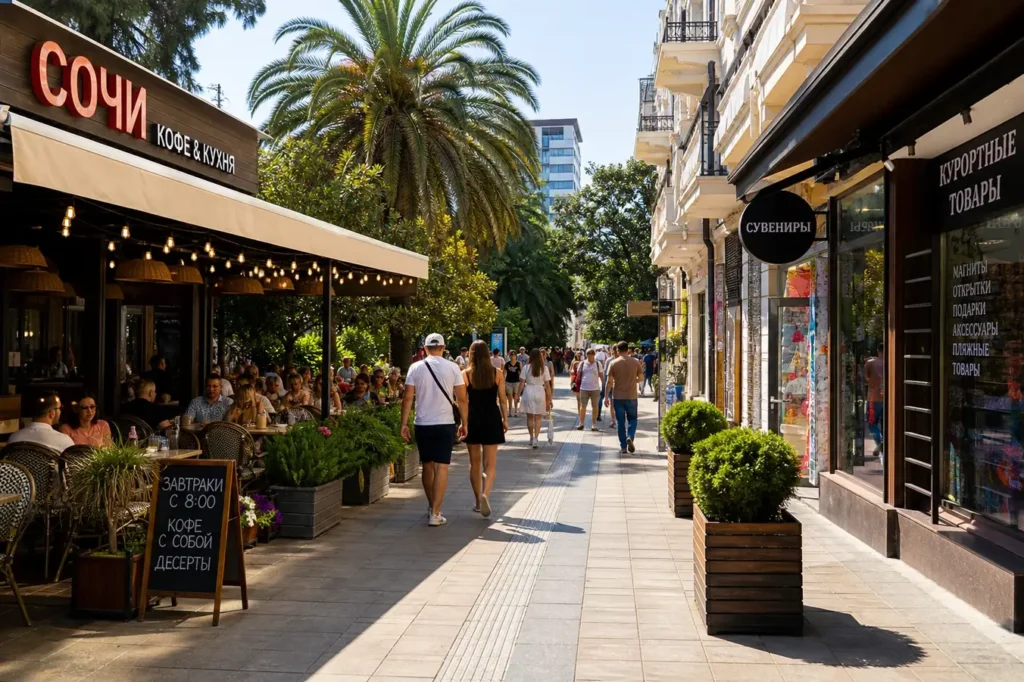
Main image: AI-generated illustration. It may not show the place exactly as it looks.
Browse more: All Etiquette and Safety · All How-To · All How-To in Sochi · All Sochi
FAQ
Do I really need to learn Russian phrases if my phone has a translation app?
Translation apps are essential backup, but learning core phrases first is faster in real situations. Apps require typing, photo upload, or voice input—all slower than saying 'Спасибо' or 'Счёт, пожалуйста' directly. In busy markets or taxis, quick phrases work better. Use apps for complex questions, not basic communication.
Is English widely spoken in Sochi?
In central Sochi hotels, restaurants, and Olympic Park, yes—many staff speak English. Outside these zones (beaches, local markets, mountain villages, smaller restaurants), Russian is the only language. Do not assume English availability outside tourist clusters.
What if I mispronounce words? Will locals understand?
Yes. Russians understand tourist pronunciation and appreciate the effort. Sochi is used to international visitors. Speak slowly, smile, and do not worry about accent. If they don't understand, they will ask you to repeat or suggest using a translation app.
Should I learn formal or informal Russian?
Always start formal. Use 'Вы' (Vy—formal you) and 'Здравствуйте' (formal hello) unless the person is clearly young or already speaking informally to you. Switching from formal to informal is easy and welcomed. Switching from informal to formal after getting it wrong is awkward.
Can I get by with just hand signals and gestures?
Partially, yes—in markets, beaches, and casual settings, gestures work. However, in taxis (for price negotiation), restaurants (for dietary requests), and any formal situation, spoken phrases are essential. Combining both is the strongest approach.
How long does it take to learn enough Russian for a Sochi trip?
20–30 core phrases take 2–3 hours to memorize. Pronunciation takes practice, but you can learn basic ones in one evening. Most visitors do not need fluency—just survival phrases and confidence. Spending an evening before your trip learning key phrases makes a visible difference.
What translation app works best in Russia?
Google Translate has the widest language database and reliable offline mode. Yandex Translate (Russian-owned) is trained on Russian and handles nuance better. DeepL is highly accurate but may need internet. Download two apps as backup—they catch different errors.
Do I need to learn Cyrillic script?
Not essential if you use transliteration (Latin letters). Most signs in Sochi have Cyrillic only, so a translation app or phrasebook is handy. Learning Cyrillic takes 1–2 hours and helps you recognize place names, but it is not required for a short visit.
Russia Vibes is a one-person project. A coffee keeps it going
How we research and update our guides
About this guide: AI assistance and accuracy
This guide is created with the help of AI and is based on official sources where available. Mistakes can still happen. Opening hours, prices, rules and other details are given to the best of our knowledge as of the date shown and can change without notice. It offers general recommendations only, not professional, legal or travel advice. Please confirm important details with the official source before you travel; you are responsible for your own plans and decisions.

Take this guide with you
Get a free PDF of this guide to print or read offline: key facts, tips and a map link on a few clean pages.
Report an issue on this page
Paying for your trip: please read
International sanctions affect payments between Russia and many other countries. In practice, cards issued in the EU, the UK, the US and several other countries often do not work in Russia, Russian cards usually do not work abroad, and some booking platforms, airlines and payment providers limit or suspend their services for Russia. The situation changes frequently.
We do not give legal or financial advice, and this site does not encourage anyone to break or circumvent sanctions. Whatever you plan, you are responsible for following the laws and regulations that apply to you, including those of your country of residence and citizenship.
Many travelers still organise their stay lawfully. It is worth asking your bank or payment provider what is currently permitted, contacting hotels, tour operators and carriers directly about the payment methods they accept, and checking which services are open to customers from your country. Clarify payment, cancellation and refund terms before you commit to a booking, and keep your plans flexible.
Partner links on this site may not be available in every country, and prices, availability and rules in our guides can differ from what you see when you book.