
Gorki is a station of the Kazan Metro. Opened as part of the first stage on 27 August 2005, it was the southeastern terminus of the system until December 2008. The station sits beneath the southeastern Gorki-1 residential district and serves as an interchange point on the metro’s single line connecting the city’s southern and northern ends.
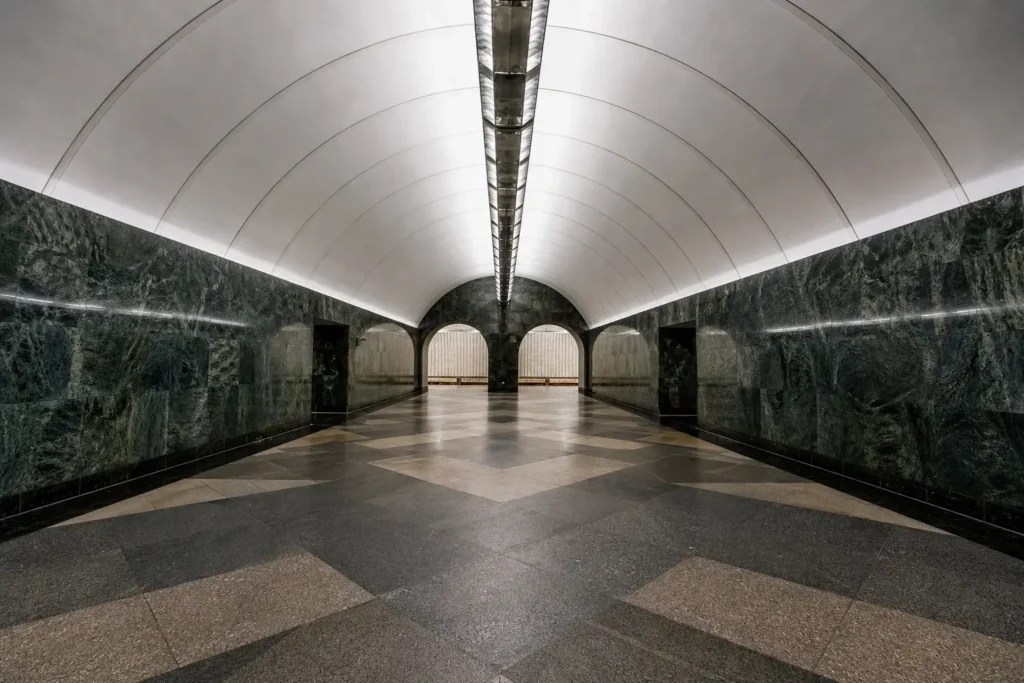
Developed by architects A. Mustafin, R. Khisamov and T. Mukhametzyonov, the station’s theme is a two-tone high-tech industrial design that blends with the surrounding Soviet-time panel buildings. The station features a monolithic vault split into segments, with lighting elements along its central axis creating a steam effect, and walls faced with dark green Indiana marble with additional illuminated niches.
Quick Facts
| Russian name | Горки |
|---|---|
| Built / opened | 2005 |
| Architect(s) | A. Mustafin, R. Khisamov, T. Mukhametzyonov |
| Address | Richard Sorge Street, Kazan OpenStreetMap · Google Maps |
| District | Kazan |
| Interchanges | Gorki (Line 1, Northern vestibule: Zorge with Tankovaya and Malyurina streets; Southern vestibule: Zorge with Rodina street) |
| Best time to visit | Gorki station operates year-round as essential transit infrastructure. Visit during off-peak hours (mid-morning, early afternoon, or late evening) to observe the station's architectural details most clearly. Weekends typically see lighter traffic than weekdays. |
| Last updated | October 18, 2026 |
Why Visit Gorki, Kazan?
Gorki is one of the original stations from Kazan’s metro opening and represents the system’s distinctive architectural character from its inception. For transit users, it provides direct access to the Gorki-1 residential district and serves as a connecting point to surrounding areas. The station’s industrial-modern design is notable among metro stations where the emphasis is on traditional Tatar and Islamic motifs as part of modern high-tech designs. The Kazan Metro is the most advanced as well as the most modern of the Russian systems, making a visit to an original-phase station like Gorki valuable for understanding contemporary Russian metro architecture.
Highlights of Gorki, Kazan
Single-Vault Design
The station presents a typical single-vault subsurface design. The monolithic vault is split into segments, with a set of lighting elements running along its central axis that create a steam effect. Look for the segmented ceiling pattern and the row of lights running down the middle of the platform.
Tip: The vault design is most striking when you first enter from either vestibule—pause at platform level to observe the architectural interplay of light and vault segments.
Dark Green Marble Walls
The walls of the station are faced with dark green (Indiana grin) marble and behind their niches are additional lighting elements which illuminate the white vault. The marble panels create a visual contrast with the illuminated vault above and the geometric floor pattern below.
Tip: The green marble will appear different shades depending on lighting throughout the day—evening visits can offer particularly dramatic shadows and reflections.
Geometric Granite Flooring
The floor of the station is covered by Mansurovsky and Starobabansky granite plates arranged in a geometrical pattern. The pattern echoes the station's modern industrial theme and contrasts with the organic feel of many older Russian metro stations.
Tip: The floor pattern is most visible when boarding trains—look down as you walk to the edge of the platform to see the full geometric arrangement.
Two Vestibules on Richard Sorge Street
The station has two vestibules located along the Richard Sorge street. The northern one has one exit towards the intersection of Zorge with Tankovaya and Malyurina streets, whilst the southern one, which was opened slightly later on 29 September 2005, is located under the intersection of Zorge with the Rodina (motherland) street. The dual vestibule arrangement reflects the station's role serving a large residential microdistrict.
Tip: If you need to exit toward specific streets in the Gorki-1 area, choose your vestibule carefully—the southern exit connects to Rodina street, useful for reaching the southern parts of the district.
Historic First-Stage Status
Gorki opened as part of the first stage on 27 August 2005 and was (until December 2008) the southeastern terminus of the system. It remains one of only six original stations from Kazan's metro opening. The Kazan Metro was opened on 27 August 2005 by the President of Russia Vladimir Putin, the President of Tatarstan Mintimer Shaymiyev, and the President of Kazakhstan Nursultan Nazarbayev.
Tip: To see the evolution of Kazan's metro design, compare Gorki (2005, industrial high-tech) with adjacent Ametyevo (elevated, cosmic futuristic) or the later extensions like Aviastroitelnaya (2013, northern extension).
Atmosphere
Gorki station maintains the sleek, modern character designed into it over two decades ago. The underground vault creates an enclosed, purposeful atmosphere—this is a working transit hub rather than a showcase space. During rush hours (typically 7–9 a.m. and 5–7 p.m.), the platform fills with commuters heading to and from the Gorki-1 microdistrict. Off-peak hours reveal the station’s design more clearly, with the interplay of green marble, segmented vault, and geometric floor patterns most visible. The industrial high-tech theme gives the station a somewhat austere quality compared to older Russian metros, but the refined material choices—marble, granite, strategic lighting—elevate it beyond mere functionality. The acoustic environment is relatively quiet for a metro station, and the lighting creates a calm rather than oppressive feeling despite being underground.
History of Gorki, Kazan
The first geological survey began in 1984, and by 1989 the construction of the first stage was drawn up and submitted for final authorisation to begin construction. In 1991, the Soviet Union broke up and the economic, as well as political turmoil that rocked Tatarstan and Russia, caused the Kazan Metro project to be axed. Luckily for Kazan, throughout the 1990s, the status of it being the most visible autonomous capital reinforced its position; enough for the Federal government to issue a review of the project in 1995 and authorising the construction.
The most prominent deadline was the city’s millennium anniversary in 2005. After securing financing and training, the first stone was laid on 27 August 1997. The first stage of six stations features deep-level tunnels all built by tunnel boring machines, and the stations are either sub-surface or elevated.
Gorki opened as part of the first stage on 27 August 2005 and was (until December 2008) the southeastern terminus of the system. The extension to Prospekt Pobedy opened on 29 December 2008 as the first extension south of Gorki station in the second stage. The station’s architects responded to its role as a terminus by creating a distinctive industrial-modern aesthetic that would anchor the system’s southeastern reach while harmonizing with the surrounding Soviet-era residential district.
Tickets and Booking for Gorki, Kazan
The Kazan Metro is a single-line system that extends for approximately sixteen kilometers and has eleven stations, operated by the municipal company Metroelectrotrans. Single-trip metro fares are budget-level (₽). Visitors can purchase single tickets at station booths or use the smart-card system available to frequent users. Foreign visitors may purchase single tickets; the official website (kazanmetro.ru) provides current fares. Rush hours (approximately 7–9 a.m. and 5–7 p.m. on weekdays) bring heavy crowding on the line, particularly heading toward central stations. Outside these times, the metro is typically less crowded and easier to navigate. Check the official website for any service disruptions or schedule changes.
Plan and Book
How to Get to Gorki, Kazan
The station has two vestibules located along the Richard Sorge street. The northern vestibule has one exit towards the intersection of Zorge with Tankovaya and Malyurina streets, whilst the southern vestibule is located under the intersection of Zorge with the Rodina (motherland) street. Choose your exit based on your destination within the Gorki-1 microdistrict. Taxis and private ride services can drop you at either vestibule entrance.
Accessibility
The station is an underground subsurface facility. Specific accessibility information regarding wheelchair access, lifts, or companion accommodations should be verified on the official Kazan Metro website (kazanmetro.ru) or by contacting the operator directly.
Food Nearby
The Gorki-1 microdistrict surrounding the station is primarily residential. Cafes and small food shops are scattered through the area near both vestibule exits, typical of Soviet-era residential districts. For more diverse dining options, you may wish to travel to central Kazan via the metro.
What to Bring
Standard metro etiquette applies: have your ticket or card ready before boarding. The station is temperature-controlled year-round. Bags are not restricted, though large luggage may be unwieldy on crowded trains during peak hours.
Photography Rules
Photography for personal use is generally permitted in Kazan Metro stations. Tripods, commercial photography, and video recording typically require special permission; check current rules on the official website or with station staff before setting up equipment.
Family Suitability
Gorki station is suitable for families as a functional transit point. The single-vault design is relatively open and not claustrophobic. Strollers and wheelchairs are permitted, though the station has stairs to the vestibules and the crowds during peak hours may make navigation challenging with small children or mobility equipment.
Russia Vibes Tips
- The southern vestibule opened several weeks after the station itself (29 September 2005)—a small historical detail visible only if you know to look for the station's two exits and wonder why they might differ.
- Compare Gorki's high-tech industrial aesthetic with the adjacent Ametyevo station (one stop toward the north on the elevated section) to understand how Kazan's metro designers responded to different construction challenges and urban contexts.
- The station's name refers to the Gorki-1 microdistrict, part of Kazan's large Soviet-era residential development southeast of the center. Understanding this context helps explain both the station's design and its ridership patterns.
- Visit during off-peak hours to photograph the vault and marble walls without heavy crowds in frame. The green marble faces shift appearance with changing daylight angles.
- The station was the system's terminus for three years (2005–2008). If you explore the metro system, note the different architectural approaches taken at the current terminus (Dubravnaya, south) and the northern terminus (Aviastroitelnaya), opened years later.
Explore Nearby Gorki, Kazan
Related guides
 Dubravnaya: Kazan Metro’s Southern Terminal
Main image: AI-generated illustration. It may not show the place exactly as it looks.
 Sukonnaya Sloboda: Architecture and History Below GroundOpen daily 06:00–00:00
Main image: AI-generated illustration. It may not show the place exactly as it looks.
 M.Video, Kazan: Electronics Shopping, Locations and Hours
Main image: AI-generated illustration. It may not show the place exactly as it looks.
 Nardugan, Kazan: Dates, Venues and What to Expect
Main image: AI-generated illustration. It may not show the place exactly as it looks.
Browse more: More in Kazan · All Kazan · All Metro Stations · All Metro Stations in Kazan · All Other Hubs
FAQ: Gorki, Kazan
What line is Gorki station on?
Gorki is a station of the Kazan Metro served by Line 1 (the First Line). The Kazan Metro is a single-line system that extends for approximately sixteen kilometers and has eleven stations.
When did Gorki station open?
Gorki opened as part of the first stage on 27 August 2005. The Kazan Metro was opened by the President of Russia Vladimir Putin, the President of Tatarstan Mintimer Shaymiyev, and the President of Kazakhstan Nursultan Nazarbayev.
Is Gorki still a terminus station?
Gorki was (until December 2008) the southeastern terminus of the system. The extension to Prospekt Pobedy opened on 29 December 2008 as the first extension south of Gorki station. It now serves as an intermediate station.
Where are the exits at Gorki station?
The station has two vestibules located along the Richard Sorge street. The northern one has an exit towards the intersection of Zorge with Tankovaya and Malyurina streets, whilst the southern one is located under the intersection of Zorge with the Rodina street.
What is distinctive about Gorki station's design?
The station features a two-tone high-tech industrial design that blends with the surrounding Soviet-time panel buildings. It features a monolithic vault split into segments with lighting elements creating a steam effect, and walls faced with dark green Indiana marble with illuminated niches.
Which architects designed Gorki station?
Gorki was developed by architects A. Mustafin, R. Khisamov and T. Mukhametzyonov.
Is Gorki station underground?
The station presents a typical single-vault subsurface design. Unlike Ametyevo (the only elevated station in the system), Gorki is built beneath ground level.
What neighborhood does Gorki serve?
Located in the southeastern Gorki-1 microraion, the station serves this residential district. The neighborhood is a Soviet-era housing development to the southeast of central Kazan.
Russia Vibes is a one-person project. A coffee keeps it going
Last updated: October 18, 2026.
How we research and update our guides
About this guide: AI assistance and accuracy
This guide is created with the help of AI and is based on official sources where available. Mistakes can still happen. Opening hours, prices, rules and other details are given to the best of our knowledge as of the date shown and can change without notice. It offers general recommendations only, not professional, legal or travel advice. Please confirm important details with the official source before you travel; you are responsible for your own plans and decisions.
International sanctions affect payments between Russia and many other countries. In practice, cards issued in the EU, the UK, the US and several other countries often do not work in Russia, Russian cards usually do not work abroad, and some booking platforms, airlines and payment providers limit or suspend their services for Russia. The situation changes frequently. We do not give legal or financial advice, and this site does not encourage anyone to break or circumvent sanctions. Whatever you plan, you are responsible for following the laws and regulations that apply to you, including those of your country of residence and citizenship. Many travelers still organise their stay lawfully. It is worth asking your bank or payment provider what is currently permitted, contacting hotels, tour operators and carriers directly about the payment methods they accept, and checking which services are open to customers from your country. Clarify payment, cancellation and refund terms before you commit to a booking, and keep your plans flexible. Partner links on this site may not be available in every country, and prices, availability and rules in our guides can differ from what you see when you book.Paying for your trip: please read
Report an issue on this page

Take this guide with you
Get a free PDF of this guide to print or read offline: key facts, tips and a map link on a few clean pages.