
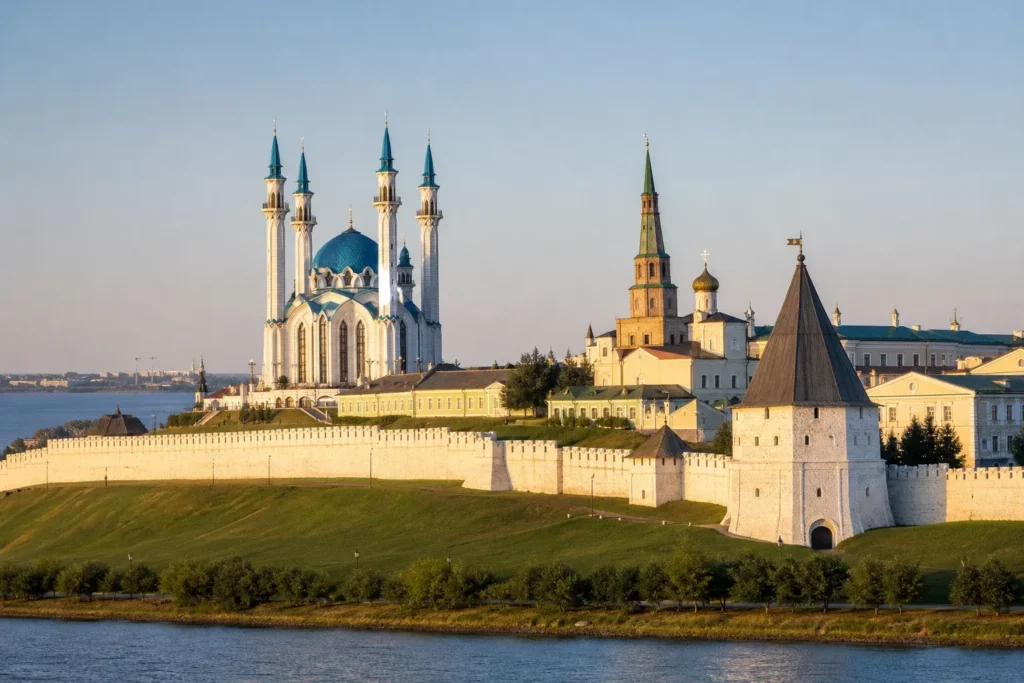
This guide walks you through the Kazan Kremlin‘s most important sites in a logical route. Whether you have two hours for a quick loop or half a day to dip into museums, you’ll discover the architectural layers here: a 10th-century Bulgar fortress, a 16th-century Russian stronghold built by Ivan the Terrible, and living monuments to religious coexistence today.
The Kazan Kremlin walking guide covers eight key stops around the complex, starting at the main gate and spiralling through the grounds. Each entry explains what to look for, why it matters, and practical tips to avoid the common mistakes first-time visitors make.
At a Glance
| # | Place | Best for | Good to know |
|---|---|---|---|
| 1 | Spasskaya Tower | Main entrance and iconic gate | Kremlevskaya street, metro Kremlevskaya. Open 24 hours daily. Ticket office inside: 8:00–20:00. Free entry to tower archway; interior access requires a separate ticket. |
| 2 | Annunciation Cathedral | Oldest structure, unique Russian design | Inside Kremlin grounds, 200 metres northeast of Spasskaya Tower. Open 8:00–20:00 daily. Free entry. Allow 15–20 minutes. |
| 3 | Kul Sharif Mosque | Modern reconstruction, spiritual coexistence | Central Kremlin grounds, 100 metres north of Annunciation Cathedral. Open 8:00–20:00 daily. Friday: closed to tourist visits 11:30–13:15 (prayer time). Visitor galleries closed daily 11:45–12:25 (midday prayer). Free entry. |
| 4 | Söyembikä Tower | Leaning landmark with legends | Northwestern section of Kremlin grounds. Open 8:00–20:00 daily. Paid entry via combination ticket or individual admission. |
| 5 | Spasskaya Tower observation deck | Free panoramic views | Ground level, south wall near Spasskaya Tower. Free entry. Open 24 hours. |
| 6 | Kremlin walls and towers | Fortress perimeter and defensive architecture | Entire perimeter accessible on walking paths. Free access. |
| 7 | Museum of the History of Tatar Statehood and Republic of Tatarstan | Historical narrative and cultural context | Central Kremlin grounds. Open Tuesday–Sunday, typically 10:00–18:00 (check official website for current hours). Paid entry; discount for under-18s. |
| 8 | Cannon Yard Museum | Military engineering and historical weaponry | Eastern section of Kremlin grounds, near the Annunciation Cathedral. Open during museum hours (typically Tuesday–Sunday 10:00–18:00). Paid entry. |
How We Chose
These eight stops were selected based on official information from the Kazan Kremlin Museum-Reserve and verified sources. They represent:
- Structures confirmed as currently open to visitors
- The oldest and most architecturally significant buildings
- Key towers you can actually enter or view from ground level
- Museums that operate on published schedules
- Viewpoints and observation areas accessible without a separate ticket
Catalog details (exact heights, restoration dates, object inventories) are excluded; this guide focuses on what a visitor can see and recognise on site.
1. Spasskaya Tower – Main entrance and iconic gate
The white stone tower with an illuminated clock is the Kremlin's most recognisable landmark and your main entry point. Built in 1556, it received its tent roof and current silhouette in 1857. The tower is actually the southern gate of the original fortress; pedestrian access runs through its archway. Inside, a ticket office and small souvenir shop occupy the ground floor. The tower serves as the starting point for all walks through the Kremlin, and you'll return to it when exiting.
Good to know: Kremlevskaya street, metro Kremlevskaya. Open 24 hours daily. Ticket office inside: 8:00–20:00. Free entry to tower archway; interior access requires a separate ticket.
Tip: Arrive before sunset to photograph the tower against the western sky, and return at dusk when the clock illuminates and the Kremlin walls glow. The nighttime view from outside the tower is often less crowded than daytime.
2. Annunciation Cathedral – Oldest structure, unique Russian design
The pale sandstone cathedral standing just inside the Kremlin is the oldest intact building within the fortress, begun in 1554 and completed in 1562. It is the only 16th-century Russian church to have six interior piers and five apses—an unusual architectural signature. The exterior is simple cream-coloured stone without the ornate decoration of later Russian churches; the bell tower that once stood above it was demolished by Soviet authorities in the 1920s. Inside, visitors can see the restoration of the interior. The cathedral marks the moment Russian power took over after Ivan the Terrible's 1552 conquest.
Good to know: Inside Kremlin grounds, 200 metres northeast of Spasskaya Tower. Open 8:00–20:00 daily. Free entry. Allow 15–20 minutes.
Tip: The cathedral's simplicity is deliberate—it was meant to assert Christian Russian authority over the conquered Tatar city. Compare it with the ornate mosques in Moscow to understand the difference. The observation deck behind the cathedral offers panoramic views of the Volga and city.
3. Kul Sharif Mosque – Modern reconstruction, spiritual coexistence
This blue-domed mosque with four minarets rises near the cathedral and represents a modern return to the Kremlin's Islamic heritage. The original mosque was destroyed when Ivan the Terrible captured the city in 1552; the current structure was rebuilt and opened in 2005, designed in traditional Islamic architecture but using contemporary techniques. It is among Europe's largest mosques. The interior features modern religious spaces and a gallery for visitors. The exterior is striking from any angle—the contrast of its blue dome against the pale stone walls and green lawns is the Kremlin's most photographed view.
Good to know: Central Kremlin grounds, 100 metres north of Annunciation Cathedral. Open 8:00–20:00 daily. Friday: closed to tourist visits 11:30–13:15 (prayer time). Visitor galleries closed daily 11:45–12:25 (midday prayer). Free entry.
Tip: Visit in late afternoon when light hits the dome directly. Remove shoes before entering. If you visit on Friday, plan to view the exterior only or come outside prayer hours. Non-Muslim visitors can view the galleries; do not enter active prayer areas.
4. Söyembikä Tower – Leaning landmark with legends
This distinctive seven-storey tower leans noticeably—it has a tilt of 194 centimetres (76 inches)—and is visible from many parts of the Kremlin. Built in the 17th or 18th century (its exact origins are debated), it once leaned even more dramatically until straightening efforts in the 1930s and 1990s. Local legend claims it is connected to the last queen of the Kazan Khanate, though historians note these stories lack historical basis. The tower offers panoramic views across the complex and over the Volga River from its interior gallery. It is one of the nine surviving towers of the original fortress.
Good to know: Northwestern section of Kremlin grounds. Open 8:00–20:00 daily. Paid entry via combination ticket or individual admission.
Tip: Climb to the gallery for a full 360-degree view of the Kremlin, the confluence of the Kazanka and Volga rivers, and the city beyond. The tower's lean becomes obvious when you stand inside and look up.
5. Spasskaya Tower observation deck – Free panoramic views
A viewing platform built into the ramparts near the Spasskaya Tower offers unobstructed views across the Kremlin complex and the Volga River valleys. The deck is positioned to see both the cathedral and mosque within the fortress, and the modern Kazan skyline beyond. It is accessible from the main grounds with no extra fee. The platform operates around the clock, making it ideal for sunrise, sunset or night views when the buildings are illuminated.
Good to know: Ground level, south wall near Spasskaya Tower. Free entry. Open 24 hours.
Tip: The best light for photography is in the late afternoon when the pale stone walls catch warm, golden light. At night, the floodlit buildings create dramatic silhouettes. This is also the least crowded viewing spot on the Kremlin grounds.
6. Kremlin walls and towers – Fortress perimeter and defensive architecture
The entire Kremlin is encircled by white sandstone walls roughly 1,800 metres long, reinforced with towers that are visible from the walking paths. The walls date from the 16th to 18th centuries, though they follow the line of earlier Tatar fortifications. You can walk along the outer perimeter (on the ground level, not on top of the walls, which are restricted) and see the Secret Tower on the northern wall, which once housed a hidden water supply well. The fortress design was influenced by Pskov architects brought in by Ivan the Terrible. The walls rise 10–15 metres and are lit at night, creating a dramatic silhouette.
Good to know: Entire perimeter accessible on walking paths. Free access.
Tip: Walk the northern wall section for views of the Kazanka River and the least-crowded views of the fortress. The western walls offer sunset perspectives. Do not climb on walls or enter any 'restricted' sections—they are off-limits for safety and security reasons.
7. Museum of the History of Tatar Statehood and Republic of Tatarstan – Historical narrative and cultural context
This museum occupies one of the Kremlin's administrative buildings and explains the complex historical layers of the site and region—from the Kazan Khanate through Russian conquest to modern Tatarstan. Exhibits include historical documents, maps, artifacts and multimedia presentations. The narrative covers the 10th-century Bulgar origins, the 13th-century Golden Horde period, the Kazan Khanate era, and the 1552 Russian conquest. It provides essential context to understand what you see walking the grounds. Most captions are in Russian and English.
Good to know: Central Kremlin grounds. Open Tuesday–Sunday, typically 10:00–18:00 (check official website for current hours). Paid entry; discount for under-18s.
Tip: Start here if you arrive without background knowledge of the site. The museum provides a chronological framework that makes the buildings and towers make more sense. Allow 45–60 minutes.
8. Cannon Yard Museum – Military engineering and historical weaponry
This open-air museum displays cannons, mortars and other military equipment from the 18th to 20th centuries, arranged in a courtyard setting. The exhibits show how the fortress was equipped for defence and later served as a military centre. The collection includes field artillery, siege weapons and small arms. Labels explain the development of Russian military technology. The yard setting allows visitors to walk among the pieces and photograph them against the backdrop of stone walls and sky.
Good to know: Eastern section of Kremlin grounds, near the Annunciation Cathedral. Open during museum hours (typically Tuesday–Sunday 10:00–18:00). Paid entry.
Tip: This is often overlooked by visitors, making it quieter than the main monuments. The weaponry provides a concrete reminder of the fortress's military function in the 17th–19th centuries.
Russia Vibes Tips
- Enter through Spasskaya Tower during daylight (any time between opening of the ticket office at 8:00 and 20:00) to buy tickets on site, but arrive early in July and August to avoid queues. Buying tickets online in advance via tickets.kazan-kremlin.ru is faster if you have a Russian card or someone who can purchase for you.
- Plan two hours for a loop of the main monuments without entering museums, or half a day (4–5 hours) to visit 2–3 museums. The Kremlin is open 24 hours, but museums and most interiors close at 20:00. Don't rush—the atmosphere and details reward a slow walk.
- Bring a printed map or screenshot from the official website before you go; Wi-Fi is not always reliable in the Kremlin grounds. The layout is straightforward but some smaller towers and museums are not immediately obvious without reference.
- Visit the Kul Sharif Mosque early or late in the day to avoid Friday and midday prayer times when galleries close. The exterior view is spectacular even if you can't enter. Non-Muslims are welcome in visitor galleries but must dress respectfully (no shorts, uncovered shoulders; women should cover hair).
- The first Tuesday of each month and 18 May (International Museum Day) offer free admission to all Kremlin museums. On all other days, individual museum tickets are cheaper than the combined ticket if you plan to visit only 2 museums. Visitors under 18 receive free entry to most museums.
- Don't miss the Kremlin observation deck near Spasskaya Tower—it is free and offers the best panoramic shot of the entire complex in one frame. Return at night when buildings are floodlit for a completely different aesthetic and far fewer crowds.
Explore Nearby Kazan Kremlin Walking Guide, Kazan
Sights near Kazan Kremlin Walking Guide, Kazan
 Kul Sharif Mosque, Kazan · typical visit: 1–2 hours6 min on foot from Kremlyovskaya, Kazan metro, Open daily 08:00–20:00
Main image: AI-generated illustration. It may not show the place exactly as it looks.
Browse more: All Culture Lists · All Guides · All Guides in Kazan · All Kazan
FAQ
Is entry to the Kazan Kremlin free?
Entry to the Kremlin grounds is free and open 24 hours via the Spasskaya Tower (main gate). Museums and some tower interiors require separate paid admission. A combined ticket covering nine museums is available, or you can buy individual museum tickets.
How long does a walking tour take?
A quick loop of the main monuments (Spasskaya Tower, Annunciation Cathedral, Kul Sharif Mosque, observation deck) takes 1.5–2 hours. If you enter 2–3 museums or climb towers, allow 4–5 hours. The Kremlin grounds are compact enough to walk end-to-end in about 45 minutes on a direct route.
Can I visit the Kul Sharif Mosque if I'm not Muslim?
Yes, non-Muslims can enter the visitor galleries. The mosque is open 8:00–20:00 daily but closes to tourists 11:30–13:15 on Fridays for prayer. Dress respectfully: no shorts or uncovered shoulders; women should cover their hair. Shoes are removed before entering.
What is the difference between the Annunciation Cathedral and the Kul Sharif Mosque?
The Annunciation Cathedral (built 1554–1562) represents Russian Orthodox authority established after Ivan the Terrible's 1552 conquest. The Kul Sharif Mosque (reopened 2005) symbolises the return of Islam to the Kremlin after 450 years. Both stand within metres of each other, representing the city's dual cultural heritage.
Can I walk on the fortress walls?
No. Visitors walk on the ground paths beside and around the walls, but walking on top of the walls is restricted for safety and security reasons. The paths allow full views of the walls and towers from ground level.
Is a guide necessary, or can I walk alone?
You can walk alone with a printed or digital map from kazan-kremlin.ru. The layout is logical and most sites are clearly visible. However, an audioguide (available at the ticket office for a small fee) provides historical context that enhances understanding. Guided tours are also available if you prefer narration.
What should I know about the Söyembikä Tower?
This seven-storey tower visibly leans due to foundation settling. Local legend connects it to the last queen of Kazan, but historians say these stories lack historical basis. You can enter and climb to the gallery for panoramic views. Entry requires a separate ticket or combined museum pass.
Why is the Kremlin a UNESCO World Heritage Site?
The Kremlin was listed in 2000 as the only surviving Tatar fortress in Russia. It preserves architectural and historical layers from the 10th century (Bulgar period), 16th–18th centuries (Russian fortress), and modern religious coexistence. Its stone walls, towers and monuments exemplify a unique fusion of Islamic and Christian Russian cultures.
Russia Vibes is a one-person project. A coffee keeps it going
Last updated: October 18, 2026.
How we research and update our guides
About this guide: AI assistance and accuracy
This guide is created with the help of AI and is based on official sources where available. Mistakes can still happen. Opening hours, prices, rules and other details are given to the best of our knowledge as of the date shown and can change without notice. It offers general recommendations only, not professional, legal or travel advice. Please confirm important details with the official source before you travel; you are responsible for your own plans and decisions.
International sanctions affect payments between Russia and many other countries. In practice, cards issued in the EU, the UK, the US and several other countries often do not work in Russia, Russian cards usually do not work abroad, and some booking platforms, airlines and payment providers limit or suspend their services for Russia. The situation changes frequently. We do not give legal or financial advice, and this site does not encourage anyone to break or circumvent sanctions. Whatever you plan, you are responsible for following the laws and regulations that apply to you, including those of your country of residence and citizenship. Many travelers still organise their stay lawfully. It is worth asking your bank or payment provider what is currently permitted, contacting hotels, tour operators and carriers directly about the payment methods they accept, and checking which services are open to customers from your country. Clarify payment, cancellation and refund terms before you commit to a booking, and keep your plans flexible. Partner links on this site may not be available in every country, and prices, availability and rules in our guides can differ from what you see when you book.Paying for your trip: please read
Report an issue on this page

Take this guide with you
Get a free PDF of this guide to print or read offline: key facts, tips and a map link on a few clean pages.