
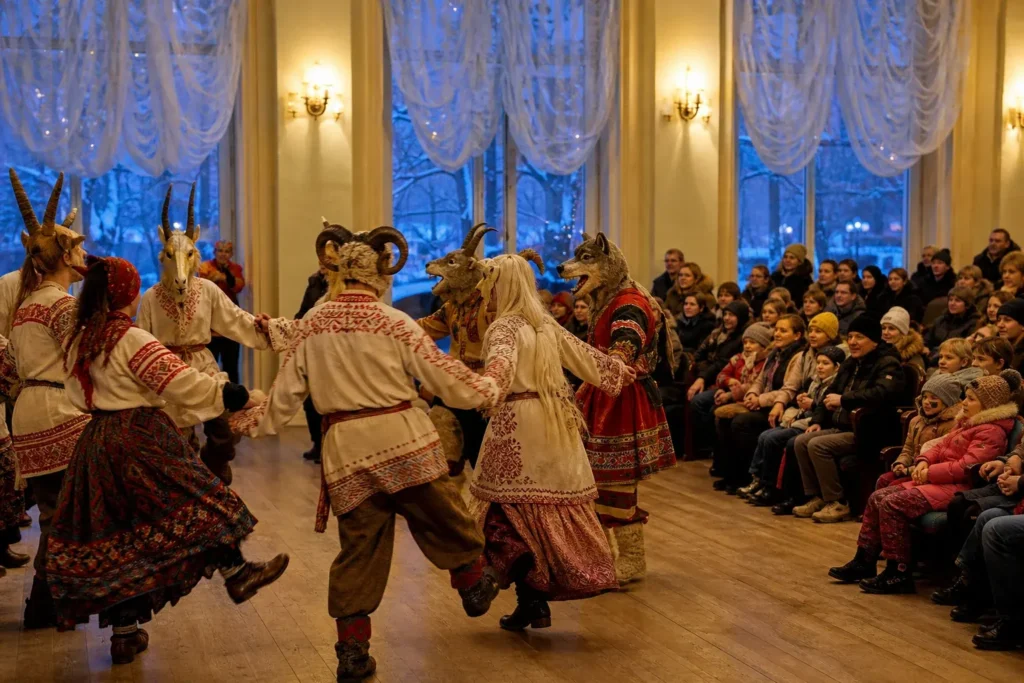
Nardugan in Kazan is not one festival with a fixed venue, a box office or a published programme. It is a midwinter folk holiday rooted in the winter solstice, and in the city it appears as a scatter of small community celebrations, mostly run by Kryashens (Christianized Tatars) and by Tatar cultural societies.
The name is usually explained as nar (fire or sun) plus tugan (born): the birth of the sun on the shortest day. Dates depend on who is celebrating, from the solstice and 25 December to mid-January (see the best-time section). For a visitor it is a chance to meet a living minority tradition rather than a staged spectacle, so expect to look for announcements and ask the host before you go.
Quick Facts
| Russian name | Нардуган |
|---|---|
| Type | Holiday / observance |
| When | Every year in midwinter. Dates differ by community and organizer, from the winter solstice in late December to mid-January, so check the host's current announcement. |
| Public holiday | No, an observance (regular working day) |
| District | Kazan |
| Best time to visit | Nardugan is a midwinter holiday, so winter is the only season for it. Dates depend on the community. Quieter tea-table gatherings by some Tatar societies are reported for 25–26 December, while Kryashen concerts often fall in mid-January, around Christmas and Epiphany. Each host sets its own date, so check the current announcement.
Most community events like this are held in the evening or at weekends, but that is not confirmed for Kazan, so check the day and start time with the host. Be careful with the first days of January. These are public non-working days in Russia, and museums, shops and public transport may run on holiday schedules. No crowd patterns for Kazan Nardugan events can be verified. The events are small and community-scale, so busy halls are not expected. |
| Last updated | October 18, 2026 |
Dates, programs and prices change from year to year. Always check the official website for the current edition.
Why Visit Nardugan, Kazan?
Nardugan shows a side of Tatar culture that the Kremlin and the embankments do not: the folk, partly pre-Christian layer that survives among Kryashens and some other Volga communities.
- A deliberate revival. Kazan Tatars themselves barely kept the holiday in the old days. What you see in Kazan today is a modern revival, which is what makes it interesting to watch.
- Folk music and costume. Concerts of Kryashen and Tatar songs, dances and masks are the usual core of a celebration.
- Small scale. Events are community-sized and mostly held in houses of culture outside the centre, so you are a guest at a local gathering, not part of a tourist crowd.
- A winter angle on Kazan. It fits into a January trip alongside the city’s museums and the New Year holiday period.
How Nardugan, Kazan Is Celebrated
In the village tradition, Nardugan was a season of visiting. Young people in masks and costumes went from house to house with songs and good-luck wishes (alkysh) for the harvest and the livestock, and hosts rewarded them with treats. Singing was meant to be done in the open air. There was also ring-divination, and Kryashen games included building a wall of ice and snow and splitting into two teams.
In Kazan the holiday is mostly a stage and hall event: a concert of Kryashen and Tatar folk music with songs, dances and costumes. Door-to-door visiting and snow games are not something to count on. The highlights below describe the main elements you may meet.
Highlights of Nardugan, Kazan
Costumed mummers (Nardugan babalary)
The best-known figures of the holiday are the mummers, who in village tradition went from house to house in masks and costumes. Typical roles are men dressed as women, bears, goats and old men and women. They sang, wished the household luck and received treats in return.
In Kazan this survives mostly as costume and song in a hall rather than as door-to-door visiting. Look for the masks and exaggerated outfits.
Tip: Do not expect street processions in the centre; the performances are staged inside the host venue.
Ring-divination songs (yozek salu)
One of the oldest customs is fortune-telling with rings, accompanied by songs, with the verses read as predictions about fate and marriage.
At modern celebrations it is more likely to appear as a folk number or a playful activity than as a serious ritual. If a programme includes it, you hear an older song tradition that concerts of newer folk repertoire often leave out.
Tip: If the host invites guests to join in, watching is welcome too; you do not need to know Tatar.
Kryashen community celebration
The most likely form of Nardugan in Kazan is a community concert organised by Kryashen groups. One report describes a mid-January celebration in a district house of culture, not in a landmark in the centre, with songs, dances and costumes and a round dance in the foyer.
This is the real centre of the revival, because Kryashens, Mishar Tatars and Nagaibaks were the groups that traditionally kept the holiday.
Tip: Look for announcements by Kryashen societies and local houses of culture, and check which district the event is in before you set off.
State Kryashen Folklore Ensemble Bermyanchek
Bermyanchek is a Kryashen folk ensemble founded in 2008 together with the Tatarstan Ministry of Culture and based in Tatarstan. Its Kryashen folk repertoire is the kind of material a Nardugan concert draws on.
Whether it appears at any given Nardugan in Kazan is not confirmed, and it is not an organizer of the holiday. Treat it as a name to look for in announcements, not as a guaranteed act.
Tip: Check the ensemble's own website or the venue's announcement for its current performance schedule.
Bavyrsak and festive baking
Food at Nardugan is simple and flour-based. The signature item is bavyrsak, small pieces of fried dough, along with other baked goods put out for guests and for the visiting mummers.
Food is not a feature of every concert, and there is no official Nardugan menu in Kazan. You are more likely to meet it at a tea-table gathering or a community party than at a formal stage show.
Tip: If you are invited to a gathering, tea and baking are part of the welcome; accepting a plate is polite.
Tea-table gatherings in late December
Some Tatar cultural societies in Volga cities hold a secular version of Nardugan on 25 and 26 December, built around a tea table, conversation and songs. One such gathering in Kazan, run by a Tatar culture centre, has been reported, though without detail.
This is a different mood from the mid-January Kryashen concerts, and an example of how the holiday has been reshaped as a modern cultural occasion rather than a religious one.
Tip: These gatherings are usually announced by the society itself, so look for the centre's own notice rather than a general events listing.
House of Friendship of the Peoples of Tatarstan
The House of Friendship opened in 1999 and hosts national-cultural societies and a Sunday school, so it is a natural place for ethnic-culture events in Kazan.
A link between the House and Nardugan is not verified, so do not plan a trip on that assumption. Use it as a starting point for enquiries about Tatar and Kryashen cultural events. The address is in the getting-there section.
Tip: Ask about events before you visit; the House is a venue for societies, not a ticketed attraction.
Naberezhnye Chelny Nardugan (a different city)
Naberezhnye Chelny, another city in Tatarstan, holds a large annual Kryashen Nardugan in mid-January at its own municipal House of Friendship, "Rodnik". It is a separate event run by a different institution and is not part of Kazan's celebrations.
It is worth knowing about because it is easily mixed up with Kazan celebrations in searches. Treat any trip there as a separate journey.
Tip: Check that an event page names Kazan, not Naberezhnye Chelny, before you plan around it.
What It Means for Your Visit
Nardugan is not a public holiday or a non-working day in Russia: it is not on the federal list in the Labor Code. No closures, road closures or transport changes specific to Nardugan in Kazan were found as of October 2026.
What does matter is the surrounding holiday period. 1–8 January are non-working days, including 7 January, Orthodox Christmas, so shops, museums and public transport may follow holiday schedules. Rules and schedules change, so check each venue’s own announcement.
Events are small and community-scale and mostly held outside the centre, so crowds are not expected.
Atmosphere
Nardugan in Kazan is a winter occasion held indoors. Most reported celebrations take place in houses of culture outside the centre, so the setting is a hall or foyer with winter weather outside.
The sound is folk song, Kryashen and Tatar. The look is costume: masks and the bears, goats and old men and women of the mummers. In one reported case the celebration included a round dance in the foyer, which captures the likely tone: participatory, friendly and a little playful.
These are community gatherings, not tourist shows, so the feeling is of being a guest at a local event.
History of Nardugan, Kazan
Nardugan is a winter-solstice festival with pre-Christian roots, linked to sun worship and the Turkic sky god Tengri. It marked the turn from the shortest day toward longer ones and the idea of life renewed. Similar holidays are known to Bashkirs, Udmurts, Chuvash and other peoples of the Volga region.
After Ivan the Terrible captured Kazan in 1552, parts of the local population were Christianized, a process whose details are disputed. The Kryashens (“baptized”) folded Nardugan into Christmastide, which they also call Rashtua. By the nineteenth century, among Kryashens the word covered 25 December to 5 January in the Julian calendar, from Christmas to Epiphany, with mummers visiting houses over several days. Among the Chepets Tatars of Vyatka province it lasted only a day or two.
Kazan Tatars, by contrast, practically did not celebrate it. It was widespread among Kryashens, Mishar Tatars and Nagaibaks, and in some Muslim villages costumed mummers were not welcome. That is why Nardugan is not a traditional Kazan city holiday in the old sense.
In the early twentieth century the secular New Year took hold in Tatar society; Kazan held its first New Year tree for children in 1913. In the 1990s, during the revival of national cultures, some Tatar intellectuals proposed replacing New Year with Nardugan. The holiday returned instead in other forms: Kryashen organizations revived it as a stage and community celebration in Kazan and other Tatarstan cities, with more secular features than the village original.
Dates shifted along the way. Some calendars now place Nardugan between the solstice and Christmas, while Kryashen communities often keep the older reckoning, which falls in mid-January today. In at least one account, a Christmas festival of Kryashen song held in Kazan took over the place of Nardugan.
Today the Kazan celebrations are small and run by different hosts, including Kryashen societies, Tatar culture centres and district houses of culture. There is no single official festival.
Tickets and Booking for Nardugan, Kazan
No central organizer or ticket system for Nardugan in Kazan was found. Each event belongs to its host, such as a Kryashen society, a house of culture or a Tatar culture centre, and the host sets its own entry rules. Some ethnic-culture events in Tatarstan are free, but this is not confirmed for Kazan Nardugan, so check the announcement before you go.
Get Tickets for Nardugan, Kazan
How to Get to Nardugan, Kazan
Nardugan has no fixed venue in Kazan, so there is no single metro station or exit to give. The host’s announcement will give the address; copy the Russian version so you can show it to a taxi driver.
- Metro: Kazan has a single metro line through the centre. Enter the venue address in a map app to find the closest station. Many district houses of culture are a bus, tram or trolleybus ride beyond it.
- On foot: in winter allow extra time. Pavements near district venues may be icy, and the last stretch is often a walk through residential streets.
- Bus and taxi: city buses, trams and trolleybuses reach most districts. A taxi booked through a ride-hailing app is the simplest option for an evening event, when services thin out. Local fares are generally ₽ to ₽₽.
- House of Friendship of the Peoples of Tatarstan: ul. Pavlyukhina 57 (ул. Павлюхина, 57). It is a possible venue for ethnic-culture events, but a link to Nardugan is not confirmed. Older listings show a former address on Ostrovskogo street, which should not be used.
Accessibility
No accessibility details could be confirmed for any Kazan Nardugan event. The House of Friendship's official page on the culture portal does not mention wheelchair access, lifts or companion arrangements, and district houses of culture differ a lot in their buildings.
If you use a wheelchair, walk with difficulty or need a companion, ask the organizer before you travel about the entrance, steps, lifts, a step-free route to the hall, accessible toilets and seating.
In winter, snow and ice on the approach can be a bigger obstacle than the building itself. A taxi that can stop close to the entrance usually helps.
Food Nearby
No specific venue can be tied to Nardugan, so there is no fixed list of places to eat; what is nearby depends on where the event is held.
The food of the holiday is simple and flour-based. Bavyrsak, small pieces of fried dough, is the classic, and Tatar cafés in Kazan commonly serve it and other Tatar baking. If an event is in a district house of culture, check the area on a map app beforehand, as cafés may be few in residential streets.
What to Bring
Warm winter clothing, a hat, gloves and boots with a good grip are the essentials; the walk to a district venue can be icy. Keep the event address in Russian on your phone, along with an offline map in case of weak signal.
Bring some patience for a flexible start time, since small community events do not always run to a strict schedule (confirm the start with the host).
Photography Rules
No event-specific photography rules were found, and each venue and host sets its own. These are community gatherings, so ask the organizer, or the performers when possible, before taking close-up photos of people, especially children and anyone in a mask.
Stage lighting in halls is often dim, and flash can disturb performers, so avoid it.
Family Suitability
Folk concerts with costumes, masks and songs can interest children, and the mummers' bears and goats are playful characters. Programmes, age limits and venues vary by host, though, and nothing about family arrangements could be verified for Kazan.
Ask the organizer whether the event suits the age of your children and how long it lasts. Fortune-telling about marriage is a traditional part of the holiday, but it is usually presented lightly.
Russia Vibes Tips
- Search in Russian and Tatar as well as English. Terms such as "Нардуган Казань" and "Нардуган кряшены" are more likely to find host announcements.
- Check which Nardugan an announcement is about. Bashkortostan also has a Nardugan, including a summer one, and Naberezhnye Chelny holds its own Kryashen event; neither is a Kazan celebration.
- Mid-January is the best period to look for Kryashen events, as it matches the older calendar reckoning; the late-December tea-table gatherings are a different format.
- Kazan's large New Year and Christmas street fairs are separate city events, not Nardugan, so do not use them as a guide to dates or programme.
Explore Nearby Nardugan, Kazan
Sights near Nardugan, Kazan
 Kazan Kremlin · typical visit: 2–4 hours2 min on foot from Kremlyovskaya, Kazan metro, Open 24 hours
Main image: AI-generated illustration. It may not show the place exactly as it looks.
 Kul Sharif Mosque, Kazan · typical visit: 1–2 hours6 min on foot from Kremlyovskaya, Kazan metro, Open daily 08:00–20:00
Main image: AI-generated illustration. It may not show the place exactly as it looks.
Browse more: More in Kazan · All Cultural Events · All Events & Holidays · All Events & Holidays in Kazan · All Kazan
FAQ: Nardugan, Kazan
Is Nardugan a Muslim or an Orthodox holiday?
Neither. It has pagan and Tengrist roots as a solstice festival. Kryashens, who are Orthodox, fold it into Christmastide, while some Muslim Tatar villages historically did not welcome the costumed mummers.
Is there a big Nardugan festival in Kazan like Sabantuy?
No. No single official festival with a fixed venue or programme was found. What exists are smaller community celebrations by different hosts.
Can I see Nardugan in summer?
Not in Kazan. The Tatar holiday is a midwinter one. A summer Nardugan exists in Bashkir tradition, but that is a separate event in another region.
Do I need to know Tatar to enjoy it?
The language of each event depends on the host and could not be verified. Songs and costumes can be enjoyed without understanding the words, and you can ask the organizer beforehand.
Russia Vibes is a one-person project. A coffee keeps it going
Last updated: October 18, 2026.
How we research and update our guides
About this guide: AI assistance and accuracy
This guide is created with the help of AI and is based on official sources where available. Mistakes can still happen. Opening hours, prices, rules and other details are given to the best of our knowledge as of the date shown and can change without notice. It offers general recommendations only, not professional, legal or travel advice. Please confirm important details with the official source before you travel; you are responsible for your own plans and decisions.
International sanctions affect payments between Russia and many other countries. In practice, cards issued in the EU, the UK, the US and several other countries often do not work in Russia, Russian cards usually do not work abroad, and some booking platforms, airlines and payment providers limit or suspend their services for Russia. The situation changes frequently. We do not give legal or financial advice, and this site does not encourage anyone to break or circumvent sanctions. Whatever you plan, you are responsible for following the laws and regulations that apply to you, including those of your country of residence and citizenship. Many travelers still organise their stay lawfully. It is worth asking your bank or payment provider what is currently permitted, contacting hotels, tour operators and carriers directly about the payment methods they accept, and checking which services are open to customers from your country. Clarify payment, cancellation and refund terms before you commit to a booking, and keep your plans flexible. Partner links on this site may not be available in every country, and prices, availability and rules in our guides can differ from what you see when you book.Paying for your trip: please read
Report an issue on this page

Take this guide with you
Get a free PDF of this guide to print or read offline: key facts, tips and a map link on a few clean pages.