
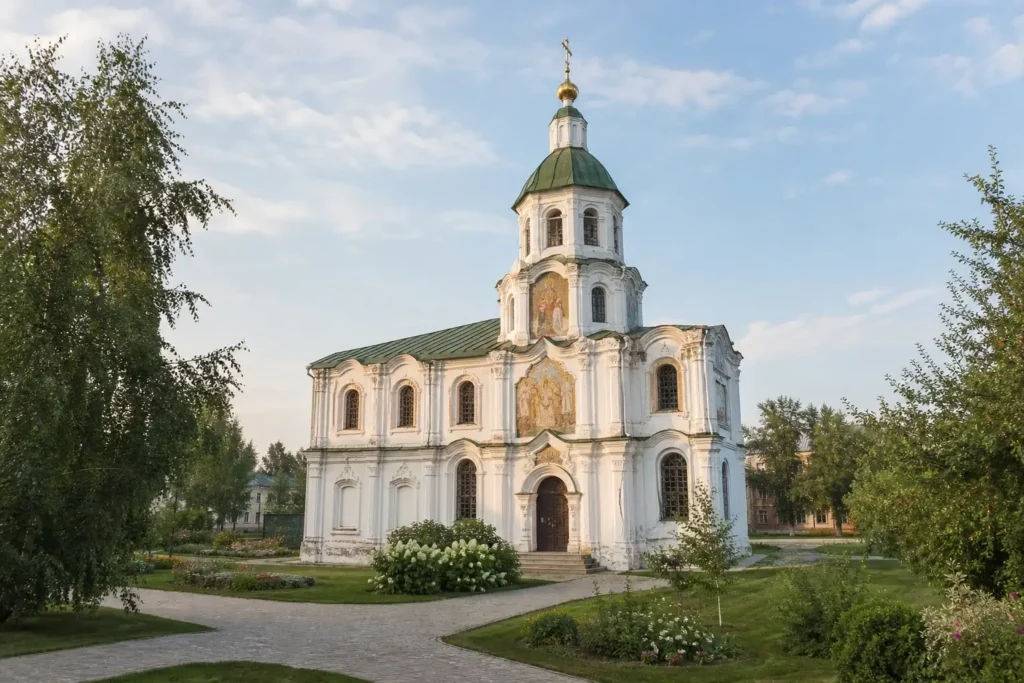
The Church of the Savior, Irkutsk, also called the Spasskaya Church, is the oldest surviving stone building in the city. It stands in a small garden in the historic center, just north of Kirov Square and close to the Angara river, and it is the only building that survives from the original Irkutsk fort, according to travel sources.
The stone church was begun in 1706 and consecrated in 1710, and it is known for the painted frescoes on its outer walls, which are rare in Siberia. It is a working church again, so visiting rules apply. Services, opening times and access change, so check the official source before you go.
Quick Facts
| Russian name | Спасская церковь (Церковь Спаса Нерукотворного Образа) |
|---|---|
| Built / opened | 1706–1710 |
| Architect(s) | Moses Dolgikh (traditionally credited) |
| Address | улица Сухэ-Батора, 2, Иркутск |
| District | Irkutsk (historic center, north of Kirov Square near the Angara) |
| Opening hours | It is a working church, and visiting times follow its services. The daily schedule is not verified here (as of October 2026 – check the official site of the parish). |
| Admission | Entering the church is normally free. Check the parish for rules on donations, any museum exhibition inside or guided tours. |
| Best time to visit | Weekday mornings are quiet, and visits are easier outside services. Summer is comfortable for walking in the garden, while in winter the snow makes the white walls look sharp and the paths may be slippery. Church holidays are busier, and access may be limited then. |
| Recommended duration | 20 to 40 minutes |
| Website | spashram-irk.ru |
| Last updated | October 13, 2026 |
What Is (and Isn't) Part of a Visit to Church of the Savior, Irkutsk?
| Part | Status | Notes |
|---|---|---|
| The church building and interior | Included in the standard ticket | A working church, normally free to enter outside services. |
| The garden around the church | Included in the standard ticket | A small public park with paths and trees. |
| Services and ceremonies | Separate ticket or institution | Visits are limited during services, and the parish sets the rules. |
| Epiphany Cathedral | Outside / not part of it | A separate cathedral nearby with its own times and rules. |
| The old Irkutsk fort | Not open to visitors | Nothing of the fort survives above ground apart from this church. |
| Kirov Square | Outside / not part of it | The main square of the city lies just south of the church. |
Why Visit Church of the Savior, Irkutsk?
The church is the best place in Irkutsk to see the city’s earliest stone architecture. It is described as the oldest surviving stone building in the city, and it is the only structure that remains from the fort where Irkutsk began, according to travel sources.
It is also unusual to look at. Early 19th-century frescoes decorate the outside walls, which is rare in Siberia, according to travel sources, and a tall bell tower with a green roof was added later in the 18th century. It is small, close to Kirov Square and the Epiphany Cathedral, and easy to fit into a short walk along the Angara.
Highlights of Church of the Savior, Irkutsk
The oldest surviving stone building in Irkutsk
Work on the stone church began in 1706, and it was consecrated on 1 August 1710, according to travel sources. It replaced an older wooden church on the same site, within the walls of the Irkutsk fort. It is described as the oldest surviving stone building in the city and one of the oldest in Eastern Siberia, so it is a key stop for anyone interested in the early town.
Tip: Read the carved stone outside showing the old church and city, which travel sources mention.
The painted outer walls
In the early 19th century the church was painted inside and outside, according to travel sources, and the exterior frescoes are rare in Siberia. The images of saints on the facade, together with Siberian Baroque details such as framed panels and relief decoration, give the building its decorated look. Look at the rear and the upper walls, where the paintings are most visible.
Tip: Go in good light and walk around the whole building to see the paintings on each side.
The bell tower with the green roof
A bell tower with a green roof and a tall spire was added in the second half of the 18th century, in 1758 to 1762, according to a travel source. It is one of the most visible features and contrasts with the white walls of the church. It is the first thing you see from Kirov Square.
Tip: Look at it from the garden side for the best view of the white walls and the green roof.
The only survivor of the Irkutsk fort
The church stood within the walls of the old Irkutsk fort and is the only building of it that survived, according to travel sources. The fort is the origin of the city, which was founded in the 17th century. Nothing else of it stands above ground, so the church is the main link to the earliest years of Irkutsk.
Tip: Combine it with the monument to the founders of Irkutsk on the embankment nearby.
The garden around the church
The church stands in a small park with paths and trees, north of Kirov Square, according to a travel source, which makes it a calm spot in the center. The garden gives space to look at the building from different angles. It is also close to the Angara river and the Epiphany Cathedral.
Tip: Take a slow walk around the building before you go in.
The interior and the museum exhibition
The interior is that of a working church, with icons and candles, and the building also had a museum exhibition on the history of the Irkutsk diocese, according to a travel source. Services were restored in 2006, according to travel sources, so visitors may see worship. Check the parish for visiting times, dress code and photography rules.
Tip: Cover your shoulders and knees, and for women a headscarf is customary.
Atmosphere
The Church of the Savior feels small, old and quiet next to the busy center. White walls and a green roof stand in a garden, and from the paths you see the painted details on the outside and the tall bell tower. Traffic and the square are close, but the garden slows things down.
It is quietest on weekday mornings and busier around services and church holidays. In summer the trees give shade and the colors stand out, and in winter the snow makes the white walls and the green roof look sharper. Visitors are a mix of worshippers, walkers and travellers on the Trans-Siberian route.
History of Church of the Savior, Irkutsk
Irkutsk began as a wooden fort on the Angara river in the 17th century, and the first church on this site, the Church of the Savior, was a wooden building within the walls of the fort, according to travel sources. Sources date it to the 1660s or 1672.
The wooden church was replaced by a stone one. Work began in 1706, according to travel sources, and the church was consecrated on 1 August 1710. On that day a banner with the image of the Savior and an icon were carried in from the old wooden church. The Moscow architect Moses Dolgikh is traditionally named as the author of the project, according to a travel source, though the attribution should be checked.
A great fire in 1716 destroyed much of the old fort, according to a travel source, and the stone church survived. In the 18th century a bell tower with a green roof was added, in 1758 to 1762, according to a travel source.
In the early 19th century the church was decorated with frescoes, both inside and outside, according to travel sources. The exterior paintings are rare in Siberia and make the church one of the unusual religious buildings between the Urals and the Pacific, according to a travel source.
After the revolutions, the church was closed in 1931, according to travel sources, but it was saved from the destruction of churches that followed, partly because it was protected as a historical monument. In 1960 it was recognized as architecturally significant, and it was restored between 1967 and 1980, according to travel sources.
In 1982 the building was made into a museum, according to a travel source, and in 2006 it was returned to the Orthodox Church and reopened for worship, according to travel sources.
Today the church is a working parish church and a regional landmark, and it is close to Kirov Square and the Epiphany Cathedral. The dates and details above come from travel sources and general knowledge and should be checked against official parish and heritage sources.
Tickets and Booking for Church of the Savior, Irkutsk
Entry. The church is a working parish church, so there is normally no ticket and no booking, and visits are welcome outside services. The parish decides the rules for visitors, for any exhibition inside and for guided visits, so check them before you go.
Rules for visitors. Dress modestly, with covered shoulders and knees, and for women a headscarf is customary. Speak quietly, and ask before photographing inside. Visitors may be asked to step aside during services.
Payment. Cash in rubles is the most reliable way to leave a donation or to buy a candle. Whether foreign Visa and Mastercard cards work was not verified and should not be assumed, and the sanctions rules of your own country may restrict some payment services, so check this yourself. Check the parish website for current visiting times.
Plan and Book
Suggested itineraries Church of the Savior, Irkutsk
20 to 30 minutes
See the white walls, the green bell tower and the painted facade from the garden, then step inside for a few minutes if the church is open. Dress modestly and stay quiet.
1 hour
Start at the Church of the Savior, look at the frescoes and the bell tower, then walk to the Epiphany Cathedral next door and along the Angara embankment.
Half day
See the church and the cathedral in the morning, walk the Angara embankment to the monument to the founders of Irkutsk and Kirov Square, and finish with lunch in the 130th Quarter.
How to Get to Church of the Savior, Irkutsk
The church is at Sukhe-Bator Street 2, in the historic center of Irkutsk on the right bank of the Angara river, just north of Kirov Square. Irkutsk has no Metro, so most visitors arrive on foot, by bus or by taxi.
- From the center: it is a short walk from Kirov Square and the Angara embankment, in a small park slightly to the right of the government administration building, according to a travel source.
- By bus or taxi: city buses and taxis stop in the center; check the current route numbers locally, since they change.
- From the station or the airport: a taxi or a bus to the center is the usual way; see the Irkutsk guide for details.
Save the address in Latin letters and in Russian, and check a map on your phone before you go.
Accessibility
Accessibility was not verified. Historic churches usually have steps at the entrance and uneven paths, so visitors with reduced mobility should ask the parish about access in advance, and expect icy paths in winter.
Food Nearby
The historic center has many cafes and restaurants, including those of the 130th Quarter and the streets around Kirov Square. Specific venues were not verified here, so check opening hours before you go.
What to Bring
Bring modest clothing, with covered shoulders and knees, and a headscarf if you are a woman and want to follow the custom. In winter wear warm layers and shoes with a good grip. Cash in rubles is useful for candles and donations.
Best Views and Photo Spots of Church of the Savior, Irkutsk
The garden path
From the garden you can frame the white walls, the painted facade and the green bell tower together, with trees around them.
Best time: Morning or late afternoon, in soft light.
The painted outer walls
A close view of the outer frescoes and the Baroque framing shows the decoration that makes the church unusual in Siberia.
Best time: Midday, in even light.
The bell tower
A low angle shows the green roof and the spire against the sky, a good contrast with the white walls.
Best time: Clear mornings.
The church in winter
Snow on the garden and the roofs makes the white walls and the green roof stand out, and the building looks very different from summer.
Best time: Winter mornings, after snow.
Photography Rules
Photography outside is usually fine, but rules differ inside a working church, where photographing worshippers, services and some icons may be restricted. Ask permission before taking pictures indoors, avoid flash and tripods, and be discreet. Drone rules also apply in cities, so check the regulations with the official source before you use one.
Family Suitability
A short visit works for families with children, as long as they can stay quiet inside a working church. The garden has paths where children can walk, but they can be icy in winter, and a stroller may not fit the entrance, so check access beforehand. It is easy to combine with the Epiphany Cathedral and the embankment.
Russia Vibes Tips
- Walk all the way around the building, since the painted frescoes are on several outer walls and the rear.
- See the church together with the Epiphany Cathedral next door, since both stand on the site of the old fort.
- Look for the carved stone outside that shows the old church and city, which travel sources mention.
- Visit outside services, and ask politely if you are unsure whether you may enter.
- Check the name on signs, since it appears as Spasskaya Church, Saviour Church and Church of the Savior of the Holy Face.
- Do not confuse it with the Kazan Church on Barrikad Street, which is a different church in another part of the city.
Explore Nearby Church of the Savior, Irkutsk
Sights near Church of the Savior, Irkutsk
 Epiphany Cathedral, Irkutsk · typical visit: 30 to 60 minutes
Main image: AI-generated illustration. It may not show the place exactly as it looks.
 Lower Angara Embankment, Irkutsk · typical visit: 1 to 2 hours
Main image: AI-generated illustration. It may not show the place exactly as it looks.
 Monument to the Founders of Irkutsk · typical visit: 10 to 20 minutes
Main image: AI-generated illustration. It may not show the place exactly as it looks.
Related guides
 130th Quarter, Irkutsk: Wooden Houses, Cafes and Window to Asia
Main image: AI-generated illustration. It may not show the place exactly as it looks.
 Pravoberezhny District, Irkutsk: The Old Center and Its Suburbs
Main image: AI-generated illustration. It may not show the place exactly as it looks.
 Historic City Center, Irkutsk: Churches, Squares and Wooden Houses
Main image: AI-generated illustration. It may not show the place exactly as it looks.
 Shine of Russia Festival, Irkutsk: Russian Culture Days in September
Main image: AI-generated illustration. It may not show the place exactly as it looks.
 Decembrist Evenings Festival, Irkutsk: Concerts and Salons in December
Main image: AI-generated illustration. It may not show the place exactly as it looks.
Browse more: More in Irkutsk (historic center, north of Kirov Square near the Angara) · All Churches · All Irkutsk · All Sightseeing · All Sightseeing in Irkutsk
FAQ: Church of the Savior, Irkutsk
Is this the oldest building in Irkutsk?
It is described as the oldest surviving stone building in the city, according to travel sources. It is also the only building that survives from the original Irkutsk fort.
When was the church built?
Work on the stone church began in 1706, and it was consecrated in 1710, according to travel sources. An earlier wooden church stood on the site.
Why is it painted on the outside?
In the early 19th century the church was decorated with frescoes both inside and outside, according to travel sources. Exterior frescoes are rare in Siberia, which is why the church is known for them.
Can tourists go inside?
Yes, visitors are welcome outside services if they dress modestly and behave quietly. It is a working church, so access may be limited during services.
Is there an entrance fee?
No, there is normally no ticket. A donation is customary, and the parish sets the rules, so check them on site.
Where is it?
It stands on Sukhe-Bator Street 2, in a small garden just north of Kirov Square, close to the Angara river. It is within walking distance of the center.
Is it far from the Epiphany Cathedral?
No, the two churches are close to each other in the historic center, and most visitors see both in one walk. Each has its own times and rules.
How long do I need?
Twenty to forty minutes is enough for the facade, the garden and a short visit inside. Add time for the Epiphany Cathedral and the embankment.
Russia Vibes is a one-person project. A coffee keeps it going
Last updated: October 13, 2026. Found an error or something out of date? Report it and we will check and fix it.
How we research and update our guides
About this guide: AI assistance and accuracy
This guide is created with the help of AI and is based on official sources where available. Mistakes can still happen. Opening hours, prices, rules and other details are given to the best of our knowledge as of the date shown and can change without notice. It offers general recommendations only, not professional, legal or travel advice. Please confirm important details with the official source before you travel; you are responsible for your own plans and decisions.
International sanctions affect payments between Russia and many other countries. In practice, cards issued in the EU, the UK, the US and several other countries often do not work in Russia, Russian cards usually do not work abroad, and some booking platforms, airlines and payment providers limit or suspend their services for Russia. The situation changes frequently. We do not give legal or financial advice, and this site does not encourage anyone to break or circumvent sanctions. Whatever you plan, you are responsible for following the laws and regulations that apply to you, including those of your country of residence and citizenship. Many travelers still organise their stay lawfully. It is worth asking your bank or payment provider what is currently permitted, contacting hotels, tour operators and carriers directly about the payment methods they accept, and checking which services are open to customers from your country. Clarify payment, cancellation and refund terms before you commit to a booking, and keep your plans flexible. Partner links on this site may not be available in every country, and prices, availability and rules in our guides can differ from what you see when you book.Paying for your trip: please read

Take this guide with you
Get a free PDF of this guide to print or read offline: key facts, tips and a map link on a few clean pages.