
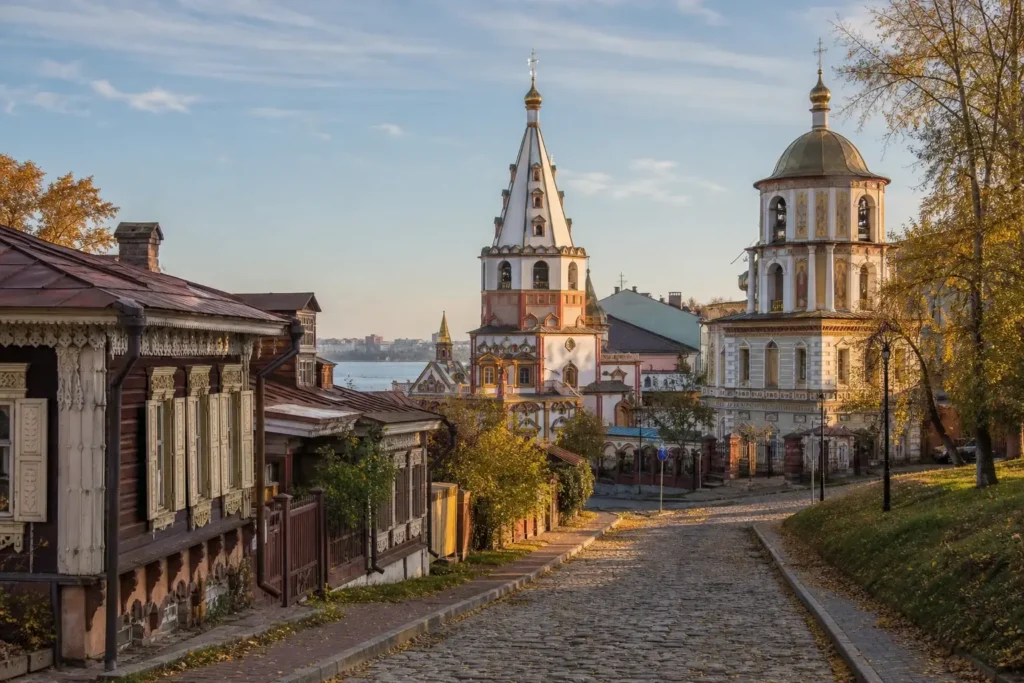
Historic City Center, Irkutsk, is the oldest part of the city, on the right bank of the Angara river, where a Cossack fort was founded in 1661. A great fire in the summer of 1879 destroyed most of the historic center, so today it is a mix of surviving old churches, buildings of the late 19th century, Soviet-era squares and restored wooden houses.
It is compact enough to walk. The main sights, such as the Church of the Savior, the Epiphany Cathedral, Karl Marx Street, the Angara embankment and the 130th Quarter, lie within a short distance of one another. Opening hours and programs change, so check the official sources before you go.
Quick Facts
| Russian name | Исторический центр Иркутска |
|---|---|
| Address | исторический центр, между набережной Ангары и улицей Ленина, Иркутск |
| District | Irkutsk (Pravoberezhny okrug, the historic center on the Angara) |
| Opening hours | The streets, squares and the embankment are open round the clock. Churches, museums and shops keep their own hours, so check each one before you go (as of October 2026 – check the official sites). |
| Admission | Free to walk. Museums, house museums and some exhibitions have their own tickets, and churches are free but have service hours. |
| Best time to visit | Summer has long days and a lively embankment, and September has golden light. Winter brings deep frost, snow and the New Year decorations. Mornings are calm, and evenings are best for the embankment and the 130th Quarter. |
| Recommended duration | Half a day to a full day |
| Last updated | October 14, 2026 |
What Is (and Isn't) Part of a Visit to Historic City Center, Irkutsk?
| Part | Status | Notes |
|---|---|---|
| Streets, squares and the embankment | Included in the standard ticket | Free to walk at any time, with no ticket. |
| Churches and the cathedral | Included in the standard ticket | Free to enter, but services set the hours and visitors should dress modestly. |
| Museums and house museums | Separate ticket or institution | Each has its own ticket, hours and closed day, such as the museum of local lore, the art museum and the Decembrist houses. |
| The 130th Quarter | Included in the standard ticket | A restored district to the south of the center; walking is free, and its museums and exhibitions have their own tickets. |
| The icebreaker Angara | Separate ticket or institution | A museum ship on the Irkutsk Reservoir, outside the old center, with its own ticket. |
| Lake Baikal and Listvyanka | Outside / not part of it | About an hour's drive away; it is a separate day trip, not part of the center. |
Why Visit Historic City Center, Irkutsk?
The center is the best place to understand how Irkutsk grew from a fort into the capital of Eastern Siberia. It has the oldest stone church in the region, a cathedral covered with frescoes, a main street with theatres and museums, and a river embankment with monuments to the city’s founders and to the emperor who approved the Trans-Siberian Railway.
It is also free and easy to explore on foot. You can combine churches, museums, cafes and the river in one day, and the center has most of the city’s restaurants and hotels. Winter and summer give two very different pictures of the same streets.
How Historic City Center, Irkutsk Is Laid Out
The center is a grid of streets that runs back from the Angara. The river embankment, with the Lower Embankment at the water and Gagarin Boulevard above it, forms the northern edge. Karl Marx Street is the main axis, about two kilometers long, running from the Alexander III monument at the river past theatres and the museum of local lore.
The oldest churches stand near the river, close to Sukhe-Bator Street, with the Church of the Savior and the Epiphany Cathedral side by side, and the Catholic church nearby. Kirov Square, on the site of the old fort, lies a short walk inland. Uritsky Street leads from Karl Marx Street toward the Central Market, and the 130th Quarter, a restored district of wooden houses, lies to the south. A sensible route runs from the river and the old churches to Karl Marx Street, then to Kirov Square and the 130th Quarter.
Highlights of Historic City Center, Irkutsk
The Church of the Savior
The Church of the Savior is the oldest stone church in Eastern Siberia, built in 1706–1710, and it stands near the river. A huge fresco covers one outer wall and makes it easy to recognize. It was once part of the Irkutsk fort, which has not survived.
Tip: Look for the large fresco on the outer wall.
The Epiphany Cathedral
The Epiphany Cathedral stands behind the Church of the Savior and was built in the first half of the 18th century. It has a tiered bell tower and is covered with frescoes, according to city guides. It is a working cathedral, so services are held.
Tip: Check the service times if you want to see the interior.
Karl Marx Street
Karl Marx Street is the main street of the old town and has the regional museum of local lore, the Okhlopkov Drama Theatre and a statue of the playwright Alexander Vampilov. The Alexander III monument stands at its river end. It is a good street for a slow walk and for cafes.
Tip: Walk it from the river toward Kirov Square.
The Angara embankment
The Lower Embankment and Gagarin Boulevard run along the river, with the monument to the founders of Irkutsk and the Moscow Gate, a reconstruction of a triumphal arch, according to separate guides. The embankment has views of the Angara and the Yunost Island. It is lively in summer and frosty and quiet in winter.
Tip: Walk here at sunset for the best light on the river.
Kirov Square
Kirov Square stands on the site of the old fort and is the main place for city events and the New Year tree in winter, according to city sources. Fountains work in summer. It is a good place to rest between streets.
Tip: Visit in December to see the main tree and the ice town.
The 130th Quarter
The 130th Quarter, also called the Irkutsk Sloboda, is a restored historic district at the foot of the Krestovaya hill, with neat wooden houses, museum exhibitions, cafes and cobbled walkways, according to a city guide. It is covered in a separate guide.
Tip: Go in the evening, when the wooden houses are lit.
The Znamensky Monastery
The Znamensky Monastery, a women's convent founded in the late 17th century, has a five-domed cathedral and a necropolis where the Decembrists and the explorer Grigory Shelikhov are buried, according to a city guide. It stands near the river and is a working monastery.
Tip: Dress modestly and keep your voice low inside.
Atmosphere
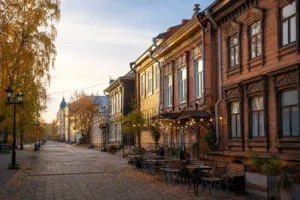
The center feels like a Siberian town that has kept some of its old face. Wooden houses with carved window frames stand beside stone churches with bright frescoes, and the river is never far away. You hear bells from the churches, trams on the main street and the chatter of cafes on summer terraces.
It is calm in the morning, busy at lunchtime and lively on summer evenings, when the embankment fills with walkers. In winter the streets are quiet, the frost is deep and the lights of the squares and houses glow in the early dusk.
History of Historic City Center, Irkutsk
Irkutsk began in 1661 as a wooden fort built by Cossacks on the bank of the Angara. A settlement soon grew outside its walls, and by the early 1670s the first wooden church, the Spasskaya, had been built, according to a history page. In 1686 the fort received city status.
In the late 17th century the Znamensky Monastery, for women, was founded, and the Epiphany Cathedral and the stone Church of the Savior were built in the early 18th century. The Church of the Savior, built in 1706–1710, is the oldest stone church in Eastern Siberia.
By the early 19th century Irkutsk had become a cultural center of Eastern Siberia, with schools, theatres and libraries, according to a city guide. The city also received many exiles, including the Decembrists, whose houses are now museums.
On 22 and 24 June 1879 a great fire destroyed most of the historic center, killed 11 people and left thousands homeless, according to a history page. It divided the city’s history into before and after the fire. Among other losses, the archaeological museum and about 10,000 books of the Geographical Society burned. The center was rebuilt by the end of the century, according to a city guide.
Buildings of the rebuilt center include the museum of local lore, in a Moorish style, completed in 1883, and the Kazan Church, built in the late 19th century. The monument to Emperor Alexander III was unveiled in 1908, removed in 1920 and replaced by a new statue in 2003.
For the 350th anniversary of the city in 2011, the embankment was renewed, the Moscow Gate was reconstructed and a monument to the founders was unveiled, according to separate guides, and the 130th Quarter was restored as a district of wooden houses.
The details above come from city guides and history pages and should be checked against official sources.
Tickets and Booking for Historic City Center, Irkutsk
Entry. Walking in the historic center is free. Churches are free to enter, and museums, house museums and exhibitions have their own tickets, which are sold by each museum, usually at the entrance, with online sales at some. Rates for Russian citizens and concessions differ from those for foreign visitors.
Planning. Closed days differ by museum, and opening hours change by season, so check each museum’s official site. Guided walking tours are offered by local agencies, but a guide is not needed to explore on foot.
Check the official sites of each museum for current tickets and hours.
Plan and Book
Advertisement: these are partner links. If you book or buy through them, we may earn a commission at no extra cost to you.
Suggested itineraries Historic City Center, Irkutsk
2 hours
Start at the Church of the Savior and the Epiphany Cathedral near the river, walk along the Lower Embankment to the monument to the founders and the Moscow Gate, then climb to Kirov Square.
Half day
Begin at the oldest churches, walk the length of Karl Marx Street to the Alexander III monument and Gagarin Boulevard, have lunch near Uritsky Street, and finish in the 130th Quarter.
Full day
Add the museum of local lore, the art museum and a Decembrist house in the morning, walk the embankment and the main street at midday, and spend the evening in the 130th Quarter with dinner at a local restaurant.
How to Get to Historic City Center, Irkutsk
The historic center lies on the right bank of the Angara, in the Pravoberezhny okrug of Irkutsk. Irkutsk has no Metro, so most visitors arrive by taxi, bus, tram or on foot.
- From the airport: a taxi to the center is the easiest way; the distance is about 6 to 10 kilometers, depending on the part of the center.
- From the railway station: the station is about 1 to 3 kilometers from most of the center, so a short taxi ride or a bus or tram is enough.
- Within the center: everything is walkable, with trams and buses on the main streets.
Check the current routes with the operators. See the Irkutsk guide for how to reach the city.
Accessibility
Accessibility was not verified. Pavements are old in places, and many historic buildings, including wooden houses and churches, have steps, so visitors with reduced mobility should ask each museum or church about access, and expect icy paths in winter.
Food Nearby
The center has the city's largest choice of cafes and restaurants, including some covered in separate guides, such as Pepel on Sukhe-Bator Street, Strizhi on Karl Marx Street, Partizan and Sobraniye Speshilova on Sedova Street, Ulus and Kochevnik for Buryat and Mongolian food, and the Central Market for local products.
What to Bring
Bring comfortable shoes for old pavements, layers for changing weather and very warm clothes in winter. Cash in rubles is useful for small purchases, and modest clothes with a scarf for women help in churches.
Best Views and Photo Spots of Historic City Center, Irkutsk
The Church of the Savior and its fresco
The large fresco on the outer wall of the oldest stone church gives a colorful picture against the old walls.
Best time: Morning, in side light.
The Epiphany Cathedral from the street
The tiered bell tower and the frescoed walls give a classic picture of the old center.
Best time: Late afternoon, in warm light.
The Angara embankment at sunset
The wide river with the sun low over the water and the long line of the embankment gives a calm, open view.
Best time: Sunset, in summer.
The 130th Quarter in the evening
The carved wooden houses lit by lanterns and garlands give a warm, fairy-tale street scene.
Best time: After dark, especially after snow.
Photography Rules
Photography is allowed in streets and squares, as in most public spaces. Inside churches and museums, ask permission and follow the signs, since photography and flash may be restricted. Drones may need permissions in the center.
Family Suitability
The center suits families, with open squares, a river embankment, museums with children's programs and wooden houses to look at. Distances are walkable, but old pavements and cobbles are hard for strollers, and winter cold limits time outdoors.
Russia Vibes Tips
- Start at the oldest churches near the river and walk inland, so that the main street and the squares come in order.
- Check the closed days of museums, since they differ and many are closed on Monday or Tuesday.
- Walk Karl Marx Street in the morning and the embankment in the evening for the best light.
- Visit in December for the New Year decorations on Kirov Square, and bring very warm clothes.
- Use the 130th Quarter for dinner, since it has many restaurants within a short walk.
- Do not expect a single old town, since the 1879 fire destroyed most of it and the center mixes old and later buildings.
Explore Nearby Historic City Center, Irkutsk
Sights near Historic City Center, Irkutsk
 Kirov Square, Irkutsk · typical visit: 30 to 60 minutes
Main image: AI-generated illustration. It may not show the place exactly as it looks.
 Karl Marx Street, Irkutsk · typical visit: 1 to 2 hours
Main image: AI-generated illustration. It may not show the place exactly as it looks.
 Church of the Savior, Irkutsk · typical visit: 20 to 40 minutes
Main image: AI-generated illustration. It may not show the place exactly as it looks.
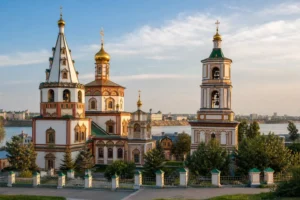 Epiphany Cathedral, Irkutsk · typical visit: 30 to 60 minutes
Main image: AI-generated illustration. It may not show the place exactly as it looks.
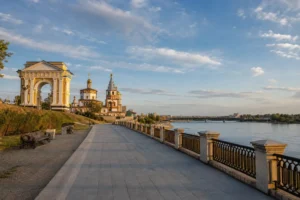 Lower Angara Embankment, Irkutsk · typical visit: 1 to 2 hours
Main image: AI-generated illustration. It may not show the place exactly as it looks.
Related guides
 130th Quarter, Irkutsk: Wooden Houses, Cafes and Window to Asia
Main image: AI-generated illustration. It may not show the place exactly as it looks.
 Harat’s Pub, Irkutsk: Where the Irish Pub Chain Began
Main image: AI-generated illustration. It may not show the place exactly as it looks.
 EDISON Craft Bar, Irkutsk: Craft Beer and Live Music Evenings
Main image: AI-generated illustration. It may not show the place exactly as it looks.
 Pyaterochka, Irkutsk: Convenience Store Chain for Visitors
Main image: AI-generated illustration. It may not show the place exactly as it looks.
 Half-Day Historic Center Itinerary, Irkutsk: A Four-Hour Walk
Main image: AI-generated illustration. It may not show the place exactly as it looks.
Browse more: More in Irkutsk (Pravoberezhny okrug, the historic center on the Angara) · All Irkutsk · All Landmarks · All Neighborhoods · All Neighborhoods in Irkutsk
FAQ: Historic City Center, Irkutsk
What is the historic center of Irkutsk?
The oldest part of the city on the right bank of the Angara, with the oldest churches, Karl Marx Street, the embankment and the 130th Quarter.
How old is Irkutsk?
It was founded in 1661 as a Cossack fort and received city status in 1686.
Why are there few old buildings?
A great fire in June 1879 destroyed most of the historic center, and it was rebuilt by the end of the century.
What is the oldest building?
The Church of the Savior, built in 1706–1710, is the oldest stone church in Eastern Siberia.
Is the center free to visit?
Yes, the streets, squares and the embankment are free. Museums have their own tickets.
How long do I need?
Two hours for the main churches and the embankment, half a day with Karl Marx Street and the 130th Quarter, and a full day with museums.
Can I walk everywhere?
Yes, the main sights are within walking distance of one another, with trams and buses on the main streets.
Is Baikal in the center?
No. The lake is about an hour's drive away, and the center is on the Angara river.
Russia Vibes is a one-person project. A coffee keeps it going
Last updated: October 14, 2026. Found an error or something out of date? Report it and we will check and fix it.
How we research and update our guides
About this guide: AI assistance and accuracy
This guide is created with the help of AI and is based on official sources where available. Mistakes can still happen. Opening hours, prices, rules and other details are given to the best of our knowledge as of the date shown and can change without notice. It offers general recommendations only, not professional, legal or travel advice. Please confirm important details with the official source before you travel; you are responsible for your own plans and decisions.
International sanctions affect payments between Russia and many other countries. In practice, cards issued in the EU, the UK, the US and several other countries often do not work in Russia, Russian cards usually do not work abroad, and some booking platforms, airlines and payment providers limit or suspend their services for Russia. The situation changes frequently. We do not give legal or financial advice, and this site does not encourage anyone to break or circumvent sanctions. Whatever you plan, you are responsible for following the laws and regulations that apply to you, including those of your country of residence and citizenship. Many travelers still organise their stay lawfully. It is worth asking your bank or payment provider what is currently permitted, contacting hotels, tour operators and carriers directly about the payment methods they accept, and checking which services are open to customers from your country. Clarify payment, cancellation and refund terms before you commit to a booking, and keep your plans flexible. Partner links on this site may not be available in every country, and prices, availability and rules in our guides can differ from what you see when you book.Paying for your trip: please read

Take this guide with you
Get a free PDF of this guide to print or read offline: key facts, tips and a map link on a few clean pages.