
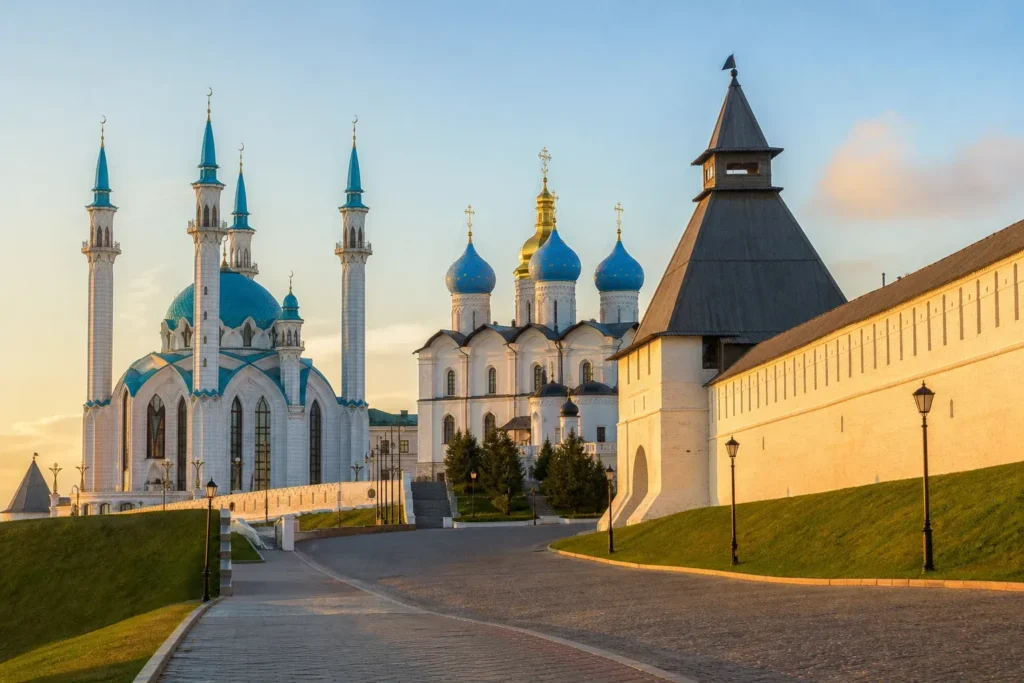
Kazan is a city where Orthodox and Islamic traditions sit side by side—sometimes literally, with mosques and churches less than 100 meters apart within the Kremlin walls. For visitors, this cultural richness requires understanding local customs that reflect both Russian and Tatar heritage. Understanding Kazan etiquette and customs starts with knowing that this is not a single set of rules but a practice of respect toward two coexisting traditions.
This guide covers what a respectful visitor needs to know before arriving at religious sites, entering homes, dining with locals, or simply moving through public spaces. Learning a few customs makes the difference between a tense encounter and a warm welcome—Kazan residents appreciate visitors who show respect for their city’s unique balance.
Quick answer: Respect dress codes at mosques (women cover hair, shoulders and knees) and churches (closed shoes, modest clothing). Use formal titles with strangers, remove shoes when invited to homes, avoid smiling at strangers in public (it's normal Russian behavior), never shake hands across a doorway, and bring a gift when visiting a home. The core principle across Kazan is showing deference to older people, religious traditions, and the local custom of multicultural coexistence.
At a Glance
| Total time | Core rules take moments to apply; planning ahead (gifts, modest clothing) takes 10–15 minutes |
|---|---|
| Typical cost | free |
| Last updated | October 18, 2026 |
What You Need Before You Start
- Modest, closed clothing for visiting religious sites
- Headscarf or scarf (provided free at mosques if needed)
- Understanding of formal address (surnames and titles until invited otherwise)
- Small gift if invited to a Russian home (flowers, wine, chocolates, or sweets)
- Awareness that Kazan is split between Muslim Tatar and Orthodox Russian cultures—both are equally respected
Compare Your Options
| Option | Duration | Price | Notes |
|---|---|---|---|
| Learn core etiquette rules before arrival (recommended) | 10–15 minutes of reading plus adaptation during your stay | Free | This approach lets you move through Kazan with confidence and avoid awkward moments. You will understand dress codes, formal address, and home customs in advance, which shows respect and improves your interactions. This is the recommended option for any visitor planning to visit homes, dine with locals, or spend more than a day in the city. |
| Learn etiquette on the go by observing and asking locals | varies; trial and error throughout your stay | Free | Some visitors prefer to learn by watching how locals behave and asking questions when uncertain. This works for public spaces but leaves you vulnerable to mistakes at religious sites or in homes. Locals generally forgive visitors who are clearly trying but may view carelessness as disrespectful. Suitable for brief, tourist-focused visits, but less ideal if you want to build genuine connections. |
| Hire a local guide who explains customs as you go | varies by tour length (typically 3–8 hours) | ₽₽ | A professional guide can explain etiquette in real time, navigate both Russian and Tatar traditions, and provide context for what you are seeing. This is especially valuable if you plan to visit both mosques and churches, dine at a family-run restaurant, or meet with locals. Guides can also alert you to current sensitivities or local events that affect behavior. |
| Attend a cultural orientation workshop (if available) | 1–2 hours | ₽ | Some cultural centers or tour operators in Kazan offer short orientations on Russian and Tatar customs. These are rare but valuable if you are planning an extended stay or a business visit. Check with your hotel or the Kazan tourism office for current offerings. |
₽ budget · ₽₽ moderate · ₽₽₽ upscale · ₽₽₽₽ splurge. Price levels are estimates compared with typical prices for visitors.
Step-by-Step Instructions
Step 1: Understand Kazan's dual culture before you arrive
Kazan is roughly half ethnic Tatar (mostly Muslim) and half ethnic Russian (mostly Orthodox Christian). The city is famous for peaceful coexistence of these traditions. Expect to see muezzin calls from mosques followed by church bells. Learn that both cultures are equally valued and equally sensitive to disrespect. Know that some visitors' previous experience with Russian cities may not prepare them for the specific Islamic traditions visible here—headscarves are common among women, and mosques are active places of worship, not just tourist sites.
Tip: Download offline maps with labels in both Cyrillic and Latin script. Many signs in the Old Tatar Quarter use Tatar as well as Russian, and understanding what you are looking at helps you navigate with respect.
Step 2: Dress modestly at religious sites from the moment you enter
For mosques: women must cover shoulders, knees and hair. Scarves are provided free at the entrance if you arrive without one. Men should wear long pants and closed shoes. For Orthodox churches: remove hats, wear closed shoes, and cover shoulders and knees. Immodest clothing (shorts, sleeveless shirts, transparent fabrics) will be noticed and may result in you being offered a wrap or being asked to leave. Plan your outfit before entering, not after—turning back to change is disruptive to worshippers inside.
Tip: Bring a lightweight scarf in your bag even if you think you will not need it. The Kul Sharif Mosque and major churches require them; carrying one means you are never caught off guard.
Step 3: Use formal address and surnames until invited to do otherwise
Address people as Mr./Ms. (Mr./Ms. + surname) or by their formal title until they invite you to use their first name. This applies in shops, with guides, at restaurants, and in any conversation with someone you have just met. Calling a stranger by a nickname or using informal pronouns is disrespectful. In Kazan, where formality is mixed with warmth, this gesture is noticed and appreciated.
Tip: If someone tells you their name is 'Dmitri Ivanov,' you address them as 'Dmitri Ivanovich' (using the patronymic form) or simply 'Mr. Ivanov.' When they say 'call me Dmitri,' you may then switch to the first name. Staff at hotels and restaurants are addressed formally unless they suggest otherwise.
Step 4: Never smile at strangers in public—it is not rudeness, it is the cultural norm
Russians and Tatars do not smile at strangers on the street, in the metro, or in cafés. This is not an expression of unfriendliness but a normal, neutral expression. Smiling is reserved for friends and genuine moments of warmth. A visiting foreigner who smiles constantly at strangers may be perceived as either naive or false. Expect serious faces and do not interpret them as hostility. Locals are quick to help if you actually need assistance; their seriousness does not mean coldness.
Tip: Adapt to the local expression rather than trying to change it. You will feel more natural and will blend in better. When you do smile—at a friend, a shopkeeper who helps you, or someone who makes a joke—it carries real weight.
Step 5: Never shake hands across a threshold or through a doorway
In Russian tradition, shaking hands, hugging, kissing, or passing important items across a threshold is considered bad luck or improper. The doorway symbolizes a boundary between outside and inside, public and private. If you are greeting someone who arrives at a door or leaving a home, wait until you or they are fully inside or outside the threshold before greeting them. This rule applies in homes, offices, shops, and museums.
Tip: If you almost shake hands across a doorway and realize the mistake, a polite nod and smile works just as well. Locals will understand if you accidentally break this rule once; the key is not to repeat it.
Step 6: Remove your shoes when invited into a Russian home
Removing outdoor shoes is not optional; it is an absolute requirement in nearly all Russian homes. Russian apartments are kept scrupulously clean, and outdoor shoes are considered contaminated by principle—especially in winter when streets are treated with salt or mud. Your host will offer you slippers (called tapochki) to wear inside. Accept them without hesitation. Walking through a Russian home in your street shoes will produce an immediate and firm correction.
Tip: Wear socks or hose in good condition. Wear shoes that are easy to remove (laces take time; slip-ons are ideal). If you are uncomfortable showing your feet, wear closed socks.
Step 7: Bring a gift if invited to a home; follow the flower rule carefully
Never arrive empty-handed. The minimum acceptable gift is a box of chocolates, a cake, a bottle of wine, or good spirits. Flowers are traditional and well-received, but observe this rule strictly: always bring an odd number of flowers. Even numbers are reserved for funerals and are deeply inauspicious. Avoid yellow flowers, as they symbolize separation or farewell. A bouquet of three, five, or seven flowers is perfect.
Tip: Supermarkets near tourist areas sell ready-made gift sets (chocolates, wines, flowers) if you have limited time. A small, tasteful gift shows respect and is far better than arriving empty-handed, which is considered rude.
Step 8: At the table, wait for your host to begin eating and understand the generosity
When invited to a Russian meal, do not start eating until your host begins. A Russian host intentionally places more food on the table than anyone could reasonably eat—this is a sign of respect for the guest and a way of saying 'feel free to eat as much as you like.' Try a little of everything offered. Refusing food can be seen as rude or insulting; polite acceptance is expected. If you have dietary restrictions, mention them in advance so the host can plan accordingly.
Tip: Leaving some food on your plate is acceptable; completely cleaning it is not necessary. The host will worry if you seem to leave hungry, so accept a second helping graciously or clearly signal you have had enough.
Step 9: Understand toasts and alcohol etiquette if you drink
Toasts are a central part of Russian hospitality. When someone makes a toast (especially with vodka or wine), you are expected to listen respectfully and participate. It is considered rude to refuse a toast entirely, though you can politely decline the alcohol itself and participate with water or juice. Never pour your own drink; wait for others to pour for you, and be ready to pour for them in return. Taking a sip after each toast is normal.
Tip: If you do not drink alcohol, say so politely in advance. Hosts will respect this and have alternatives ready. Do not make a show of it; simply say 'I don't drink' or 'I prefer not to,' and move forward.
Step 10: Show visible respect for war monuments and ask permission before taking photos
The memory of World War II (called the Great Patriotic War in Russia) is sacred to many Russians and Tatars. Do not joke about or take frivolous photos at war memorials. Always ask permission before photographing people, religious sites, private spaces, or official buildings. In mosques and churches, photography is often prohibited or restricted to certain areas; look for signs or ask staff. Respecting privacy is crucial to maintaining good relations.
Tip: When in doubt, ask. A simple 'May I take a photo?' shows courtesy and often results in a yes, a friendly correction, or an offer to take a better photo for you.
Common Mistakes to Avoid
- Smiling at strangers constantly. Visitors often expect smiling to be universal politeness, but in Kazan (as in Russia generally), smiling at strangers reads as strange or insincere. Neutral expressions are the norm; save smiles for people you know or genuine moments of warmth. This single adjustment will help you blend in immediately.
- Showing up at a mosque or church in shorts or sleeveless clothing, then expecting to borrow a wrap. Some sites provide wraps, but this puts staff in an awkward position and slows your entry. Dress modestly before you arrive. If you are unsure, bring a scarf and long pants or a skirt in your bag—this takes seconds and shows respect.
- Shaking hands across a doorway or threshold. Even if someone extends their hand across a door frame, step inside or outside the threshold first. This is so deeply rooted in Russian culture that locals notice immediately. If you catch yourself mid-handshake, it is fine—laugh it off and greet them on the correct side of the door.
- Refusing food or drink when offered, or eating before your host begins. In Russian homes, refusing food can be taken as an insult to the host's generosity. Even if you are not hungry, accept a small portion and eat with them. This is not about the food; it is about showing respect for their effort.
- Bringing an even number of flowers or yellow flowers to a home. Three, five, or seven flowers only. Even numbers and yellow flowers are associated with funerals and are considered deeply unlucky. This is a hard rule in Russian culture and applies in Kazan regardless of the background of your host.
- Using first names with strangers or formal acquaintances. Until invited to use a first name, address people formally (Mr./Ms. or by title + surname). This is especially important with shopkeepers, guides, and anyone you have just met. Formal address is a sign of respect, not coldness, and Kazan residents appreciate it.
- Taking photos of people, religious sites, or war monuments without asking. Photography is restricted in some mosques and churches. Always ask 'May I take a photo?' This courtesy often leads to permission, helpful suggestions about the best angles, or a local volunteer offering to take a better photo for you.
Tickets, Payment and Booking
Etiquette and customs are free to learn and apply. No tickets, apps, or special bookings are needed. The information in this guide is based on widely documented Russian and Tatar social norms that apply across Kazan.
Where to learn more:
- Ask staff at your hotel or guesthouse for advice specific to your plans (visiting a home, dining with locals, visiting religious sites).
- Hire a local guide through your hotel or a tourism office if you want real-time cultural coaching.
- Observe how locals behave in public spaces (metro, shops, streets) and adapt your own demeanor accordingly.
No currency exchanges or special preparations are required. The cost of following these customs is zero; the benefit is improved interactions and a deeper, more respectful experience of the city.
Russia Vibes Tips
- Kazan is a city of two call times: the muezzin's call to prayer from mosques and church bells. Hearing both at different times of day is normal and intentional. Rather than being jarring, it is a sound map of the city's coexistence. Learn to recognize and appreciate both.
- If you are invited to a Tatar home, your host may serve tea and traditional sweets (like chak-chak) rather than a full meal. Accepting and enjoying these is a sign of respect for the tradition. Do not be polite and refuse; partake genuinely.
- Punctuality is important in Russian culture. Arriving on time or slightly early for social gatherings shows respect. Being late is seen as disrespectful to your host, even if the culture is otherwise informal.
- When passing items (money, change, documents) in shops or with strangers, use both hands or your right hand only. Using one hand or your left hand alone is considered disrespectful. This applies to gifts, payments, and any formal exchange.
- If you are using public transport (marshrutkas or buses), money is passed hand-to-hand forward to the driver and change comes back the same way. This is normal; do not be surprised by the chain of hands. It is also the accepted etiquette.
- Kazan has about 60 mosques and 60 churches—nearly equal. If you visit one tradition's site, consider visiting the other to understand the balance. Staff at both will be warm to respectful visitors who are genuinely curious.
Explore Nearby Understanding Kazan etiquette and customs, Kazan
Sights near Understanding Kazan etiquette and customs, Kazan
 Kazan Kremlin · typical visit: 2–4 hours2 min on foot from Kremlyovskaya, Kazan metro, Open 24 hours
Main image: AI-generated illustration. It may not show the place exactly as it looks.
 Kul Sharif Mosque, Kazan · typical visit: 1–2 hours6 min on foot from Kremlyovskaya, Kazan metro, Open daily 08:00–20:00
Main image: AI-generated illustration. It may not show the place exactly as it looks.
 Bauman Street, Kazan · typical visit: 1.5–3 hours7 min on foot from Kremlyovskaya, Kazan metro, Open 24 hours
Main image: AI-generated illustration. It may not show the place exactly as it looks.
Related guides
 Walking Old Tatar Sloboda, Kazan: Mosques, Museums and a 3-Hour Route
Main image: AI-generated illustration. It may not show the place exactly as it looks.
 Two Days in Kazan: Kremlin, Old Tatar Settlement and Views
Main image: AI-generated illustration. It may not show the place exactly as it looks.
 Using public transport in Kazan, Kazan: Metro, Trams and How to Pay
Main image: AI-generated illustration. It may not show the place exactly as it looks.
Browse more: All Etiquette and Safety · All How-To · All How-To in Kazan · All Kazan
FAQ
Do I have to cover my hair in every mosque in Kazan?
Hair coverage is required or strongly preferred in active mosques, especially the Kul Sharif Mosque inside the Kremlin. Scarves are provided free at the entrance if needed. Some smaller or historical mosques may have different rules; ask staff upon arrival. Women visiting Orthodox churches do not need to cover hair, but shoulders and knees must be covered.
What if I refuse food when invited to a Russian home?
Refusing food is seen as insulting to the host and their effort. Even if you are not hungry, accept at least a small portion and eat with them. If you have dietary restrictions or allergies, mention them in advance so the host can plan accordingly. Simply saying 'I am not hungry' after the host has cooked is considered rude.
Can I bring an even number of flowers or yellow flowers as a gift?
No. Even numbers of flowers and yellow flowers are associated with funerals and are deeply unlucky in Russian culture. Always bring an odd number (three, five, seven) and avoid yellow. This rule applies regardless of the age, background, or beliefs of your host.
Is it okay to smile at people on the street?
Smiling at strangers in public is not customary in Russia or Kazan. A neutral or serious expression is normal and does not indicate unfriendliness. Save smiles for friends and genuine moments. Smiling constantly at strangers may be perceived as naive or insincere rather than polite.
What if I accidentally shake hands across a doorway?
Step inside or outside the threshold and greet them on the correct side of the door. Locals will understand if it is a one-time mistake. This is a traditional rule with deep cultural roots, but an accidental breach can be laughed off with good humor.
Do I need formal training to understand Kazan etiquette?
No. Reading this guide and observing how locals behave is sufficient. You do not need formal classes. The key is showing genuine respect for religious sites, older people, and the city's dual cultural traditions. Locals appreciate visitors who make an effort, and minor mistakes are forgiven if your intention is clear.
Is photography allowed in all mosques and churches?
Photography rules vary by site. Some mosques and churches prohibit photos entirely, while others allow them in certain areas. Always ask staff or look for signs before taking photos. Never photograph worshippers or people praying without explicit permission. Asking 'May I take a photo?' shows courtesy and usually results in a yes or friendly guidance.
What is the difference between Tatar and Russian customs in Kazan?
Tatars are predominantly Muslim; Russians are predominantly Orthodox Christian. Both groups live in Kazan side by side and observe similar secular social norms (formality, punctuality, respect for elders, hospitality). Religious customs (dress codes, prayer times, holiday observances) differ, but both are equally respected in the city. Visitors should approach both traditions with equal respect.
Russia Vibes is a one-person project. A coffee keeps it going
Last updated: October 18, 2026.
How we research and update our guides
About this guide: AI assistance and accuracy
This guide is created with the help of AI and is based on official sources where available. Mistakes can still happen. Opening hours, prices, rules and other details are given to the best of our knowledge as of the date shown and can change without notice. It offers general recommendations only, not professional, legal or travel advice. Please confirm important details with the official source before you travel; you are responsible for your own plans and decisions.
International sanctions affect payments between Russia and many other countries. In practice, cards issued in the EU, the UK, the US and several other countries often do not work in Russia, Russian cards usually do not work abroad, and some booking platforms, airlines and payment providers limit or suspend their services for Russia. The situation changes frequently. We do not give legal or financial advice, and this site does not encourage anyone to break or circumvent sanctions. Whatever you plan, you are responsible for following the laws and regulations that apply to you, including those of your country of residence and citizenship. Many travelers still organise their stay lawfully. It is worth asking your bank or payment provider what is currently permitted, contacting hotels, tour operators and carriers directly about the payment methods they accept, and checking which services are open to customers from your country. Clarify payment, cancellation and refund terms before you commit to a booking, and keep your plans flexible. Partner links on this site may not be available in every country, and prices, availability and rules in our guides can differ from what you see when you book.Paying for your trip: please read
Report an issue on this page

Take this guide with you
Get a free PDF of this guide to print or read offline: key facts, tips and a map link on a few clean pages.