
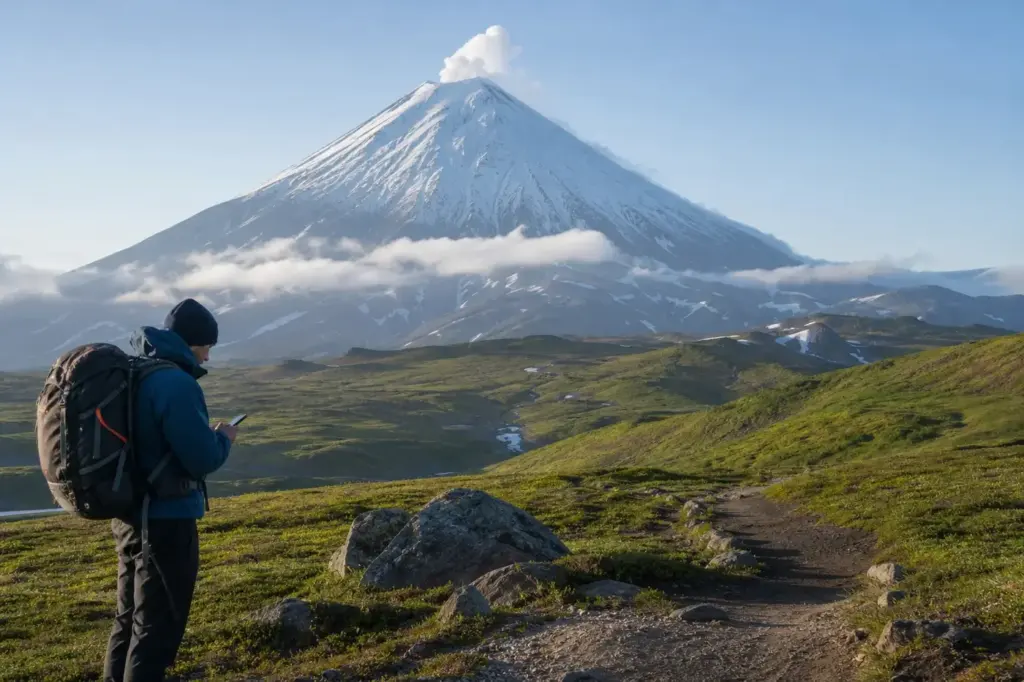
This guide shows how to check volcano activity and trail closures in Kamchatka before you hike or book a tour. It is for visitors who want to understand alert levels, find official information and decide whether a route is open.
The recommended approach is to check the official volcano monitoring information, ask your operator and the park office, and recheck on the morning of the hike. The steps below explain how to read alert levels and what to do if conditions change, and the options compare the main sources. Read the steps in order, note the questions to ask and keep a spare day in your plan, because weather in Kamchatka changes quickly and plans often need to move.
Quick answer: Check the official volcano monitoring colour code, ask your operator and the park office about trail status, and recheck on the morning of your hike. Conditions can change within hours.
At a Glance
| Total time | About 15 minutes the day before and again on the morning |
|---|---|
| Typical cost | Free |
What You Need Before You Start
- A phone with internet access or an eSIM
- The name of the volcano and the route
- Your operator's contact details
- Knowledge of the aviation colour code
- A flexible schedule for closures
Compare Your Options
| Option | Duration | Price | Notes |
|---|---|---|---|
| Official monitoring information | Few minutes | Free | The most reliable source for alert levels and notices. Best for understanding the situation. |
| Your operator or guide | Few minutes | Free | Local knowledge about trails, closures and conditions. Best for practical decisions. |
| Park or reserve office | Few minutes | Free | Official trail status and rules for protected areas. Best for permits and closures. |
| Hotel or local contacts | Few minutes | Free | Useful for local news and transport. Not a substitute for official information. |
| Weather services | Few minutes | Free | Forecasts for wind, cloud and rain. Best for deciding the day. |
₽ budget · ₽₽ moderate · ₽₽₽ upscale · ₽₽₽₽ splurge. Price levels are estimates compared with typical prices for visitors.
Step-by-Step Instructions
Step 1: Identify the volcano and route
Write down the volcano, the trailhead and the planned route. Different volcanoes have different monitoring and park rules, so you need the correct name before you search. If you are unsure which area a trail belongs to, ask your operator or hotel.
Tip: Keep the names in both English and Russian.
Step 2: Find the official monitoring information
Volcano activity in Kamchatka is monitored by official scientific teams, which publish alert levels and updates, often called the aviation colour code. Look for the official monitoring page of the Kamchatka volcano response team and use its current notices rather than social media posts. Ask your operator for the exact source.
Tip: Do not rely on unofficial posts or screenshots.
Step 3: Read the colour code
The aviation colour code runs from green, meaning quiet, to yellow, orange and red for increasing activity. Green and yellow are common; orange and red mean a more serious situation. A higher level does not always mean closure, but it should make you ask your guide. Read the explanation text, not just the colour.
Tip: Ask the guide what the current level means for your route.
Step 4: Check the weather
Check the forecast for the volcano, not just the city. Wind, cloud and rain can close routes on the day and affect safety. Look at the next day and the trend. If the forecast is poor, move the hike or the helicopter flight to another day.
Tip: Check the forecast in the morning and the evening before.
Step 5: Ask the operator and the park office
Operators and park offices know which trails are open and what the current rules are. Ask whether the route is open, whether any area has been closed and what the alternative is. If you hike independently, ask the park or local authority about registration and closures.
Tip: Ask for the answer in writing if it affects your booking.
Step 6: Recheck on the morning
Check the monitoring information and the weather again on the morning of your trip. Activity can change overnight, and closures can be announced at short notice. If the guide cancels or changes the route, accept the decision. Ask your guide or operator for the current details before you set out.
Tip: Keep a flexible plan with a spare day.
Step 7: Have a fallback plan
If a trail is closed or activity is raised, have an alternative: another route, a viewpoint, a hot spring or a day in the city. Do not push on because you travelled far. Staying flexible is the safest and cheapest option.
Tip: Keep a list of alternative activities.
Common Mistakes to Avoid
- Relying on unofficial posts or old screenshots.
- Checking only the city weather and not the volcano.
- Ignoring a raised alert level because the sky looks clear.
- Not rechecking on the morning of the hike.
- Assuming a trail is open because it was open last week.
Tickets, Payment and Booking
Information on volcano activity and trail closures is free and does not need a ticket. Use official monitoring pages, park offices and your operator.
- Where: the official volcano monitoring page, the park or reserve office and your licensed local operator.
- Payment: nothing to pay for information. For tours, cards issued outside Russia do not work, so ask which methods the operator accepts for visitors and plan cash.
- Warnings: do not rely on unofficial posts, screenshots or paid advice that cannot name its source.
Confirm routes and rules before you set out.
Russia Vibes Tips
- Save the monitoring page and your operator's number offline; coverage can drop on the slopes.
- Check the information the evening before and again at breakfast; closures are often announced early.
- Ask what the colour code means for your specific route, not just in general.
- Take a screenshot of the notice in case coverage drops.
- Treat the colour code as one input; weather and ground conditions matter as much.
- If you hike independently, tell someone your route and return time.
Explore Nearby How to Check Volcano Activity and Trail Closures in Kamchatka, Kamchatka Peninsula
Browse more: All Etiquette and Safety · All How-To · All How-To in Kamchatka Peninsula · All Kamchatka Peninsula
FAQ
What does the aviation colour code mean?
It is a scale from green to red used to inform aviation and the public about volcano activity. Green means quiet, yellow means raised activity, orange means a higher risk and red means an eruption or a serious threat. Read the explanation text with the colour.
Where can I find official information?
Use the official volcano monitoring page of the Kamchatka response team and the notices of the park or reserve. Your operator can tell you which source to use. Avoid unofficial posts and screenshots. Ask your guide or operator for the current details before you set out.
Does a yellow level mean the trail is closed?
Not necessarily. Yellow is common and often does not close trails, but it should make you ask your guide about the situation. Closures depend on the specific volcano, the route and the park rules. Ask your guide or operator for the current details before you set out.
Who decides whether a trail is closed?
Park and reserve authorities and local authorities decide, based on safety and monitoring information. Your guide and operator will tell you what is open. Follow their decision. Ask your guide or operator for the current details before you set out.
Can I check activity in English?
Some official pages and notices provide English information, but not always. Ask your operator for the exact source and use a translation tool if needed. Always read the explanation text carefully. Ask your guide or operator for the current details before you set out.
What if the trail closes after I book?
Ask the operator in advance about changes, credits and refunds. Many operators offer another route or another day. Keep spare days in your plan so a closure does not break your trip. Ask your guide or operator for the current details before you set out.
How often should I check?
The evening before and again on the morning of your hike. Activity and weather can change overnight, and closures can be announced at short notice. Check again if your plans change. Ask your guide or operator for the current details before you set out.
Is the information free?
Yes. Official monitoring information and park notices are free to read. You pay only for tours and permits arranged through operators. Confirm what your tour includes. Ask your guide or operator for the current details before you set out. Conditions change quickly, so keep a spare day in your plan.
Russia Vibes is a one-person project. A coffee keeps it going

Take this guide with you
Get a free PDF of this guide to print or read offline: key facts, tips and a map link on a few clean pages.
Report an issue on this page
Paying for your trip: please read
Payments and bookings between Russia and many other countries are currently restricted. In practice, cards issued in the EU, the UK, the US and several other countries often cannot be used in Russia, Russian cards usually cannot be used abroad, and some booking platforms, airlines and payment providers limit or pause their services for Russia. The situation changes frequently.
We do not give legal or financial advice, and this site does not encourage anyone to break any rule that applies to them. Whatever you plan, you are responsible for following the laws and regulations that apply to you, including those of your country of residence and citizenship.
Many travelers still organise their stay without problems. It is worth asking your bank or payment provider what is currently possible, contacting hotels, tour operators and carriers directly about the payment methods they accept, and checking which services are open to customers from your country. Clarify payment, cancellation and refund terms before you commit to a booking, and keep your plans flexible.
Partner links on this site may not be available in every country, and prices, availability and rules in our guides can differ from what you see when you book.
How we research and update our guides
About this guide: AI assistance and accuracy
This guide is created with the help of AI and is based on official sources where available. Mistakes can still happen. Opening hours, prices, rules and other details are given to the best of our knowledge as of the date shown and can change without notice. It offers general recommendations only, not professional, legal or travel advice. Please confirm important details with the official source before you travel; you are responsible for your own plans and decisions.
* Affiliate link: as an Amazon Associate we earn from qualifying purchases at no extra cost to you.