
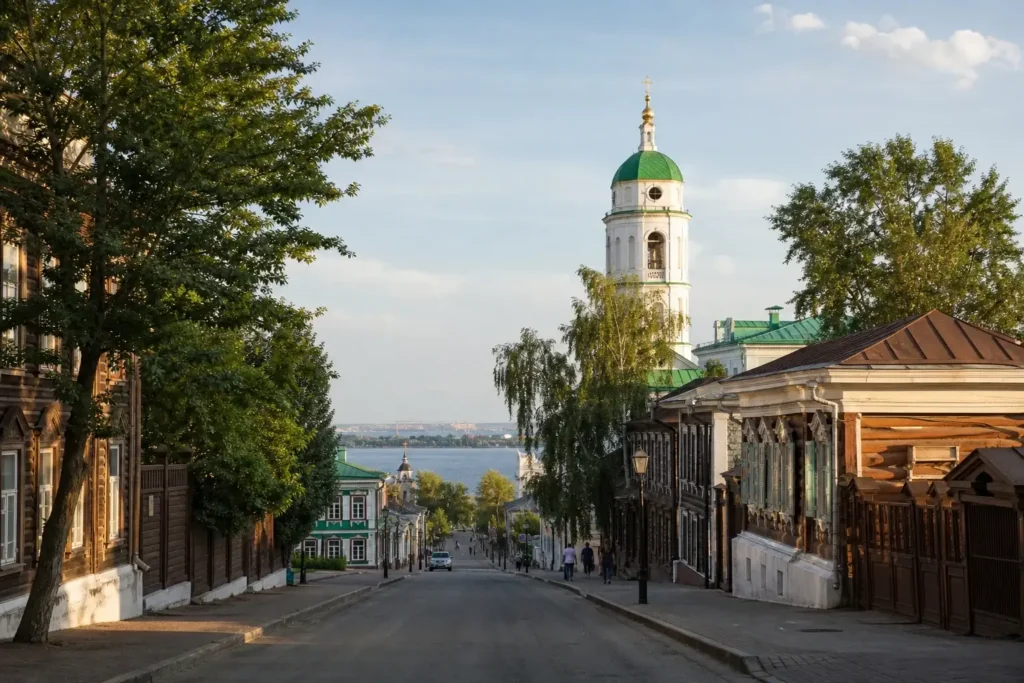
The Green Line Self-Guided Walking Tour, Irkutsk, is a tourist route through the historic center that you follow on your own, without a guide. It starts at the Alexander III Monument on the bank of the Angara and ends near the 130th Quarter at Holy Cross Church, passing churches, museums, monuments and old merchant houses on the way. This guide picks ten stops along the route and puts them in walking order.
The whole route is about five kilometres and links around thirty sights, so it can take anywhere from a couple of hours to a full day, depending on how many museums you enter. Use the ten entries as a shorter version: walk the whole line and go inside only where you are curious.
At a Glance
| # | Place | Best for | Good to know |
|---|---|---|---|
| 1 | Alexander III Monument, Irkutsk | Start of the route | Right bank of the Angara, historic center; free to see. |
| 2 | Lower Angara Embankment, Irkutsk | Best river stretch | Right bank, historic center; free and open all day. |
| 3 | Epiphany Cathedral, Irkutsk | Best Siberian Baroque | Sukhe-Bator Street, near the Angara; free to enter, check service times and dress modestly. |
| 4 | Church of the Savior, Irkutsk | Oldest stone building | North of Kirov Square near the Angara; check the official source for opening hours. |
| 5 | Kirov Square, Irkutsk | Green heart of the center | Historic center; free, with cafes and museums within a short walk. |
| 6 | Irkutsk Regional Art Museum | Best indoor stop | Lenin Street, historic center; paid, check the official site for hours and closed days. |
| 7 | Karl Marx Street, Irkutsk | Best old-town street | Historic center, right bank; free to walk. |
| 8 | Irkutsk Regional Museum of Local Lore | Best for regional history | Karl Marx Street, historic center; paid, check the official source for hours. |
| 9 | Holy Cross Church, Irkutsk | End of the route | Sedova Street, historic center; free to see, check service times for the interior. |
| 10 | 130th Quarter, Irkutsk | Best finish for dinner | Sedova Street area, southern historic center; free to walk, with paid cafes inside. |
How We Chose
The entries are based on the route’s start and end points and on well-known sights in the historic center that lie on or beside it. We did not walk it for this list, and we have not confirmed every stop against an official route map.
- Walking order: entries follow the direction of the route, from the river to the 130th Quarter, so you can use the list as a sequence.
- Variety: monuments, a square, churches, museums and a restored district, so the walk does not feel repetitive.
- Operating places: each entry is a named place that normally welcomes visitors.
Hours and ticket rules change, so check the official source of each museum or church before you go.
1. Alexander III Monument, Irkutsk – Start of the route
The route begins in a small square on the bank of the Angara, where Karl Marx Street reaches the water. The monument honors the emperor under whom the Trans-Siberian Railway was started, a link that helped turn Irkutsk into a major Siberian city. Stand here first to get your bearings: the river is on one side and the old town opens up behind you.
Good to know: Right bank of the Angara, historic center; free to see.
Tip: Take your first photo here in the morning, when the square is usually quiet.
2. Lower Angara Embankment, Irkutsk – Best river stretch
A riverside promenade close to the start of the route. The Angara is wide and cold even in summer, and the open view across the water gives the first stretch of the walk a spacious feel. Nearby you can find the Monument to the Founders of Irkutsk and the Russia Gate, which are easy additions if you want a longer riverside loop.
Good to know: Right bank, historic center; free and open all day.
Tip: The wind off the river is colder than in the streets behind it, so keep a layer in your bag.
3. Epiphany Cathedral, Irkutsk – Best Siberian Baroque
A working cathedral in the oldest part of the city, built in the early eighteenth century. Its patterned brick walls, tiered bell tower and decorated window frames are typical of the Siberian Baroque style. Step inside for the painted interior, or simply walk around the outside to see how the building changes in different light.
Good to know: Sukhe-Bator Street, near the Angara; free to enter, check service times and dress modestly.
Tip: Visit outside service times for a quiet look, or stand at the back to hear the choir.
4. Church of the Savior, Irkutsk – Oldest stone building
A small white church standing in a garden, the oldest surviving stone building in the city. It came through the great fire of 1879, which destroyed much of old Irkutsk. Its thick walls and plain decoration are a useful contrast to the richer cathedral nearby, so the two make a natural pair on the walk.
Good to know: North of Kirov Square near the Angara; check the official source for opening hours.
Tip: Look at both churches back to back and compare how plain and how decorated Siberian church architecture can be.
5. Kirov Square, Irkutsk – Green heart of the center
The main square of the historic center, lying between Lenin Street and Sukhe-Bator Street on the site of the old fort. It is a good place to sit down mid-walk, with trees, benches and a view of the buildings that surround it. In winter it is where the city puts up its New Year tree and ice town.
Good to know: Historic center; free, with cafes and museums within a short walk.
Tip: Use the square as your rest stop, since it sits near the middle of the route.
6. Irkutsk Regional Art Museum – Best indoor stop
The main art museum of the city, named after Vladimir Sukachev and often called the first art gallery beyond the Urals. It is a good choice if the weather turns or if you want a break from walking. The collection gives a picture of Russian and regional art and of how a Siberian city built its own cultural life.
Good to know: Lenin Street, historic center; paid, check the official site for hours and closed days.
Tip: Pick one museum for the day rather than several, or the route will stretch far beyond a few hours.
7. Karl Marx Street, Irkutsk – Best old-town street
The main street of the old town runs toward the river and is the best single walk for getting a feel for the historic center. Along it you see wooden and stone houses, a regional museum and cafes. The route crosses and follows it in places, so it works as a useful thread connecting several stops.
Good to know: Historic center, right bank; free to walk.
Tip: Walk it toward the Angara so the river opens up at the end.
8. Irkutsk Regional Museum of Local Lore – Best for regional history
The oldest museum in Siberia, with its main building on Karl Marx Street. It shows the nature, peoples and history of the region, which helps explain why Irkutsk grew where it did. If you want one museum that frames everything else on the walk, this is a good choice.
Good to know: Karl Marx Street, historic center; paid, check the official source for hours.
Tip: Visit early in the walk if you want context for the later stops.
9. Holy Cross Church, Irkutsk – End of the route
A Siberian Baroque church on a small hill on Sedova Street, opposite the 130th Quarter. It marks the end of the Green Line, so reaching it feels like a natural finish. From the foot of the hill you look across to the wooden roofs of the quarter below.
Good to know: Sedova Street, historic center; free to see, check service times for the interior.
Tip: Walk up the hill for the view back over the quarter before you cross the street.
10. 130th Quarter, Irkutsk – Best finish for dinner
A district of restored and rebuilt wooden houses just beyond the end of the route. Only a few buildings are genuine monuments, so treat it as a lively reconstruction of the old town. A bronze Babr, the beast from the city's coat of arms, stands near the entrance, and there are cafes and restaurants for a meal after the walk.
Good to know: Sedova Street area, southern historic center; free to walk, with paid cafes inside.
Tip: Plan the walk so you arrive here toward evening and eat on the spot.
Russia Vibes Tips
- Start at the Angara and walk away from the river. The route is built that way, and you finish near the restaurants of the 130th Quarter rather than at the water.
- Keep the route light on museums. Entering even a few makes the day much longer than the walking itself.
- Carry a paper or offline map from the tourist information office or a phone map, because the markings on the ground can fade.
- Wear comfortable shoes. Some pavements in the old town are uneven, and wooden sidewalks can be slippery after rain or snow.
- Choose your season. Summer evenings and clear winter days both work, but spring and autumn can change quickly, so check the forecast.
- Combine the walk with a festival. During events such as Irkutsk City Day the center is busier, which adds atmosphere but slows the route.
Explore Nearby Green Line Self-Guided Walking Tour, Irkutsk
Sights near Green Line Self-Guided Walking Tour, Irkutsk
 Kirov Square, Irkutsk · typical visit: 30 to 60 minutes
Main image: AI-generated illustration. It may not show the place exactly as it looks.
 Karl Marx Street, Irkutsk · typical visit: 1 to 2 hours
Main image: AI-generated illustration. It may not show the place exactly as it looks.
 Lower Angara Embankment, Irkutsk · typical visit: 1 to 2 hours
Main image: AI-generated illustration. It may not show the place exactly as it looks.
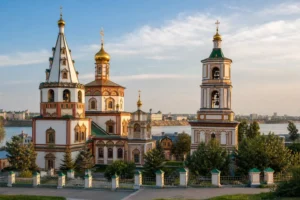 Epiphany Cathedral, Irkutsk · typical visit: 30 to 60 minutes
Main image: AI-generated illustration. It may not show the place exactly as it looks.
Related guides
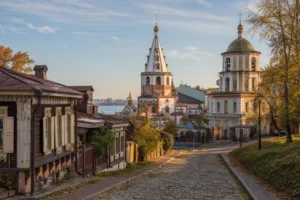 Historic City Center, Irkutsk: Churches, Squares and Wooden Houses
Main image: AI-generated illustration. It may not show the place exactly as it looks.
 130th Quarter, Irkutsk: Wooden Houses, Cafes and Window to Asia
Main image: AI-generated illustration. It may not show the place exactly as it looks.
Browse more: All Culture Lists · All Guides · All Guides in Irkutsk · All Irkutsk
FAQ
What is the Green Line in Irkutsk?
It is a self-guided tourist route through the historic center, about five kilometres long, passing churches, museums, monuments and old houses. It begins at the Alexander III Monument on the Angara and ends near the 130th Quarter.
How long does the Green Line take?
Walking without long stops takes a few hours. If you enter museums and churches or stop for lunch, it can fill a whole day. Decide in advance how many interiors you want to see and plan around them.
Do I need a guide for the Green Line?
No. The route is designed for independent walking, and most sights can be recognized on your own. A guide is useful only if you want deeper history, which you can arrange locally.
Is the route marked on the ground?
The route is described as a marked line, but the marking can fade or change. Use a map from the tourist information office or a phone map as a backup, and ask locally if you are unsure of the direction.
Where does the Green Line start and end?
It starts at the Alexander III Monument on the bank of the Angara and ends at Holy Cross Church near the 130th Quarter. Walking in that direction means you finish near restaurants.
Is the Green Line suitable for children?
Yes for older children, as the stops are short and varied, but five kilometres is long for small ones. Focus on the monuments, the embankment and the 130th Quarter, and skip interiors to save energy.
Can I do the Green Line in winter?
Yes, but dress very warmly, because the river wind is cold. Shorten the walk and plan indoor stops at museums or cafes. Daylight is short, so start early.
Are the stops free?
Walking the route and seeing the monuments, streets and exteriors is free. Museums have their own tickets, and churches may be free to enter. Check each official source before you go.
Russia Vibes is a one-person project. A coffee keeps it going
Last updated: October 14, 2026. Found an error or something out of date? Report it and we will check and fix it.
How we research and update our guides
About this guide: AI assistance and accuracy
This guide is created with the help of AI and is based on official sources where available. Mistakes can still happen. Opening hours, prices, rules and other details are given to the best of our knowledge as of the date shown and can change without notice. It offers general recommendations only, not professional, legal or travel advice. Please confirm important details with the official source before you travel; you are responsible for your own plans and decisions.
International sanctions affect payments between Russia and many other countries. In practice, cards issued in the EU, the UK, the US and several other countries often do not work in Russia, Russian cards usually do not work abroad, and some booking platforms, airlines and payment providers limit or suspend their services for Russia. The situation changes frequently. We do not give legal or financial advice, and this site does not encourage anyone to break or circumvent sanctions. Whatever you plan, you are responsible for following the laws and regulations that apply to you, including those of your country of residence and citizenship. Many travelers still organise their stay lawfully. It is worth asking your bank or payment provider what is currently permitted, contacting hotels, tour operators and carriers directly about the payment methods they accept, and checking which services are open to customers from your country. Clarify payment, cancellation and refund terms before you commit to a booking, and keep your plans flexible. Partner links on this site may not be available in every country, and prices, availability and rules in our guides can differ from what you see when you book.Paying for your trip: please read
 Ask Masha