
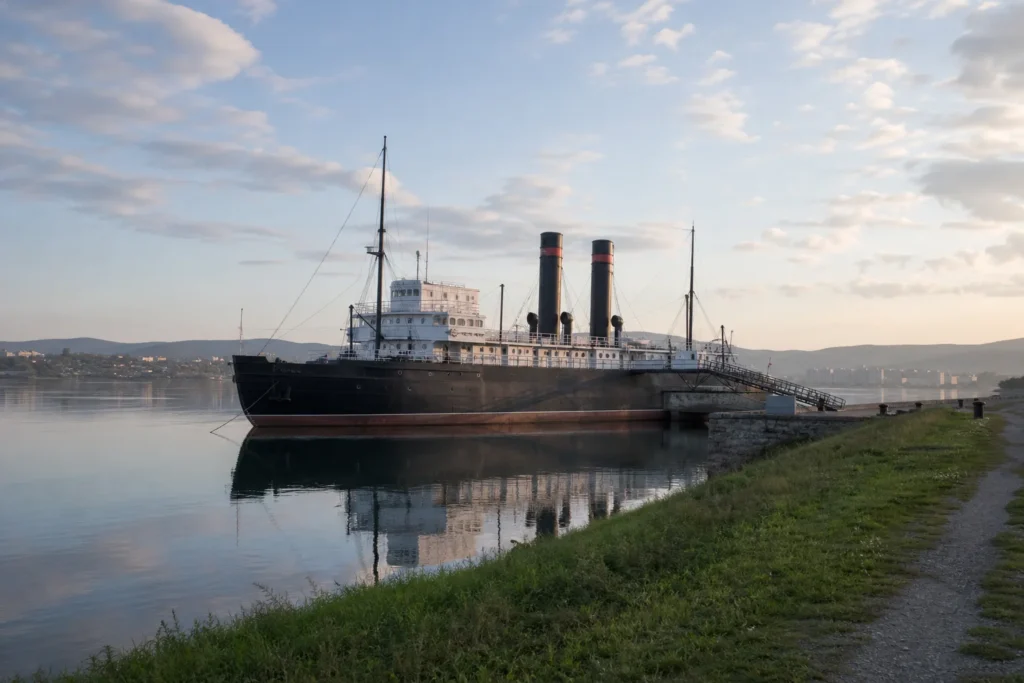
The Angara Icebreaker Museum, Irkutsk, is a museum inside a real steamship, one of the oldest icebreakers in the world. The ship was built in England, delivered in parts to Lake Baikal and put into service in 1900, and today it is moored on the Irkutsk Reservoir on Marshal Zhukov Avenue, several kilometers from the center, according to travel sources.
Visitors walk on board and go down into the engine rooms, and the museum covers the history of navigation on Lake Baikal. It is a trip out of the center, so plan the transport. Opening hours, tickets and access change, so check the official source before you go.
Quick Facts
| Russian name | Музей «Ледокол «Ангара» |
|---|---|
| Built / opened | 1991 |
| Address | проспект Маршала Жукова, 36А, Иркутск |
| District | Irkutsk (Solnechny microdistrict, on the Irkutsk Reservoir near the Angara Dam) |
| Opening hours | Open Tuesday to Sunday and closed on Mondays, according to travel sources. Listings give slightly different hours, from about 10:00 to 18:00 and from 11:00 to 19:00 (as of October 2026 – check the official site). |
| Admission | Entry is paid. The price was not verified here, and rates for Russian citizens and concessions differ, so check the official site. |
| Best time to visit | Weekday mornings are quiet, and the museum is closed on Mondays, according to travel sources. Summer is the most pleasant time for the shore and the deck, while winter is cold, and the ship is not heated everywhere. Tour groups can make late morning busier. |
| Recommended duration | 1 to 1.5 hours |
| Website | ledokolangara.iokm.ru |
| Last updated | October 13, 2026 |
What Is (and Isn't) Part of a Visit to Angara Icebreaker Museum, Irkutsk?
| Part | Status | Notes |
|---|---|---|
| The ship, its deck and the engine rooms | Included in the standard ticket | The main attraction, reached by a permanent gangway. |
| The exhibition on Baikal navigation | Included in the standard ticket | Models, photographs, documents and navigation equipment. |
| Lake Baikal and the sister ship Baikal | Outside / not part of it | The lake is about 70 km away, and the Baikal did not survive. |
| The Angara Dam | Outside / not part of it | A nearby dam from 1956, not part of the museum. |
| The historic center of Irkutsk | Outside / not part of it | Several kilometers away, covered in the Irkutsk guide. |
Why Visit Angara Icebreaker Museum, Irkutsk?
The Angara is the only surviving ship of the original icebreakers of Lake Baikal in Russia, according to a travel source, and it is among the oldest icebreakers in the world. It was built to carry passengers and to break the ice across the lake while the Trans-Siberian Railway was still incomplete around Baikal.
Visitors can see more than a display case. You walk on the deck and descend into the engine rooms to see the boilers and the steam gauges, and the museum shows models of Baikal ships, photographs and documents. It makes a good counterpart to the churches and wooden houses of the center, and it links the city to the story of the railway and the lake.
Highlights of Angara Icebreaker Museum, Irkutsk
The steamship itself
The Angara was ordered in England in 1898 from the Armstrong Whitworth yard in Newcastle, according to travel sources, and was brought in parts by rail to Listvyanka on Lake Baikal, where it was assembled. It entered service on 1 August 1900, according to a general source. You reach it by a permanent gangway and can walk on the deck, where you see the two funnels and some of the ship's guns.
Tip: Look at the funnels and the deck first, then go below.
The engine rooms and boilers
Visitors go down into the hull to the engine rooms, where the boilers and the many temperature and steam gauges can be seen, according to a travel source. It is the most memorable part of the visit, since it shows how a steamship of 1900 worked. The tour is mostly self-guided.
Tip: Wear shoes with a good grip, since the stairs and the decks can be steep and slippery.
The exhibition on Baikal navigation
The museum, known as the Museum of the History of Navigation on Lake Baikal, opened on the ship in 1991 after restoration, according to travel sources. It displays models of Baikal ships, historical photographs, documents and navigation equipment. It tells how the lake was crossed before and after the Circum-Baikal Railway.
Tip: Spend time with the model ships and the photographs, since they show the lake's fleet.
The role in the Trans-Siberian story
The Angara was designed to work alongside the larger train ferry Baikal, which carried railway cars across the lake, according to travel sources. Before the Circum-Baikal Railway opened in 1905, the two ships carried passengers and cargo across Baikal, and the Angara cut a path through the ice for the larger ferry in winter. The Baikal was later damaged in the civil war and did not survive.
Tip: Read about the sister ship Baikal, which explains why the Angara matters.
A ship that sank several times
After years of service and then reserve, the Angara was moved to the Irkutsk Reservoir, where it sank more than once and lay abandoned for years, according to travel sources. It was raised and restored in the late 1980s and early 1990s. Historians note it as one of the oldest icebreakers and one of the most often sunk ships, according to a travel source.
Tip: Ask at the desk about the restoration, which is part of the museum's story.
The setting on the reservoir
The ship is moored on the Irkutsk Reservoir, close to the Angara Dam, which dates from 1956 and is about two kilometers long, according to a travel source. The reservoir shore offers open views of water and sky, and the walk to the ship runs along its edge. It feels very different from the old center.
Tip: Allow a few minutes for a walk along the shore after the visit.
Atmosphere
The Angara Icebreaker Museum feels like stepping onto a working ship. The dark hull stands on the water with two tall funnels and a gangway leading up, and the wind off the reservoir carries the smell of metal and water. Inside, the stairs go steeply down to the boilers, where the brass gauges and pipes fill the engine rooms.
It is quiet on weekday mornings and busier when tour groups arrive. In summer the shore is open and bright, and in winter the ice and the cold make the ship look as it did when it broke through the ice of Baikal, while the rooms inside are cold and dim.
History of Angara Icebreaker Museum, Irkutsk
In the 1890s, the Trans-Siberian Railway was being built, and the section around Lake Baikal was not yet finished. The Russian government ordered two ships from the Armstrong Whitworth yard in Newcastle to carry passengers and railway cars across the lake: the large train ferry Baikal and the smaller icebreaker Angara, according to travel sources. The Angara was ordered in 1898.
The ships were built in England, taken apart and sent to Russia by rail, according to travel sources, and the Angara was brought to Listvyanka, where it was assembled. It was put into service on 1 August 1900, according to a general source, and it worked on Lake Baikal, carrying passengers and, in winter, cutting a path through the ice for the Baikal.
The Circum-Baikal Railway opened in 1905, according to a travel source, and the two ships made two trips a day across the lake until then. Afterward the ships were used for other work or kept in reserve, according to a travel source.
The larger ferry Baikal was damaged by artillery fire in 1918, during the civil war, according to a general source, and did not survive. The Angara stayed in service in various roles for decades, according to a travel source, until around 1949.
In 1967 the Angara was towed to the Irkutsk Reservoir, where it sank more than once, according to travel sources. It stayed submerged for a long period before being raised in the late 1980s and restored in the following years, according to travel sources.
The museum opened on the ship in 1991 as the Museum of the History of Navigation on Lake Baikal, according to travel sources. The ship is moored at the reservoir and is reached by a permanent gangway. It is described as the only surviving ship of the original Baikal icebreakers in Russia and as one of the oldest icebreakers in the world, according to travel sources.
The dates and details above come from travel sources and general knowledge, and they differ between sources (for example, some give the ship’s construction date as 1898 or 1899), so they should be checked against official museum sources.
Tickets and Booking for Angara Icebreaker Museum, Irkutsk
Where to buy. Tickets are normally sold at the museum on the day, and the museum has an official website. The price was not verified here, and rates for Russian citizens and concessions differ, so check the official site.
On the ship. The tour is largely self-guided, and photography has been reported as allowed, according to a travel source, though rules may change, so ask at the desk. A cloakroom may be available for coats and large bags.
Payment. Cash in rubles is the most reliable way to pay. Whether foreign Visa and Mastercard cards work was not verified and should not be assumed, and the sanctions rules of your own country may restrict some payment services, so check this yourself. Check the museum’s official website for current tickets and hours.
Plan and Book
Suggested itineraries Angara Icebreaker Museum, Irkutsk
1 hour
Walk along the gangway onto the deck, go down to the engine rooms and boilers, then look at the models and photographs in the exhibition area.
2 hours
See the ship and the exhibition, then walk along the reservoir shore toward the Angara Dam for views of the water before you head back to the center.
Half day
Visit the museum in the morning, take a bus back to the center, and see the 130th Quarter and the Decembrist house museums in the afternoon to link the railway story to the city's history.
How to Get to Angara Icebreaker Museum, Irkutsk
The museum is at Marshal Zhukov Avenue 36A, in the Solnechny microdistrict on the Irkutsk Reservoir, several kilometers southeast of the center, according to travel sources. It is not within walking distance of the old center, and Irkutsk has no Metro, so most visitors come by trolleybus, bus or taxi.
- By trolleybus: trolleybuses 1 and 3 run to the Marshal Zhukov Avenue stop, just past the Angara Dam, and the museum is a short walk along the reservoir, according to a travel source; other lines are also mentioned, so check the current routes with the operator.
- By taxi: a taxi from the center is the easiest way and takes less time than the bus.
- Travel time: the trip from the center by bus takes about half an hour, according to a travel source.
Save the address in Latin letters and in Russian, and check a map on your phone before you go.
Accessibility
Accessibility was not verified. The ship is reached by a gangway and has steep stairs down to the engine rooms, so visitors with reduced mobility should ask the museum about access in advance, and expect icy surfaces in winter.
Food Nearby
The microdistrict around the museum has fewer cafes than the center, so most visitors eat in the center, where the 130th Quarter and the streets around Kirov Square have many cafes and restaurants. Specific venues were not verified here, so check opening hours before you go.
What to Bring
Bring shoes with a good grip for steep stairs and metal decks, and a warm layer, since the ship and the reservoir shore can be cold and windy. Cash in rubles is useful for tickets, and a phone with an offline map helps in finding the stop.
Best Views and Photo Spots of Angara Icebreaker Museum, Irkutsk
The ship from the reservoir shore
From the shore you can frame the whole hull with its two funnels against the water and sky, which shows the ship's profile.
Best time: Morning or late afternoon, in soft light.
The deck and the funnels
On the deck you can photograph the funnels, the guns and the gangway with the reservoir behind them.
Best time: Midday, in even light.
The engine rooms
The boilers and gauges are the most photogenic interior, with brass and iron in a dim light.
Best time: Weekday mornings, when there are fewer visitors.
The ship in winter
Ice and snow around the hull make the ship look as it did when it worked on Baikal, with the dark hull against white.
Best time: Winter mornings, after snow.
Photography Rules
Photography has been reported as allowed on the ship, according to a travel source, but rules can change, so ask at the desk. Avoid flash in narrow engine rooms and respect other visitors. Drone rules also apply near the dam and the reservoir, so check the regulations with the official source before you use one.
Family Suitability
The museum suits families with children who like ships, and the engine rooms are a highlight. The stairs are steep and the decks can be slippery, and strollers cannot use the gangway easily, so check access beforehand. Plan the trip from the center, since it takes about half an hour each way.
Russia Vibes Tips
- Plan the trip as a separate outing from the center, since the museum is several kilometers away on the reservoir.
- Go down to the engine rooms, which are the best part of the visit.
- Take the trolleybus to the Marshal Zhukov Avenue stop and walk along the reservoir, or take a taxi if you are short of time.
- Read about the sister ship Baikal before you go, since it explains why the Angara was built.
- Combine the visit with the Angara Dam, which is close by.
- Wear shoes with a good grip, since stairs and decks can be steep and wet.
Explore Nearby Angara Icebreaker Museum, Irkutsk
Related guides
 Irkutsk: 130 Kvartal, Decembrists and Gateway to Lake Baikal
Main image: AI-generated illustration. It may not show the place exactly as it looks.
 Port Baikal Day Trip, Irkutsk: Ferry and Railway End of the Line
Main image: AI-generated illustration. It may not show the place exactly as it looks.
 Listvyanka Day Trip, Irkutsk: Getting to Lake Baikal and Back
Main image: AI-generated illustration. It may not show the place exactly as it looks.
 Solnechny Microdistrict Tram Stop, Irkutsk: What Is Verified
Main image: AI-generated illustration. It may not show the place exactly as it looks.
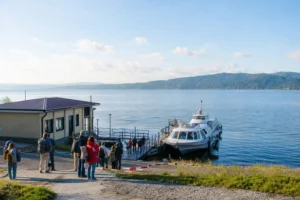 Raketa Pier, Irkutsk: River Boats from the Angara toward Baikal
Main image: AI-generated illustration. It may not show the place exactly as it looks.
Browse more: More in Irkutsk (Solnechny microdistrict, on the Irkutsk Reservoir near the Angara Dam) · All Irkutsk · All Museums · All Sightseeing · All Sightseeing in Irkutsk
FAQ: Angara Icebreaker Museum, Irkutsk
Is the Angara icebreaker in the center of Irkutsk?
No, it is moored on the Irkutsk Reservoir on Marshal Zhukov Avenue, several kilometers from the center, near the Angara Dam. Plan the trip by trolleybus, bus or taxi.
When was the Angara built?
It was ordered in England in 1898 and entered service on Lake Baikal in 1900, according to travel sources. Some sources give 1899 for its construction.
Can I go inside the ship?
Yes, visitors can walk on the deck and go down into the engine rooms, where the boilers can be seen, according to a travel source. The tour is mostly self-guided.
Is it the oldest icebreaker?
It is described as one of the oldest icebreakers in the world and the only surviving ship of the original Baikal icebreakers in Russia, according to travel sources.
When is the museum open?
It is open Tuesday to Sunday and closed on Mondays, according to travel sources, with slightly different hours in different listings. Check the official site.
How long do I need?
About an hour to an hour and a half is enough for the ship and the exhibition. Add the travel time of about half an hour each way from the center.
How do I get there?
Many visitors take trolleybus 1 or 3 to the Marshal Zhukov Avenue stop and walk along the reservoir, according to a travel source. A taxi is faster.
What was the Angara used for?
It carried passengers and cargo across Lake Baikal and broke the ice for the larger train ferry Baikal while the railway around the lake was unfinished, according to travel sources.
Russia Vibes is a one-person project. A coffee keeps it going
Last updated: October 13, 2026. Found an error or something out of date? Report it and we will check and fix it.
How we research and update our guides
About this guide: AI assistance and accuracy
This guide is created with the help of AI and is based on official sources where available. Mistakes can still happen. Opening hours, prices, rules and other details are given to the best of our knowledge as of the date shown and can change without notice. It offers general recommendations only, not professional, legal or travel advice. Please confirm important details with the official source before you travel; you are responsible for your own plans and decisions.
International sanctions affect payments between Russia and many other countries. In practice, cards issued in the EU, the UK, the US and several other countries often do not work in Russia, Russian cards usually do not work abroad, and some booking platforms, airlines and payment providers limit or suspend their services for Russia. The situation changes frequently. We do not give legal or financial advice, and this site does not encourage anyone to break or circumvent sanctions. Whatever you plan, you are responsible for following the laws and regulations that apply to you, including those of your country of residence and citizenship. Many travelers still organise their stay lawfully. It is worth asking your bank or payment provider what is currently permitted, contacting hotels, tour operators and carriers directly about the payment methods they accept, and checking which services are open to customers from your country. Clarify payment, cancellation and refund terms before you commit to a booking, and keep your plans flexible. Partner links on this site may not be available in every country, and prices, availability and rules in our guides can differ from what you see when you book.Paying for your trip: please read

Take this guide with you
Get a free PDF of this guide to print or read offline: key facts, tips and a map link on a few clean pages.