
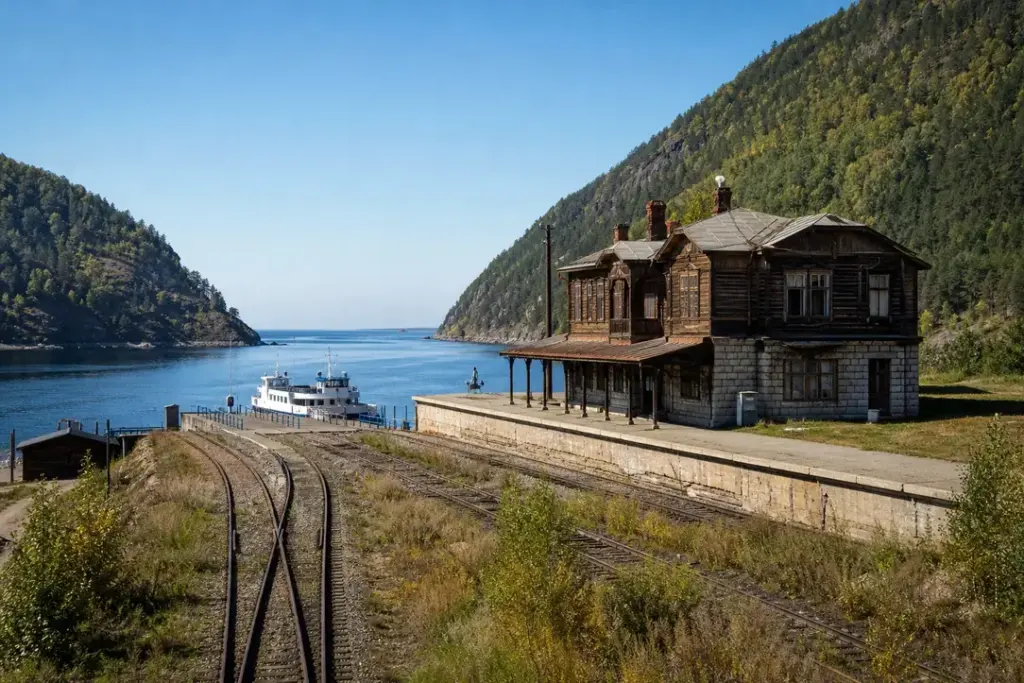
Port Baikal Railway Station marks the western terminus of the historic Circum-Baikal Railway, one of the most spectacular rail lines in Russia. Situated at the junction where the Angara River flows from Lake Baikal’s southern tip, the station opened in 1900 as a critical link in the original Trans-Siberian route—before a dam transformed the geography and left it a dead end.
Today the station is where travellers board heritage trains for all-day excursions that wind along the lake’s southwestern shore, passing through dozens of hand-built tunnels and engineering marvels dating from the early 1900s. A passenger ferry connects directly across the river to Listvyanka, making it a practical interchange on the Baikal circuit.
Quick answer: Circum-Baikal Heritage Train to Slyudyanka (8 hours round trip, ₽₽). 2 more ways compared below.
Quick Facts
| Russian name | Станция Байкал |
|---|---|
| Type | Railway station |
| Built / opened | 1900 |
| Address | Port Baikal, Irkutsk Oblast, Russia Google MapsApple MapsYandex Maps2GIS |
| District | Slyudyansky |
| Best time to visit | Late May to September offers the warmest, most reliable weather and daily ferry and train service. June–August is peak season with full daily schedules and the most predictable conditions. September is calmer, with fewer tourists and excellent light. Winter (Nov–Feb) is dramatic—the Angara River freezes, the lake ices over, and the landscape becomes stark—but heritage trains run only sporadically and ferries may not operate; check locally before planning winter visits. |
How to Get to and from Port Baikal Railway Station, Lake Baikal
| Option | Duration | Price | Notes |
|---|---|---|---|
| Circum-Baikal Heritage Train to Slyudyanka | 8 hours round trip | ₽₽ | Departs Wed–Sun from Port Baikal (schedule varies). Most trains leave mornings and arrive Slyudyanka late afternoon, then return. Diesel locomotive with open-air cars standard; steam engine some services. Includes short stops at Polovina and other heritage stations. Book through tour operators in Listvyanka or Irkutsk; seats with lake views cost more. Bring food and water; no dining car. |
| Ferry to Listvyanka | 15–20 minutes | ₽ | Passenger ferries cross the Angara River mouth multiple times daily to Listvyanka. Timetable depends on season and water level; typically operate morning to early evening. Book at the terminal or through hotel services. Connects to buses to Irkutsk (70 km, 1.5 hours). |
| Taxi or Private Car to Irkutsk | 1.5–2 hours | ₽₽ | Private vehicles available from Listvyanka shuttle services. Not recommended direct from Port Baikal; use ferry to Listvyanka first. Irkutsk is 70 km away by road. |
₽ budget · ₽₽ moderate · ₽₽₽ upscale · ₽₽₽₽ splurge. Price levels are estimates compared with typical prices for visitors.
Why Visit Port Baikal Railway Station, Lake Baikal?
The station itself is modest and historic, a federal heritage site preserved from the early railway era. But its real significance lies in being the departure point for one of Asia’s most dramatic train journeys. The 85 km Circum-Baikal Railway run to Slyudyanka takes up to eight hours and rewards you with unobstructed lake views, stops at remote engineering landmarks—39 tunnels, 248 bridges, stone galleries—and the chance to walk sections of shore between stations.
It connects directly to the ferry serving Listvyanka and Irkutsk, making it essential infrastructure for any serious Baikal visit that includes scenic rail travel.
Highlights of Port Baikal Railway Station, Lake Baikal
The 1900 Station Building
The original timber and stone structure is modest but carries enormous historical weight. It served as a major turning point in the Trans-Siberian route when the railway first reached Baikal. Before the Circum-Baikal Railway opened in 1905, passengers disembarked here and boarded ice-breaking ferries to cross to the eastern shore. The building now houses a small museum documenting this crucial era.
Tip: Arrive early to explore the station building and track layout before boarding the heritage train; crowds gather later.
Circum-Baikal Railway Departure
The narrow-gauge heritage trains departing from here (usually Wednesday to Sunday) follow the original 1900s alignment hugging Baikal's shoreline. Most trips use a diesel locomotive with open-air viewing cars, though some include a restored Soviet-era steam engine for the dramatic approach from Slyudyanka. The journey takes you through terrain so steep and rocky that tunnels and viaducts were the only way to build a route.
Tip: Book seats facing the lake for views; the railway curves constantly, giving excellent photo angles from both sides. Tours typically run full day; bring food and water.
Tunnel Engineering Structures
The Circum-Baikal line includes 38 tunnels totalling over 9 kilometres, the longest (Polovina tunnel) exceeding 700 metres. Built entirely by hand between 1898 and 1905, they were engineered to avoid unstable shoreline rock. Each tunnel frames a different angle of the lake or forest. Stone-built gallery walls reinforce exposed sections—all original work, never rebuilt.
Tip: The train slows through tunnels; have your camera ready. The Polovina tunnel halfway along the route is the most dramatic, and the station there is a traditional stop for photos.
Angara River Mouth & Ferry Connection
Port Baikal sits where the Angara River narrows sharply as it leaves Lake Baikal. The ferry terminal is metres from the rail station, with passenger boats crossing to Listvyanka several times daily. In winter the river freezes solid, adding to the raw beauty of the landscape. The setting is dramatically steep—you look up to forested cliffs on both banks.
Tip: Check ferry schedules before boarding the train if you plan to return to Irkutsk the same day. Evening sailings connect to bus services; the last ferry is usually early evening.
Views of Lake Baikal
The station platform itself offers the first unobstructed views of Lake Baikal from the Irkutsk-side travel circuit. The lake here is 1.6 km wide and visibly deepens from the shore. In clear weather you can see across to the eastern mountains. In winter, vast ice floes drift southward down the river; in summer the water is startlingly blue.
Tip: Stop on the platform for 10 minutes before boarding to orient yourself and photograph the landscape. The light is clearest in morning and late afternoon.
Heritage Train Museum Display
The station forecourt displays vintage rolling stock and interpretive panels explaining the 1900–1905 construction history. A small museum room inside documents how passengers once transferred here between rail and ferry, and shows engineering tools, photographs and correspondence about the line's building. The exhibits are modest but illustrate the immense difficulty of building rail through this terrain.
Tip: Allocate 30 minutes for museum exploration if you arrive early. Tour guides on the heritage trains can explain features as you travel, but the station museum provides helpful context first.
Atmosphere
Port Baikal is windswept, elemental and quiet outside of tour times. The landscape is steep, rocky and dark-forested, with the vast lake dominating the view. The station building—weathered timber and stone from 1900—sits on a raised platform with railway tracks, abandoned sidings and ferry infrastructure. The air carries the smell of diesel, wood and cold water even in summer. The place feels removed: no shops, few services, just the core infrastructure of railway and river crossing. On train days (Wed–Sun), the platform fills briefly with heritage train groups; otherwise it’s almost deserted. The overall impression is of time stopped, a living museum of early 20th-century rail infrastructure serving a landscape that has barely changed.
History of Port Baikal Railway Station, Lake Baikal
Port Baikal emerged in 1900 when the Trans-Siberian Railway reached Lake Baikal’s western shore. The original route divided into seven major sections, and the Baikal crossing was the most challenging. Rather than build a railway around the lake immediately, engineers decided to link the shores with ferry transport until a land route could be engineered.
Between 1900 and 1904, Port Baikal served as the rail terminus. Passengers descended from trains and transferred to massive ice-breaking ferries—the SS Baikal and SS Angara, built in Newcastle-upon-Tyne—which could transport both passengers and loaded railway cars across to Mysovaya (now Babushkin) on the eastern shore. The ferries operated year-round, breaking ice in winter and carrying freight in summer.
This arrangement was always intended as temporary. Between 1898 and 1905, engineers carved the Circum-Baikal Railway around the southern and southwestern shores: 260 kilometres of line requiring 39 tunnels, 18 galleries and 248 bridges. The narrow, rocky shoreline and steep terrain meant almost every kilometre needed a bridge or tunnel. When the Circum-Baikal line opened in 1905, the ferries ceased operating and Port Baikal became a traditional rail junction, though one at a dead end.
For five decades Port Baikal remained a working station on the main Trans-Siberian route. Trains from Irkutsk descended to the coast, and trains from Slyudyanka joined the main line here. Then in 1956, the Irkutsk Hydropower Station flooded the Angara River valley, submerging the rail section from Irkutsk to Port Baikal. The route was abandoned and never rebuilt. Port Baikal became a true dead-end siding—the western terminus of a heritage railway, not a mainline junction.
Today the station and the Circum-Baikal line operate as a museum railway and major tourist attraction. The station building, train control infrastructure, and several restored vintage carriages are maintained as federal cultural heritage sites. The engineering structures—the tunnels, viaducts and galleries—survive essentially unchanged from 1905, a record of Victorian-era railway construction in conditions few modern engineers would accept.
Tickets and Payment at Port Baikal Railway Station, Lake Baikal
The station itself does not sell tickets. Heritage train rides are booked through tour operators based in Listvyanka or Irkutsk. The main operator runs scheduled trips Wednesday to Sunday; departure days and times vary seasonally. Online booking opens 4–6 weeks in advance on the operator’s website. If a date shows as unavailable, walk-up tickets are rarely available (trains often run full).
Ferry tickets to Listvyanka are purchased at the terminal building on the day of travel; no advance booking is usually necessary. Bring passport (for Russian citizens) or visa documentation if required.
The heritage train service includes admission to the train ride and brief museum display at the station. Separate tickets are not available for the station building alone. Concession rates exist for Russian students and pensioners; ask the operator for current rates. For all details on the train schedule and booking, check the East Siberian Railway operator’s website or request information through hotels in Listvyanka.
How to Get to Port Baikal Railway Station, Lake Baikal
Port Baikal is not directly accessible by scheduled bus from Irkutsk. The practical route is: (1) Take a bus from Irkutsk to Listvyanka (70 km, 1.5–2 hours; buses depart regularly from the central bus station); (2) From Listvyanka waterfront, board the passenger ferry across the Angara River mouth to Port Baikal (15–20 minutes). Ferry timetables vary by season but typically run morning to early evening. Alternatively, book a private car or taxi from Irkutsk to Listvyanka, then ferry across.
No train service connects Irkutsk directly to Port Baikal; the rail line was flooded in 1956. The heritage trains that use the Circum-Baikal Railway depart from Slyudyanka (via Irkutsk mainline train) or from the station itself if you arrive by ferry.
Accessibility
The station platform is at ground level with a gentle slope; wheelchair access is possible with assistance. The heritage train cars are vintage with steps and narrow doorways, not designed for wheelchair users. The ferry to Listvyanka has a ramp and accessible seating. The station building is single-storey with a level entrance. No accessible toilets or lifts are available; facilities are basic. Companions travel free on the heritage train if pre-arranged.
Food Nearby
No cafes, restaurants or shops operate at Port Baikal station itself. The settlement is very small. Bring packed food and water for the full day. In Listvyanka (accessible by ferry), several cafes, small shops and restaurants serve basic Russian and tourist meals. Ask your hotel in Listvyanka or Irkutsk to prepare a lunch box if booking the heritage train tour.
What to Bring
Warm clothing layers (the wind on the lake platform is strong and cold year-round). Sunscreen and hat for summer sun off the water. Sturdy shoes for boarding steps. A jacket is essential even in summer—the railway runs close to the water and wind accelerates. For the heritage train journey, bring snacks and at least one litre of water; toilets are basic. Binoculars are useful for wildlife spotting. A phone charger is wise as no charging is available at the station.
Photography Rules
Photography is permitted throughout the station and on heritage trains without charge. No tripods, drones or commercial filming are allowed on the platforms or trains. Flash is not needed outdoors. The station building interior is open to casual photography. Bring a fast camera or ISO 400+ film for the tunnel passages, which are lit only by daylight entering from the sides.
Family Suitability
The heritage train journey is suitable for children aged 5+, though the journey is long (8 hours) and requires sustained interest. The vintage train cars are cramped and jolting; very young children may find it uncomfortable. Strollers cannot be brought aboard the train. Ferry travel is safe for all ages and takes only 15 minutes. The station platform is open and windy; supervise young children closely. No play areas or children's facilities exist at the station.
Russia Vibes Tips
- Book heritage train tickets at least one week in advance during summer; popular departure days (Sat–Sun) sell out. Check the operator's website for the current season's schedule—it changes annually based on weather and maintenance.
- Arrive at Port Baikal at least 30 minutes before train departure if you've come via ferry, to explore the station and board without rush. The platform fills quickly on tour days.
- Sit on the left side of the train (facing the lake) for the best views on the route from Port Baikal toward Slyudyanka. The line hugs the shoreline and curves constantly.
- If you reach Port Baikal and the next heritage train is not for days, the ferry crossing to Listvyanka is worth the journey for the Baikal scenery alone. Do not feel obligated to take the full train tour.
- Winter ice makes the Angara River mouth visually spectacular (frozen floes stacked like white mountains), but ferry schedules are unpredictable and heritage trains run rarely. Plan a winter visit only with flexible dates and local weather contacts.
- The Circum-Baikal line is sometimes called 'Krugobaikalka' locally. If asking locals for directions, use that name; 'Port Baikal' refers to the station but 'Krugobaikalka' refers to the full railway experience.
Explore Nearby Port Baikal Railway Station, Lake Baikal
Sights near Port Baikal Railway Station, Lake Baikal
 Listvyanka, Lake Baikalabout 4.0 km away · typical visit: 2–3 days
Main image: AI-generated illustration. It may not show the place exactly as it looks.
 Shamanka Rock, Lake Baikal – about 226.6 km away · typical visit: 30–45 minutesOpen 24 hours
Main image: AI-generated illustration. It may not show the place exactly as it looks.
 Olkhon Island, Lake Baikalabout 224.4 km away · typical visit: 2–3 days
Main image: AI-generated illustration. It may not show the place exactly as it looks.
Train stations and river piers near Port Baikal Railway Station, Lake Baikal
 Listvyanka Rogatka Ferry Pier, Lake Baikalabout 1.5 km away (~25 min walk)
Main image: AI-generated illustration. It may not show the place exactly as it looks.
Related guides
 Lake Baikal: Where to Go, What to See and How to Visit
Main image: AI-generated illustration. It may not show the place exactly as it looks.
Browse more: More in Slyudyansky · All Airports & Transport · All Airports & Transport in Lake Baikal · All Lake Baikal · All Railway Stations
FAQ: Port Baikal Railway Station, Lake Baikal
Is Port Baikal station part of the main Trans-Siberian Railway?
No. The original Trans-Siberian route passed through Port Baikal (1900–1905), but when the Circum-Baikal Railway opened and a hydropower dam flooded the Irkutsk–Port Baikal section in 1956, the main line was rerouted. Today only heritage trains operate from Port Baikal.
Can I take a train directly from Irkutsk to Port Baikal?
No. The rail line between Irkutsk and Port Baikal was flooded in 1956 and never rebuilt. From Irkutsk, take a bus to Listvyanka (1.5–2 hours), then ferry across the Angara River to Port Baikal (15–20 minutes).
What is included in a heritage train ticket?
The ticket includes the all-day train ride from Port Baikal or Slyudyanka (8 hours), brief stops at heritage stations, and access to the station museum. Food is not included; bring your own lunch and water.
How often do heritage trains run?
Trains typically operate Wednesday to Sunday in the main season (May–September), with varying schedules. Check the operator's website for current times; service is less frequent in shoulder seasons and winter.
Is the ferry to Listvyanka reliable year-round?
Summer and autumn ferries are reliable with multiple daily sailings. Winter (Nov–Feb) is unpredictable; ice can affect schedules. Spring thaw (April–May) is also variable. Always check locally before winter travel.
What age are children allowed on the heritage train?
No official minimum age exists, but the journey is 8 hours of slow train travel through remote terrain. Children under 5 may struggle; ages 5+ are generally comfortable with adult supervision. Infants in lap seats are allowed.
Is the station accessible for people with mobility issues?
The platform is level and accessible. However, the vintage heritage train cars have high steps and narrow doorways unsuitable for wheelchairs. The ferry to Listvyanka is accessible. Companion tickets are free with pre-arrangement.
Can I visit the station without taking a train?
Technically yes, but the station is remote with no services. The main reason to visit is to board the heritage train. A brief stop to view the building and platform is possible if you're passing by ferry, but it is not a developed tourist attraction on its own.
Russia Vibes is a one-person project. A coffee keeps it going

Take this guide with you
Get a free PDF of this guide to print or read offline: key facts, tips and a map link on a few clean pages.
Report an issue on this page
Paying for your trip: please read
Payments and bookings between Russia and many other countries are currently restricted. In practice, cards issued in the EU, the UK, the US and several other countries often cannot be used in Russia, Russian cards usually cannot be used abroad, and some booking platforms, airlines and payment providers limit or pause their services for Russia. The situation changes frequently.
We do not give legal or financial advice, and this site does not encourage anyone to break any rule that applies to them. Whatever you plan, you are responsible for following the laws and regulations that apply to you, including those of your country of residence and citizenship.
Many travelers still organise their stay without problems. It is worth asking your bank or payment provider what is currently possible, contacting hotels, tour operators and carriers directly about the payment methods they accept, and checking which services are open to customers from your country. Clarify payment, cancellation and refund terms before you commit to a booking, and keep your plans flexible.
Partner links on this site may not be available in every country, and prices, availability and rules in our guides can differ from what you see when you book.
How we research and update our guides
About this guide: AI assistance and accuracy
This guide is created with the help of AI and is based on official sources where available. Mistakes can still happen. Opening hours, prices, rules and other details are given to the best of our knowledge as of the date shown and can change without notice. It offers general recommendations only, not professional, legal or travel advice. Please confirm important details with the official source before you travel; you are responsible for your own plans and decisions.
* Affiliate link: as an Amazon Associate we earn from qualifying purchases at no extra cost to you.