
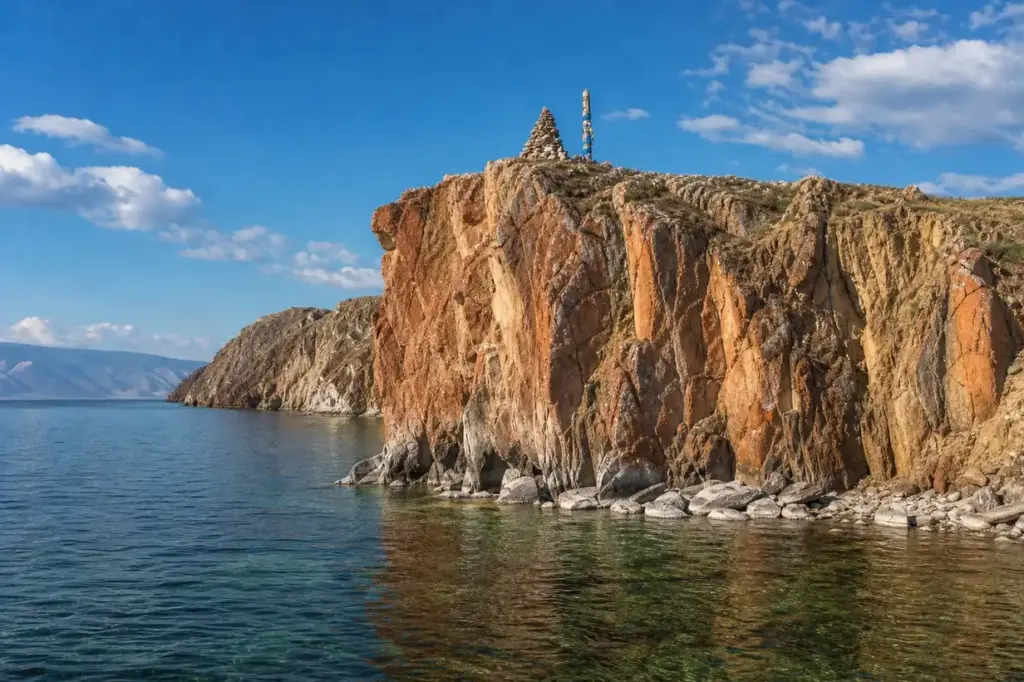
The Northern Olkhon Island and Cape Khoboy route guides you through Siberia’s most striking lake landscape. This 3-day itinerary is for hikers and nature photographers who want to walk the less-trafficked western shore of the island, spotting Baikal seals, standing on 200-meter cliffs, and camping under open sky. You’ll move at a moderate pace, carrying essentials each day, with the island’s UAZ (off-road vehicle) available to shuttle supplies and offer rides on the return.
By the end, you will have seen Cape Khoboy’s red stone cliffs at the northern tip, walked past the Three Brothers rock towers, explored coastal caves, and learned why this site remains sacred to Buryat shamanic tradition and why winter visitors come to see transparent blue ice under their feet.
Route: 2 stops, about 29.5–30 hours including walking (estimate)
Route map
At a glance: Day 1: Travel from Irkutsk to Khuzhir village, arriving late afternoon; explore Shamanka Rock at sunset. Day 2: Full-day northern drive and trek to Cape Khoboy through capes and caves, overnight near the cape. Day 3: Hike from Cape Khoboy south along the coast through tundra steppe and rocky slopes back to Khuzhir; return to Irkutsk in the evening.
Day 1: Irkutsk to Khuzhir Village
Depart Irkutsk in the morning for the 250-kilometre drive north along the Primorsky Mountains and Lake Baikal's western shore. Cross the Olkhon strait by ferry (about 40 minutes; year-round by hovercraft during spring and autumn, by ice in winter, directly by vehicle in summer). Arrive in Khuzhir mid-to-late afternoon; settle into accommodation and walk to nearby Shamanka Rock for sunset views.
- Irkutsk city center – Meeting point and departure (08:00–10:00 morning)
- Road café – Stop en route for lunch (midday)
- Olkhon strait ferry – Vehicle and passenger crossing (40 minutes)
- Khuzhir village – Main island hub; accommodation, shops, restaurants (arrival 16:00–17:00)
- Shamanka Rock (Cape Burkhan) – Sacred rock formation and cliffs 15 minutes' walk from village; prayer ribbons and spiritual markers visible (sunset walk, 1 hour)
Tip: Book accommodation in Khuzhir in advance, especially in summer (June–August). Request that your accommodation arrange transport and a guide for Day 2 before you arrive; full-day northern excursions usually depart early (09:00–10:00) and return by evening.
Day 2: Cape Khoboy Excursion and Northern Trek
Depart early by UAZ vehicle heading north along the western coast, stopping at several capes and rock formations. Drive to the trailhead near Peschanoye, then hike 12 kilometres north to Cape Khoboy through taiga forest, tundra steppe, and open coastal terrain. Explore the dramatic red-stone cliffs at the cape's tip, marked by a large cairn. Camp near the cape or return by vehicle to Khuzhir in the evening, depending on your tour package.
- Peschanoye hamlet – UAZ drop-off point for trekking start (10:00–10:30 morning)
- Sagaan-Khushun Cape – Cliffs overlooking Maloe More ('Small Sea') strait (brief stop)
- Shunte Cape (Shunte-Leviy) – Rocky outcrop with views west (30 minutes)
- Three Brothers rocks – Three distinctive stone towers and coastal caves; icy grottoes in winter (2–3 hours hiking, photo stop)
- Coastal caves and Uzur Bay – Eroded rock formations and beach; possible Baikal seal sightings (1 hour)
- Cape Khoboy – 200-metre red cliffs, cairn and totem pole at tip; panoramic views of both Maloe More and Bolshoe More ('Big Sea'); northern boundary of the island (5 hours total trekking from Peschanoye)
Tip: Bring sturdy hiking boots with ankle support; the terrain is rocky and uneven, and slopes can be steep near the cape. Carry at least 2 litres of water and snacks; there are no facilities between Peschanoye and Cape Khoboy. A light rain jacket and wind layer are essential, even in summer. Respect prayer ribbons (khadaks) and cairns at the cape—these are sacred markers; do not remove or rearrange them.
Day 3: Cape Khoboy to Khuzhir Trek
Hike south from Cape Khoboy back toward Khuzhir, roughly 37 kilometres over one or two days depending on your route and pace. The trek is not a marked trail; navigation follows the coast and open terrain south-southeast toward the village. Terrain is generally gentle but exposed to wind. Arrive in Khuzhir by afternoon, then depart for Irkutsk by evening.
- Cape Khoboy – Starting point for southbound trek (early morning departure)
- Three Brothers rocks – Landmark on return route (2–3 hours hiking)
- Coastal sections and secluded coves – Sandy and rocky beaches; sheltered spots (ongoing)
- Peschanaya Bay – Long sandy stretch (halfway point or overnight camp)
- Khuzhir village – Village arrival (5 hours final trekking, or split over two days)
- Return ferry crossing – Vehicle and passenger ferry back to mainland (40 minutes)
- Irkutsk city center – Evening arrival (18:00–19:00 return)
Tip: If doing this trek in two days, plan to camp near Peschanoye or one of the coastal coves on the first night. Pack a lightweight tent and sleeping bag rated for Siberian conditions (even summer nights are cool). On the return journey, the coast is always visible, making navigation straightforward even without a marked trail. Allow extra time if stopping to photograph landscapes or wildlife; a quiet pace increases chances of spotting Baikal seals resting on rocks.
Russia Vibes Tips
- Summer (June–August) is the optimal season for this route. Late spring and early autumn can bring rain and cold. In winter, the route operates with vehicle transport on ice rather than foot trekking; consult specialized winter tour operators and check ice conditions before booking.
- Water sources exist but are unreliable; bring a water filtration system or purification tablets and refill at streams only if necessary. Do not rely on finding drinking water on the route itself.
- Mobile coverage is minimal or absent once you leave Khuzhir. Inform your accommodation of your expected return time and carry a basic map or GPS device. If trekking independently (without a guide), leave a detailed itinerary with your accommodation.
- Olkhon Island is sacred to Buryat shamanic tradition. Cape Khoboy and Shamanka Rock are spiritually significant sites; visitors are expected to show respect by not disturbing prayer ribbons, cairns, or rock formations. Photography is permitted at Shamanka Rock and the cape, but ask permission before photographing local visitors engaged in spiritual practices.
- The island's roads are poor and often impassable after rain. If traveling in late spring or early autumn, confirm road conditions with your accommodation or tour operator before booking transport. Winter routes by ice are safest when ice is thickest (January–February); avoid March and November when ice is unstable.
- Baikal seal sightings are possible year-round but most common in summer and autumn. If you encounter a seal on shore, keep at least 50 metres distance and avoid sudden movements; they are shy and will retreat into the water if disturbed.
Explore Nearby Northern Olkhon Island and Cape Khoboy Route, Lake Baikal
Sights near Northern Olkhon Island and Cape Khoboy Route, Lake Baikal
 Cape Khoboy, Lake Baikal · typical visit: 3–4 hours
Main image: AI-generated illustration. It may not show the place exactly as it looks.
 Shamanka Rock, Lake Baikal · typical visit: 30–45 minutesOpen 24 hours
Main image: AI-generated illustration. It may not show the place exactly as it looks.
 Olkhon Island, Lake Baikal · typical visit: 2–3 days
Main image: AI-generated illustration. It may not show the place exactly as it looks.
 Listvyanka, Lake Baikal · typical visit: 2–3 days
Main image: AI-generated illustration. It may not show the place exactly as it looks.
Related guides
 Lake Baikal: Where to Go, What to See and How to Visit
Main image: AI-generated illustration. It may not show the place exactly as it looks.
Browse more: All Itineraries · All Itineraries in Lake Baikal · All Lake Baikal · All Themed Routes
FAQ
How many days does this route take?
The full itinerary is 3 days: one day driving from Irkutsk to Khuzhir, one full day exploring Cape Khoboy by vehicle and foot, and one day trekking or driving back to Khuzhir and returning to Irkutsk. The trek from Cape Khoboy to Khuzhir can be done as a single long hike (5–7 hours) or split over two days with camping.
Do I need a guide for the Cape Khoboy route?
A guide is strongly recommended, especially if you plan to trek solo from Cape Khoboy back to Khuzhir. Most visitors book a tour through their accommodation in Khuzhir or arrange a guide in advance. The route is not marked, and Siberian weather can change rapidly. Guides also provide cultural and natural history context about sacred sites and wildlife.
What is the difference between the northern and southern routes on Olkhon Island?
The northern route (Cape Khoboy route) features dramatic red-stone cliffs, the 200-metre Cape Khoboy, coastal caves, and Three Brothers rock formation. The southern route includes Shamanka Rock, Peschanoye sand dunes, and warmer, sandier beaches. Both can be visited, but require separate full days.
Can I visit Cape Khoboy in one day from Khuzhir?
Yes. A one-day excursion by vehicle is available: the driver takes you to the trailhead, you hike to the cape, explore for 1–2 hours, and return by vehicle to Khuzhir by evening. This requires no camping and is suitable for visitors with limited time.
Is the hike from Cape Khoboy to Khuzhir difficult?
The trek is graded as easy to moderate. Terrain is mostly gentle coastal slopes and open tundra steppe with no major elevation gain. However, the route is exposed to wind and weather, unmarkd, and covers 37 kilometres, so it demands good fitness and proper preparation. First-time hikers on unfamiliar terrain should hire a guide.
When is the best time to visit?
Summer (June–August) offers the warmest weather, longest daylight, and easiest road and ferry conditions. Early September can also be good with fewer crowds. May and October are feasible but cooler and wetter. Winter (December–February) offers spectacular transparent blue ice and a completely different landscape but requires specialized winter tours and ice-vehicle transport.
What should I pack?
Bring sturdy hiking boots, wind and rain jacket, layers for cool mornings and evenings, at least 2 litres of water per day, high-energy snacks, sun protection, a headlamp, and a map or GPS. If camping, bring a three-season tent, sleeping bag rated for 5°C or lower, and a cooking setup. Toilet paper and a trowel are essential; pack out all waste.
Are there facilities or villages on the route?
No. Khuzhir is the only village on the island with shops, restaurants, and accommodation. The northern route is remote; there are no water sources, shelters, or food supplies between the trailhead and Cape Khoboy. Uzury village exists at the northeast tip but is only accessible by vehicle or as part of guided tours.
Russia Vibes is a one-person project. A coffee keeps it going

Take this guide with you
Get a free PDF of this guide to print or read offline: key facts, tips and a map link on a few clean pages.
Report an issue on this page
Paying for your trip: please read
Payments and bookings between Russia and many other countries are currently restricted. In practice, cards issued in the EU, the UK, the US and several other countries often cannot be used in Russia, Russian cards usually cannot be used abroad, and some booking platforms, airlines and payment providers limit or pause their services for Russia. The situation changes frequently.
We do not give legal or financial advice, and this site does not encourage anyone to break any rule that applies to them. Whatever you plan, you are responsible for following the laws and regulations that apply to you, including those of your country of residence and citizenship.
Many travelers still organise their stay without problems. It is worth asking your bank or payment provider what is currently possible, contacting hotels, tour operators and carriers directly about the payment methods they accept, and checking which services are open to customers from your country. Clarify payment, cancellation and refund terms before you commit to a booking, and keep your plans flexible.
Partner links on this site may not be available in every country, and prices, availability and rules in our guides can differ from what you see when you book.
How we research and update our guides
About this guide: AI assistance and accuracy
This guide is created with the help of AI and is based on official sources where available. Mistakes can still happen. Opening hours, prices, rules and other details are given to the best of our knowledge as of the date shown and can change without notice. It offers general recommendations only, not professional, legal or travel advice. Please confirm important details with the official source before you travel; you are responsible for your own plans and decisions.
* Affiliate link: as an Amazon Associate we earn from qualifying purchases at no extra cost to you.