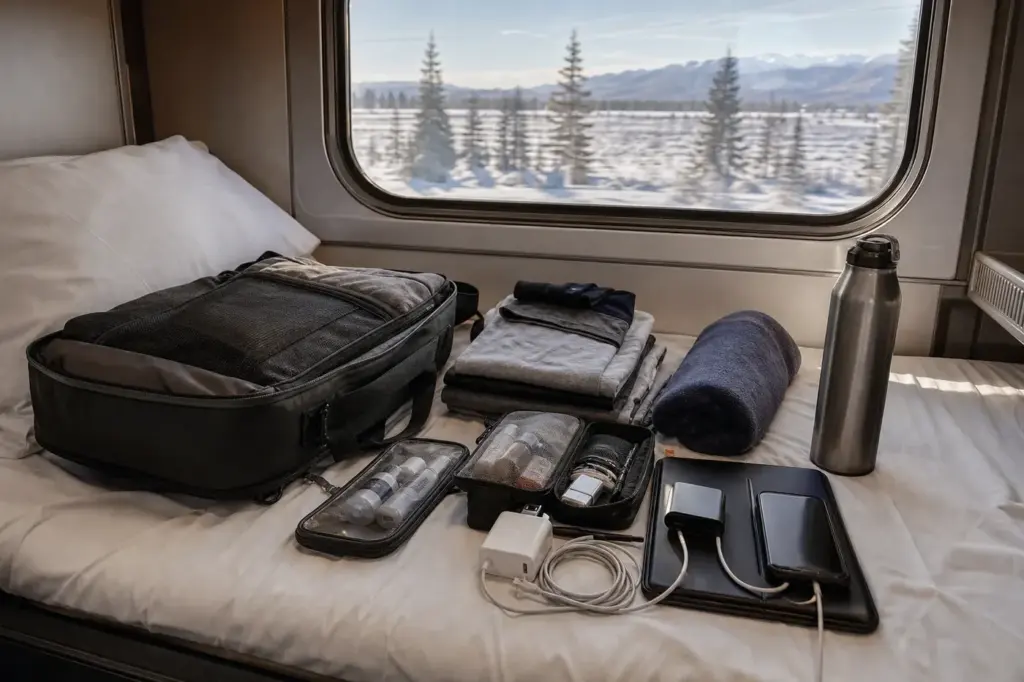
Packing for the Trans-Siberian Railway requires strategy. You’ll spend 6–7 days in a train cabin crossing 9,289 kilometres and eight time zones, sharing tight quarters with cabinmates and navigating limited luggage space. This guide helps you pack smart so you travel comfortably without hauling excess weight to and from train stations.
The key is choosing multi-purpose items, layering clothing for the heated cabin (which stays surprisingly warm despite the cold outside), and bringing only what fits in a single soft bag. Most travellers overpack, then spend days regretting it.
Quick answer: Pack one soft-sided bag with compartments, not a rigid suitcase. Bring layered clothing (lightweight pieces you can remove), a quick-dry towel, toiletries, entertainment, a power bank with adapters, and snacks. Most items are available on the train or at stops, but prices and quality vary.
At a Glance
| Total time | 30 minutes to 1 hour to pack; items needed accessible and organized before boarding |
|---|---|
| Typical cost | No cost for packing itself; budget items (snacks, adapters, towel) are modest one-time purchases |
What You Need Before You Start
- Valid Russian visa and travel document (passport)
- Train ticket with cabin assignment and class details
- Soft-sided bag or backpack (not a rigid suitcase)
- European-style plug adapter for 2-pin round sockets
- Medications and prescriptions (difficult to find at remote stations)
- Credit and debit cards plus some cash for station vendors
- Phone with offline map app and Russian phrase app installed
Compare Your Options
| Option | Duration | Price | Notes |
|---|---|---|---|
| Light packer (20–25 litre backpack) | Packing time 20 minutes; comfortable for entire journey | ₽ | Requires rewearing clothes and doing laundry at stops. Suits solo travellers and experienced backpackers. Fits easily under seats and in lockers. Best for summer travel or short routes like Moscow–Ulan-Ude (4–5 days). |
| Standard packer (40–50 litre backpack, recommended) | Packing time 40 minutes; comfortable for 6–7 day journey | ₽₽ | Balances comfort with mobility. Fits in cabin storage without dominating the space. Suitable for most travellers. Allows for some laundry between stops rather than constant rewashing. |
| Two-bag approach (50 litre + 20 litre daypack) | Packing time 45 minutes; most flexible | ₽₽ | Larger bag stays in cabin; daypack carries essentials for station exploration. Ideal if stopping at multiple cities (Yekaterinburg, Lake Baikal). More luggage handling but best for extended trips with sightseeing. |
| Minimalist hard-sleeper (platskart, 3rd class packer) | Packing time 25 minutes; most frugal | ₽ | Open carriage with 54 berths; shared common space. Pack only essentials in a small bag since berths have minimal personal storage. Cheapest ticket option. Most social; least private. Suitable for adventurous travellers. |
| First-class luxury packer (SV cabin, 2-berth private) | Packing time 60 minutes; most comprehensive | ₽₽₽ | Private 2-berth cabin with wash basin. More space and comfort mean you can bring additional items (extra shoes, more clothing, books, toiletries). Worth it for solo travellers booking both berths or couples seeking privacy. |
₽ budget · ₽₽ moderate · ₽₽₽ upscale · ₽₽₽₽ splurge. Price levels are estimates compared with typical prices for visitors.
Step-by-Step Instructions
Step 1: Measure your bag and luggage space before packing
Train compartments are small. Stand your bag upright in a corner of your cabin to see how much floor space remains. Most bottom berths have under-berth storage for luggage. Soft bags squeeze into tight spaces better than suitcases. Aim for one bag no larger than 44 litres that you can comfortably carry up and down train steps.
Tip: Travellers often bring two bags: a larger one for on-train items (sleepwear, toiletries, comfort clothes) and a smaller daypack for city exploration during stops.
Step 2: Pack light layered clothing for the warm cabin
Train carriages are kept very warm—sometimes uncomfortably so—even in winter. Bring loose cotton slacks, t-shirts, a light sweater or hoodie, and comfortable indoor shoes or slippers. Pack 4–5 t-shirts in solid colours (easy to mix and match), underwear for 5–6 days (you'll hand-wash), and one pair of smart casual clothes for city visits at stops. For outside exploration, pack a warm coat, scarf and gloves if travelling in cold months.
Tip: Avoid bringing heavy wool jumpers or thermal pyjamas; the cabin heat makes them unnecessary and they take up precious space.
Step 3: Add a microfibre quick-dry towel and essential toiletries
Train bathrooms don't provide towels or paper towels. Pack a small, quick-dry microfibre travel towel. Bring all toiletries in travel-size bottles: shampoo, body wash, face wash, moisturizer, sunscreen, toothbrush, toothpaste, deodorant, and any prescription medications. Include hand wipes for days when washing isn't convenient. Bring a small bar of soap.
Tip: A sink stopper (costs under a dollar) lets you fill the sink to hand-wash underwear and socks during longer stops—a real space-saver compared to packing many days' worth.
Step 4: Pack medications and pain relief supplies
Pharmacies are scarce at remote Siberian stations and prices are high. Bring any prescription medications, painkillers, anti-allergy medicine, tablets for stomach upset, and insect repellent (for summer travel). Include blister plasters and antiseptic cream for minor injuries. Earplugs and an eye mask are essential for light sleepers sharing a cabin or compartment.
Tip: Most travellers recommend bringing more pain relief and stomach remedies than you think you'll need; the long journey and unfamiliar food can trigger digestive complaints.
Step 5: Include entertainment and a phone charger with adapters
Bring headphones, an e-reader or tablet loaded with books or films, a notebook and pen, and playing cards or a travel board game. Pack the chargers and cables for all devices. Russian sockets use 2-pin round plugs (European standard), so bring an adapter or multi-adapter. A power bank (portable charger) keeps your phone alive during days away from outlets. Check that your adapter works with Russian voltage before leaving.
Tip: Each train carriage has a 24-hour samovar (hot water dispenser) at the end of the corridor; bring a travel mug or thermos to make tea or coffee without relying on the small cups provided.
Step 6: Pack water bottle, snacks and instant meals
Bring a reusable water bottle—the train provides free hot water from the samovar, which you can cool for drinking. Pack meal bars, instant noodles (add hot water from the samovar), tea bags, nuts, dried fruit, cheese and bread for the longer stretches between stops. The train has a dining car with meals available, but prices are higher than bringing your own supplies. Carry plastic utensils, napkins and a small utensil-cleaning kit if you plan to make instant meals.
Tip: At remote stations, babushkas (older women) sell fresh pirozhki (filled pastries) and local specialties from the platform, but they rarely accept cards—bring cash and disembark briefly, but never stray far (trains may depart without warning).
Step 7: Include cash and avoid relying solely on cards
While credit and debit cards work in most cities, many station vendors and older attendants only take cash. Bring Russian rubles for station food, tips to cabin attendants, and small purchases. ATMs exist at larger stations, but remote stops may have none. Keep cash separate from your main bag.
Tip: The train operates on Moscow time regardless of which time zone you're actually in—keep your phone set to Moscow time to avoid confusion with train schedules.
Step 8: Stow luggage correctly in your cabin
Once aboard, stow your main luggage underneath the lower berth or in designated storage racks. Keep a small daypack with essentials (toiletries, medications, phone charger, entertainment) accessible on the berth or shelf throughout the journey. Make sure the luggage doesn't block the cabin door or corridor. Lock compartment doors at night and when leaving the cabin.
Tip: If you have an upper berth, store a small bag with your immediate needs at hand level—climbing down repeatedly to fetch items from the floor is awkward in a moving train.
Step 9: Confirm bedding is provided and make up your berth
Clean sheets, blanket, pillow and pillowcase are included with your ticket. Depending on your cabin class, you may need to make your own bed or the attendant will make it for you. Check that all bedding is present and clean before settling in. Each berth has a coat hook, reading light and small shelf. Store personal items in the shelf and coat hooks, not on the floor.
Tip: If you have a bottom berth, remember that it becomes communal seating for your cabinmates during the day—the social heart of the cabin.
Common Mistakes to Avoid
- Bringing a rigid suitcase instead of a soft bag. Suitcases don't fit under berths, dominate cabin floor space, are heavy to carry at stations, and impossible to squeeze into train aisles. Use a soft backpack or travel bag with wheels.
- Overpacking warm clothing for on-train wear. The cabin is heated well; thick wool jumpers and thermal layers are unnecessary and waste space. Light layers let you adjust to the heat without losing comfort.
- Forgetting a plug adapter or bringing the wrong type. Russian outlets use European 2-pin round sockets. Without an adapter, you cannot charge your phone or laptop. Check the adapter before packing and test it with Russian outlets.
- Not bringing enough cash. Remote Siberian stations have few ATMs. Platform vendors selling food only accept cash. Without rubles on hand, you'll miss local specialties and meals. Carry at least a modest amount separate from your main bag.
- Packing items you expect to buy but later cannot find. Certain medications, specific toiletries, and good-quality sunscreen are hard to find en route or expensive. Assume you won't find what you need and bring it from home.
- Bringing too much food and snacks that occupy valuable space. The train has a dining car, and stops have food options. One or two days' worth of snacks plus instant meals are enough; fresh bread and cheese can be bought at stops.
- Ignoring weight when packing electronics. Every device with a charger adds weight. Prioritize: phone and charger are essential; a tablet or e-reader is valuable for entertainment; a laptop is rarely worth the weight and space.
Tickets, Payment and Booking
Tickets are sold through Russian Railways (RZhD) official website and at train station booking offices. Most international travellers book through licensed third-party agencies that handle visa complications and foreign payment methods. Payment options include credit cards (Visa/Mastercard), bank transfer and cash at ticket windows.
Key points:
- Book at least 2–4 weeks ahead for better cabin selection and prices.
- Foreign visitors may face payment restrictions depending on their country’s sanctions rules—check with your bank.
- Third-party resellers and touts exist; use only official RZhD channels or established travel agencies to avoid fraud.
- All bedding and basic amenities are included in the ticket price.
- Visas and border permits are your responsibility; agencies can advise but not provide them.
Russia Vibes Tips
- Book your cabin carefully. Lower berths in 2nd class (kupe) are communal seating during the day; choose an upper berth if you want privacy and uninterrupted views. First-class (SV) 2-berth cabins offer the quietest experience but can feel isolating. Most experienced travellers choose 2nd class as the best balance.
- Download offline maps and a Russian phrase app before boarding. Mobile signal is spotty in remote areas, and Wi-Fi on the train (if available) is slow. Knowing basic Russian phrases helps when asking attendants for hot water, towels or information.
- Bring a sink stopper (costs under a dollar). It's one of the best lightweight, multi-purpose items you can pack. Use it to hand-wash underwear, socks and light clothes in the washroom sink during stops, then hang items to dry in your cabin overnight or in the corridor.
- Set reminders for time zone changes. The train runs on Moscow time, but every few days you'll cross into a new time zone. Your watch will drift from the sun. Use your phone to track actual local time if exploring cities during stops.
- Talk to your cabinmates on day one. Many friendships and travel stories start on the Trans-Siberian. A simple greeting, sharing tea or snacks, and asking about their journey breaks ice and makes the confined space feel more companionable.
- Check the condition of your bedding and towels before settling in. If sheets look soiled or the blanket smells, politely ask the attendant for replacements. Attendants (provodniki) are usually helpful and change items readily.
Keep reading
Next steps

FAQ
Do I need to bring bed sheets and blankets?
No. All tickets include clean sheets, a pillow, pillowcase, blanket and hand towel in the price. You receive fresh bedding when you enter your cabin. However, bring a quick-dry microfibre towel for personal use, as train bathrooms don't provide towels.
Can I do laundry on the train?
Not in a washing machine. Hand-wash underwear and light items in the cabin washroom using the sink stopper technique. Hang items to dry overnight on hooks or the corridor. At major stops (Yekaterinburg, Irkutsk, Vladivostok), some hostels and hotels offer laundry services. Some remote stations have no laundry options, so plan accordingly.
How much luggage can I bring?
There's no official weight limit, but space is tight. Fit everything into one soft bag (40–50 litres) that slides under the lower berth or into overhead racks. Hard suitcases don't fit and create hazards in narrow aisles. Oversized bags block cabin doors and frustrate other passengers.
Is it safe to leave valuables in the cabin?
Cabins have lockable doors. Lock your cabin at night and when leaving briefly. Luggage underneath the berth is out of sight. Theft is rare but happens—don't leave expensive electronics, large amounts of cash or jewellery unattended on open berths in 3rd class (platskart). Keep important documents and cards on your person.
What if I need medication that I can't find?
Bring all prescription medications and common over-the-counter items from home. Pharmacies are scarce at remote Siberian stations and prices are high. Larger cities like Yekaterinburg and Irkutsk have pharmacies, but it's risky to rely on finding specific items en route.
Can I use my phone on the train?
What's the difference between packing for summer vs. winter travel?
Winter (December–February): Pack warm coat, insulated gloves, scarf, hat, thermal layers for outside exploration, and waterproof shoes. The cabin stays warm, so keep bulky winter clothes accessible for stops. Summer (June–August): Pack lightweight, breathable clothing, sunglasses, sunscreen and a hat. Fewer layers needed for cabin; focus on outdoor comfort during longer station stops.
Should I bring a laptop?
Only if necessary for work. Laptops are heavy, take up bag space, have limited charging opportunities, and aren't needed for typical Trans-Siberian enjoyment. An e-reader or tablet is lighter and better for entertainment. If you must bring a laptop, also bring a power bank and ensure your plug adapter works.
Russia Vibes is a one-person project. A coffee keeps it going
Planning your trip? Russia Travel Guide

Take this guide with you
Get a free PDF of this guide to print or read offline: key facts, tips and a map link on a few clean pages.
About this page
Report an issue on this page
Paying for your trip: please read
Payments and bookings between Russia and many other countries are currently restricted. In practice, cards issued in the EU, the UK, the US and several other countries often cannot be used in Russia, Russian cards usually cannot be used abroad, and some booking platforms, airlines and payment providers limit or pause their services for Russia. The situation changes frequently.
We do not give legal or financial advice, and this site does not encourage anyone to break any rule that applies to them. Whatever you plan, you are responsible for following the laws and regulations that apply to you, including those of your country of residence and citizenship.
Many travelers still organise their stay without problems. It is worth asking your bank or payment provider what is currently possible, contacting hotels, tour operators and carriers directly about the payment methods they accept, and checking which services are open to customers from your country. Clarify payment, cancellation and refund terms before you commit to a booking, and keep your plans flexible.
Partner links on this site may not be available in every country, and prices, availability and rules in our guides can differ from what you see when you book.
How we research and update our guides
About this guide: AI assistance and accuracy
This guide is created with the help of AI and is based on official sources where available. Mistakes can still happen. Opening hours, prices, rules and other details are given to the best of our knowledge as of the date shown and can change without notice. It offers general recommendations only, not professional, legal or travel advice. Please confirm important details with the official source before you travel; you are responsible for your own plans and decisions.
* Affiliate link: as an Amazon Associate we earn from qualifying purchases at no extra cost to you.