
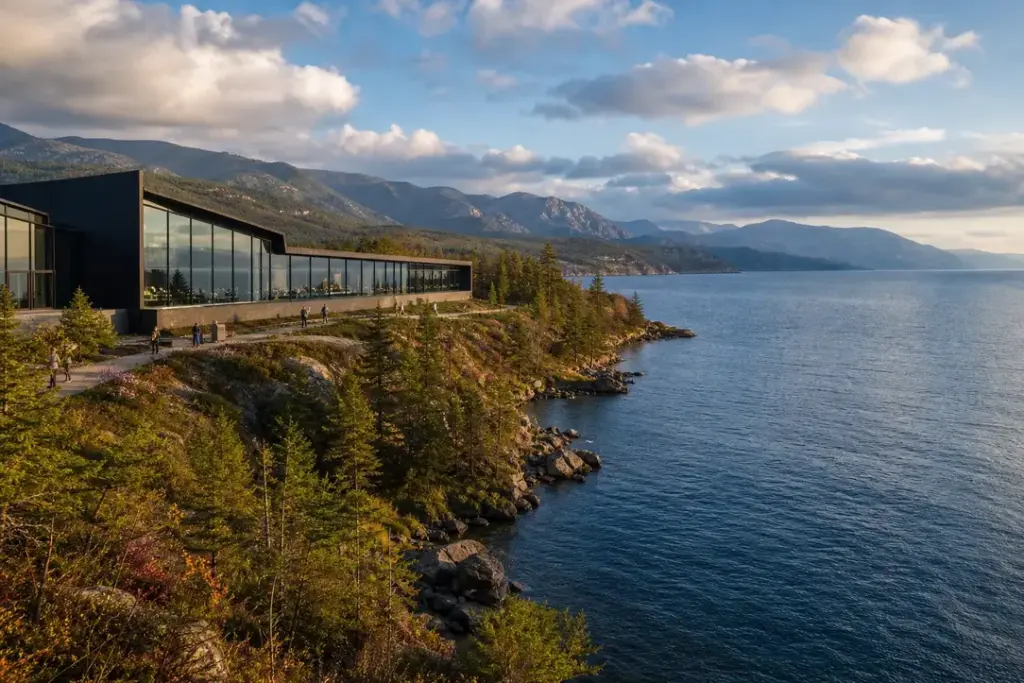
The Baikal Museum at the Irkutsk Scientific Center of the Siberian Branch of the Russian Academy of Sciences is located in Listvyanka, approximately 70 kilometers southeast of Irkutsk. The museum offers stunning views of Lake Baikal and the surrounding landscape from its location in Listvyanka, a picturesque village on the lake’s western shore.
Dedicated to Lake Baikal and its flora and fauna from scientific perspectives, the museum explains the creation and topography of the lake in which 3,000 endemic species are referenced. The live exhibits feature aquariums with 20 types of fish, 9 of them gobies, 5 types of crustaceans, 3 types of sponges, 2 types of mollusks, and Baikal seals (nerpa), showing in detail the life of all fish that live in the lake.
Quick Facts
| Russian name | Байкальский музей |
|---|---|
| Built / opened | 1993 |
| Address | Akademicheskaya Street 1A, Listvyanka, Irkutsk Oblast, Russia Google MapsApple MapsYandex Maps2GIS |
| District | Irkutsky |
| Admission | ₽₽ |
| Best time to visit | Summer (June–August) brings the most visitors, warmest weather, and greatest accessibility. Spring (April–May) and early autumn (September) offer fewer crowds and pleasant temperatures. The arboretum is best visited in late spring and summer when wildflowers and medicinal plants are in bloom. Weekday mornings tend to be quieter than weekend afternoons. |
| Website | bm.isc.irk.ru |
What Is (and Isn't) Part of a Visit to Baikal Museum, Lake Baikal?
| Part | Status | Notes |
|---|---|---|
| Main museum building and exhibits | Included in the standard ticket | Core exhibitions on Baikal geology, flora and fauna, endemic species, and lake history included in base admission. |
| Aquarium complex with live specimens | Included in the standard ticket | Live exhibits of fish, crustaceans, sponges, mollusks and seals included in standard ticket. |
| Interactive submarine (virtual descent) | Separate ticket or institution | The immersive submarine experience may require an additional ticket or reservation. |
| Arboretum | Included in the standard ticket | The adjacent botanical garden with 4 hectares of endemic and rare plants is typically included with museum admission. |
| Listvyanka village attractions outside museum | Outside / not part of it | Shamanka Rock, Chersky Mountain chairlift, and wooden architecture are separate attractions in Listvyanka and require different tickets. |
| Listvyanka Nerpinarium | Separate ticket or institution | A separate facility elsewhere in Listvyanka dedicated to seal exhibits; not part of the main museum. |
Why Visit Baikal Museum, Lake Baikal?
The museum’s exposition includes regular exhibits showcasing the lake’s diverse flora and fauna, with aquariums housing Baikal fish, crustaceans, sponges, and the famous Baikal seals (nerpa), displaying unique endemic species that inhabit the lake’s depths. One of the museum’s most exciting features is the “interactive submergence” experience, where visitors can embark on a virtual journey to the bottom of Lake Baikal in a simulated submarine, reaching the lake’s maximum depth of 1,637 meters and observing interesting species, an immersive experience that lasts about 15 minutes. An arboretum adjacent to the building displays approximately 400 plant species, some of which are rare or endangered.
How Baikal Museum, Lake Baikal Is Laid Out
The Baikal Museum is an aquarium located at the mouth of the Angara River, more than 2 kilometers west of Listvyanka. The building houses the main exhibition halls, including the live aquarium complex on the first floor. An arboretum next to the museum occupies a territory of 4 hectares together with a spring, forest and picturesque slope of Baikal shore. Visitors typically spend time viewing the main exhibitions, the aquariums, and the immersive submarine experience before exploring the arboretum grounds.
Highlights of Baikal Museum, Lake Baikal
Live Baikal Aquariums
The living exhibition began in 2004 in 11 aquariums where visitors may see 20 types of fish, 9 of them gobies, 5 types of crustaceans, 3 types of sponges and 2 types of mollusks, showing the life of all fish that live in the lake as well as Baikal seals. The aquariums have a unique system of water supply and water cycle, which takes water from a depth of 500 meters, with conditions arranged to be similar to the natural lake biocoenosis.
Tip: Arrive early in the day to see the seals most active; midday crowds can fill the small viewing areas.
Baikal Seals (Nerpa)
The famous Baikal seals (nerpa) are displayed in aquariums, allowing visitors to get up close to these unique endemic species that inhabit the lake's depths. These are the world's only freshwater seals and are found nowhere else on Earth.
Tip: Watch for feeding times if posted; they are more active and visible in the morning.
Interactive Submarine Experience
The "interactive submergence" experience allows visitors to embark on a virtual journey to the bottom of Lake Baikal in a simulated submarine, reaching the lake's maximum depth of 1,637 meters and observing the most interesting species along the way, providing a life-like glimpse into the mysterious underwater world of Lake Baikal.
Tip: This experience may be crowded; ask staff about waiting times or book separately if possible.
Lake Baikal Geology Exhibits
The museum's exhibits present a very comprehensive picture of the lake's geological construction and natural landscapes, climatic, hydro-chemical and hydrological particularities, and the origins and characteristics of its inhabitants. Interactive displays and 3D animations explain Baikal's unique rift lake formation.
Tip: Displays include detailed information in Russian; guides or audio materials in English may help non-Russian speakers.
Arboretum with Endemic Flora
The "Kamenushka" arboretum occupies a territory of 4 hectares together with a spring, forest and picturesque slope of Baikal shore. The Park's flora consists of 284 types of tracheal plants from 212 kinds, representing 63 families; 29 types of these plants are protected on the local and state level.
Tip: Best visited in summer and early autumn when wildflowers and medicinal plants are in bloom.
Endemic Fish and Creatures Display
The displays allow visitors to see unique endemic species that inhabit the lake's depths, some of which can be found at depths of up to 1,642 meters. The collection includes graylings, sculpins, and other species found only in Baikal.
Tip: Take time to read the species descriptions; each has a unique adaptation to deep, cold lake conditions.
Atmosphere
The museum features many virtual films to watch, as well as rich display forms and interactive activities, which can give a comprehensive understanding of Lake Baikal. The main aquarium halls are often busy with visitors, especially during peak hours, with the small submarine room sometimes crowded. The arboretum offers a quieter contrast to the main building, with peaceful forest paths and views of the lake and Angara River mouth. Mornings tend to be less crowded than afternoons. The museum attracts families, students, and nature enthusiasts curious about one of Earth’s most unique ecosystems.
History of Baikal Museum, Lake Baikal
The museum has a long history, with its origins dating back to 1928 when it began as a Limnological station. In 1961, it was reorganised into the Limnological Institute of the Siberian branch of the Russian Academy of Science.
In 1961, the limnological station was elevated to the status of the Institute of Limnology of the Union of Soviet Socialist Republics (USSR). Exclusively dedicated to the study of the lake’s history and its plant and animal life, the institute became a museum in 1993.
The transformation from research institute to public museum in 1993 marked a significant shift in how Baikal science was communicated to the wider world. The museum retained its rigorous scientific mission while developing engaging exhibitions for visitors. The introduction of live aquariums in 2004 represented a major upgrade, allowing visitors to observe living specimens in conditions mimicking their natural lake habitat.
Tickets and Booking for Baikal Museum, Lake Baikal
| Ticket | Price | Includes |
|---|---|---|
| Adult admission | ₽₽ | Main museum building, exhibits, aquarium complex, and arboretum access. |
| Child admission | ₽ | Same as adult ticket with access to all main exhibits and arboretum. |
| Interactive submarine experience | ₽₽ | Virtual descent to lake depths in simulated submarine; may require separate booking or advance reservation. |
₽ budget · ₽₽ moderate · ₽₽₽ upscale · ₽₽₽₽ splurge. Price levels are estimates compared with typical prices for visitors.
Tickets are purchased at the museum entrance. As of October 2026: advance booking is usually not necessary for general admission, though it is recommended during peak tourist seasons (summer months and school holidays) to avoid waiting in queues.
Where to buy: Tickets are available at the main ticket desk in the museum building. Vouchers or other arrangements should be confirmed directly with the museum by phone before arrival (+7-3952-453-146 for ticket inquiries).
Entrance: The museum is located at the entrance to Listvyanka village, easily recognizable by its modern building at the mouth of the Angara River. International visitors should note that prices for Russian citizens and concessions differ significantly. For all ticket categories, current pricing and concession details, see the official website at bm.isc.irk.ru.
Suggested itineraries Baikal Museum, Lake Baikal
1–2 hours
Begin at the aquariums on the first floor to observe the live fish, crustaceans, sponges, and seals. Then view the main geological and ecological exhibits. End with a brief walk through the arboretum if time allows.
2–3 hours
Explore the aquariums thoroughly, read detailed descriptions of each species. Tour the geological construction and historical exhibits. Experience the interactive submarine descent. Conclude with a walk through the arboretum grounds.
Half day
Spend time with the aquariums and main exhibits in the morning. Book the virtual submarine experience mid-morning or early afternoon. Enjoy a late lunch at the museum cafe or nearby restaurants in Listvyanka. Finish with an extended arboretum walk and enjoy views of the lake and Angara River mouth before returning to Irkutsk.
How to Get to Baikal Museum, Lake Baikal
From Irkutsk: The museum is located in Listvyanka, approximately 70 kilometers southeast of Irkutsk. Minibuses and tour vehicles depart regularly from Irkutsk (approximately 90 minutes to 2 hours). Private taxis and ride-share services are available. The road follows the Angara River and offers scenic views. In Listvyanka: The Baikal Museum is located more than 2 kilometers west of central Listvyanka, at the mouth of the Angara River. It can be reached on foot from the town, or by taxi/ride-share.
Walking: If staying in central Listvyanka, the museum is accessible by a 25–30 minute walk along the main road or scenic paths.
Accessibility
Specific accessibility information is not detailed on the museum's official website. Visitors with mobility concerns should contact the museum directly at +7-3952-453-146 to inquire about wheelchair access, ramps, elevators, and seating availability in the aquarium halls, especially in the small submarine experience room where limited seating is reported.
Food Nearby
The museum building may have an on-site cafe ("728 meters" has been mentioned in visitor reports as located upstairs). In central Listvyanka, approximately 2 kilometers away, several restaurants serve Russian and Siberian cuisine. Local options include traditional fish dishes and tea. Bring water and snacks if planning an extended visit to the arboretum, as facilities are limited.
What to Bring
Comfortable walking shoes for the arboretum paths and museum floors. A light jacket or sweater, as aquarium halls can be cool. Water and snacks for extended stays. Binoculars for viewing distant species in large tanks. Notebook or camera for recording observations. Sun protection (hat, sunscreen) when exploring the outdoor arboretum. In winter (November–March), warm clothing and waterproof boots are essential, though the museum remains open.
Best Views and Photo Spots of Baikal Museum, Lake Baikal
Arboretum forest clearing overlooking Baikal and Angara mouth
The arboretum occupies territory with a spring, forest and picturesque slope of Baikal shore. Wide views of the lake, surrounding mountains, and river delta create striking landscape photographs, especially in golden light.
Best time: Late afternoon for warm light; early morning for mist and clearer atmosphere over the lake.
Museum building exterior with Angara River in foreground
The museum is located at the mouth of the Angara River, where visitors can photograph the modern building against the river and lake backdrop.
Best time: Morning light for architectural detail; evening for reflection in water.
Aquarium viewing halls (if permitted)
Interior photographs of live specimens—seals, endemic fish, and aquatic ecosystems—offer unique close-up opportunities.
Best time: Midday when aquarium lighting is brightest; avoid flash to prevent animal stress.
Arboretum medicinal and rare plant sections
The arboretum features 259 types of medicinal herbs, gold rhododendron, ephedra, and silver fur from different forest zones. Colorful and textured botanical subjects.
Best time: Late May through August when plants are flowering and in full foliage.
Photography Rules
Photography and video recording are generally permitted in the public museum areas and arboretum. Flash photography may be restricted near sensitive aquarium tanks to avoid stressing the animals. Check with staff upon arrival regarding any specific restrictions or areas where photography is prohibited. Tripods may not be permitted in crowded exhibit halls.
Family Suitability
The museum contains 3D animations showing the flora and fauna of the Lake Baikal ecosystem, including the unique freshwater seals of Lake Baikal, and visitors can enjoy the seal show, which is very suitable for visiting with children. The interactive submarine experience appeals to older children and teenagers interested in science. The arboretum offers outdoor exploration suitable for young families. However, the small size of some exhibition rooms can mean crowding during peak hours. Stroller access depends on the building's layout; inquire in advance. Children under school age (younger than 6) may find the lengthy exhibits less engaging, though live animals maintain interest.
Russia Vibes Tips
- Arrive between 10:00 and 12:00 on weekdays to avoid the larger afternoon crowds and get the best views of aquarium specimens and seals.
- The submarine experience has limited capacity and no fixed session times; ask about wait times upon entry or book separately if an option is offered.
- Combine your museum visit with nearby attractions: the chairlift to Chersky Mountain viewpoint and Shamanka Rock are both within reach and offer complementary Baikal experiences.
- Bring cash as well as card payment methods; some smaller services or additional exhibits may only accept cash, and card machines are not universally available.
- If visiting in winter, confirm the exact opening hours in advance, as seasonal variations are possible and the road from Irkutsk can be affected by snow conditions.
- Use the museum's arboretum walk as your quieter, more contemplative experience—it offers escape from the crowded exhibit halls and lakeside views that rival any photograph.
Explore Nearby Baikal Museum, Lake Baikal
Sights near Baikal Museum, Lake Baikal
 Shamanka Rock, Lake Baikal – about 220.2 km away · typical visit: 30–45 minutesOpen 24 hours
Main image: AI-generated illustration. It may not show the place exactly as it looks.
 Cape Khoboy, Lake Baikalabout 257.7 km away · typical visit: 3–4 hours
Main image: AI-generated illustration. It may not show the place exactly as it looks.
 Olkhon Island, Lake Baikalabout 218.0 km away · typical visit: 2–3 days
Main image: AI-generated illustration. It may not show the place exactly as it looks.
Related guides
 Listvyanka Day Trip, Irkutsk: Getting to Lake Baikal and Back
Main image: AI-generated illustration. It may not show the place exactly as it looks.
 Listvyanka Rogatka Ferry Pier: Tickets, Schedule and Connection to Port Baikal
Main image: AI-generated illustration. It may not show the place exactly as it looks.
Browse more: More in Irkutsky · All Lake Baikal · All Museums · All Sightseeing · All Sightseeing in Lake Baikal
FAQ: Baikal Museum, Lake Baikal
Is the Baikal Museum included in a general Lake Baikal visit or Listvyanka day trip?
The museum is a separate attraction with its own admission ticket. However, most organized day trips from Irkutsk to Listvyanka include the museum as part of a larger tour package. If visiting independently, budget for a separate museum ticket in addition to transportation.
Can I see Baikal seals at the museum?
Yes, the museum's aquariums house the famous Baikal seals (nerpa), allowing visitors to see these unique endemic species up close. These are the only freshwater seals in the world.
How long does a typical visit take?
A typical visit can last from 1 to 2 hours, depending on your interest in the exhibits and whether you opt for the virtual submarine trip. Allow up to 3 hours if exploring the arboretum thoroughly.
Is the submarine experience included in the ticket price?
The interactive submarine experience may require a separate ticket or reservation. Confirm at the entrance when you arrive, as pricing and availability can vary.
Do I need to speak Russian to enjoy the museum?
While most exhibit descriptions are in Russian, the visual displays, live aquariums, and 3D animations can be understood without language. Consider booking a guide if detailed scientific information is important to you.
Can I take photographs inside the museum?
Photography is generally permitted in public areas of the museum and arboretum. Flash photography may be restricted near sensitive aquarium tanks to protect the animals; check with staff upon entry.
Is the museum accessible for people with limited mobility?
Specific accessibility details are not published online. Contact the museum directly (+7-3952-453-146) before your visit to inquire about wheelchair access, elevators, and seating availability in all areas.
Is there parking available at the museum?
The museum is located at the entrance to Listvyanka village near the Angara River mouth. Parking information is not detailed on the official website; inquire with your tour operator or contact the museum directly.
Russia Vibes is a one-person project. A coffee keeps it going

Take this guide with you
Get a free PDF of this guide to print or read offline: key facts, tips and a map link on a few clean pages.
Report an issue on this page
Paying for your trip: please read
Payments and bookings between Russia and many other countries are currently restricted. In practice, cards issued in the EU, the UK, the US and several other countries often cannot be used in Russia, Russian cards usually cannot be used abroad, and some booking platforms, airlines and payment providers limit or pause their services for Russia. The situation changes frequently.
We do not give legal or financial advice, and this site does not encourage anyone to break any rule that applies to them. Whatever you plan, you are responsible for following the laws and regulations that apply to you, including those of your country of residence and citizenship.
Many travelers still organise their stay without problems. It is worth asking your bank or payment provider what is currently possible, contacting hotels, tour operators and carriers directly about the payment methods they accept, and checking which services are open to customers from your country. Clarify payment, cancellation and refund terms before you commit to a booking, and keep your plans flexible.
Partner links on this site may not be available in every country, and prices, availability and rules in our guides can differ from what you see when you book.
How we research and update our guides
About this guide: AI assistance and accuracy
This guide is created with the help of AI and is based on official sources where available. Mistakes can still happen. Opening hours, prices, rules and other details are given to the best of our knowledge as of the date shown and can change without notice. It offers general recommendations only, not professional, legal or travel advice. Please confirm important details with the official source before you travel; you are responsible for your own plans and decisions.
* Affiliate link: as an Amazon Associate we earn from qualifying purchases at no extra cost to you.